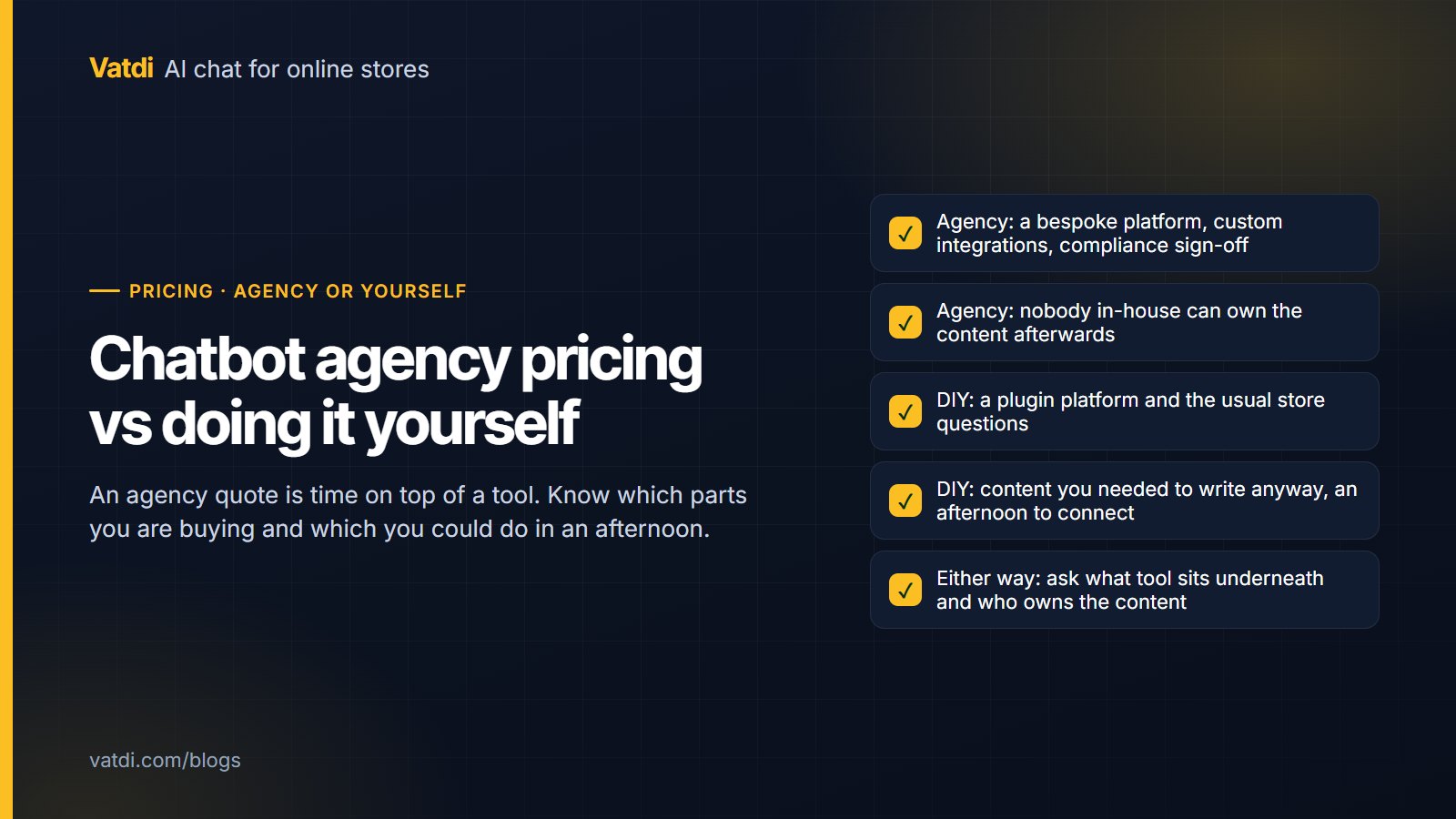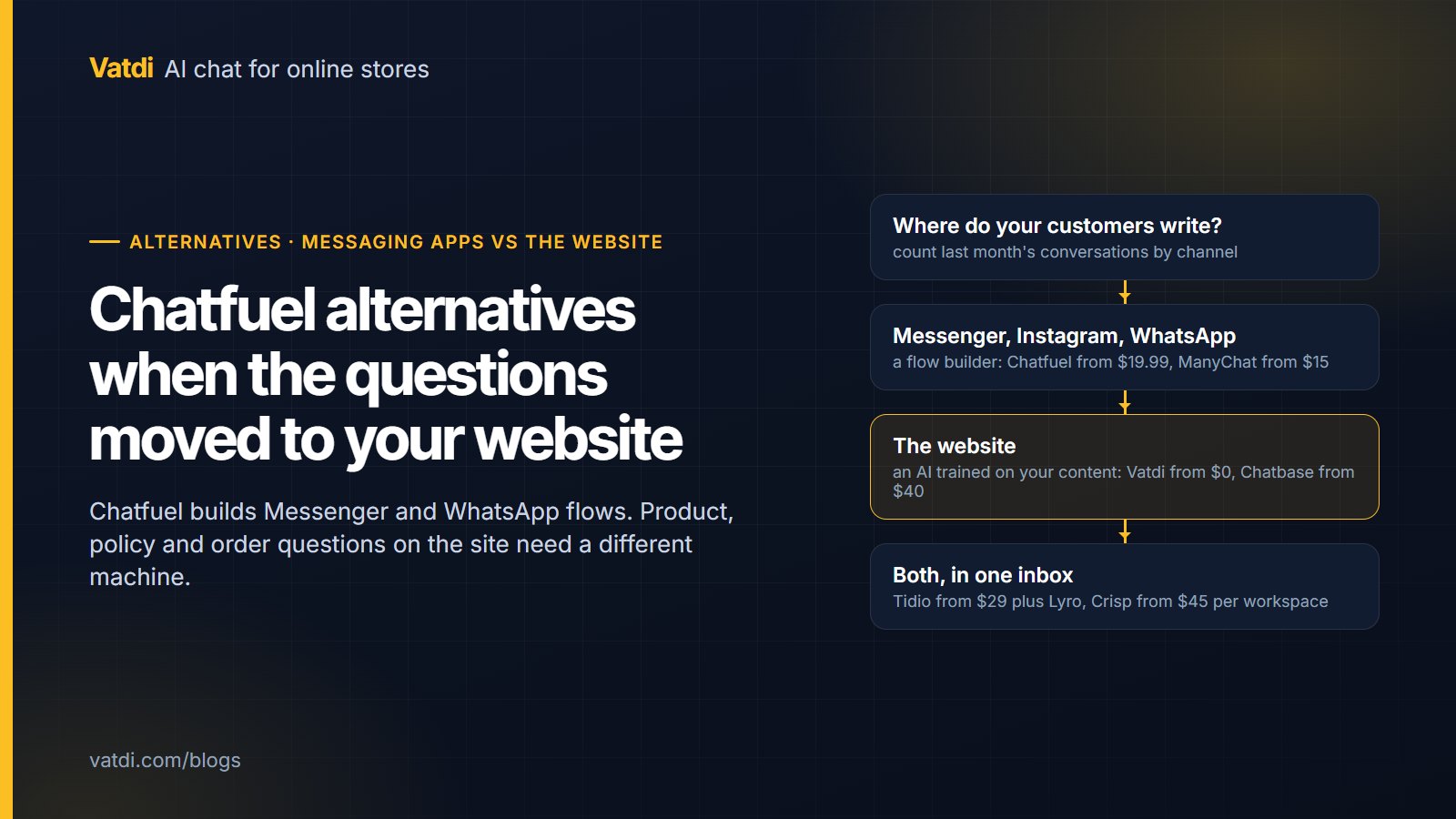
The best AI chatbots for small online stores answer from your own catalog and policies, hand difficult questions to a person, and cost what a one- or two-person shop can justify. As of September 2026, Vatdi, Tidio and Intercom serve three different budgets and team sizes. This guide compares them on training, languages, handover, lead capture and price, and ends with a setup checklist for whichever you pick.
Why a small store needs a different chatbot
Small stores have a different problem from enterprise support teams. There is usually one person answering chat, that person also packs orders, and most questions are the same twenty questions about shipping, sizing, stock and returns. The tools below are judged on how well they take those questions off your plate without creating a new admin job: no flows to build, no seats to count, no separate AI bill to forecast.
Three numbers describe most small stores that come to us: under 300 conversations a month, one or two people who ever open the inbox, and a catalog that changes weekly while the policy pages change once a year. Keep those in mind while reading the comparison; a tool that is excellent for a twelve-person support team can be a poor fit for that profile.
What to look for in an AI chatbot for a small store
Training on your own product data
The difference between a chatbot that helps and one that embarrasses you is where its answers come from. A retrieval-based chatbot (often called RAG) looks up the matching products, pages and policy snippets from your own synced content for every question, then writes the answer from those snippets, and says it does not know when nothing matches. A generic chatbot answers from its general training and will happily invent a delivery time. Ask each vendor three things: does it sync the catalog automatically from your platform, which file types can you upload for policies and manuals, and what does it do when it cannot find an answer. Vatdi, for example, syncs the catalog through its plugins, crawls your site, and accepts PDF, DOC, DOCX, CSV, TXT and Markdown uploads up to 10 MB each, plus FAQ import from CSV or Excel. See what a RAG chatbot is and how to train a chatbot on your data.
Language detection, not just translation
If you ship to more than one country, the chatbot should detect the visitor's language from the first message and answer in it, with a fallback language you choose. Check two things during a trial: whether the widget labels (placeholder text, buttons, the offline notice) change language along with the answers, and whether you can edit those translations yourself. Vatdi detects the visitor's language across 95+ languages, lets you set a fallback, and lets you translate every widget label per store with an AI first draft you review.
Human handover a one-person team can actually staff
Every vendor says it has handover. What matters for a small store is what happens when nobody is at the desk. Look for an agent-hours schedule so the widget tells visitors honestly when a person is not available, email plus browser or sound alerts when a handover is requested, the ability to reply from the same thread the customer sees, and a way to hand the chat back to the AI when you are done. Vatdi also counts missed handovers, which is a useful weekly number for a small team. More detail in what chatbot human handover is.
Lead capture without a CRM
Most small stores do not run a CRM, so "integrates with Salesforce" is not a selling point. What you need is capture in the chat or through a short pre-chat or contact form, an email the moment a lead arrives, and a CSV export you can drop into your newsletter tool. Vatdi does those three and adds an automatic 1 to 5 trust rating on each lead that you can edit. It does not have CRM or Zapier connectors, so if you need leads pushed into HubSpot automatically, HubSpot's own free chatbot builder or Intercom is the better fit.
Pricing you can forecast
Chatbot pricing comes in three shapes, and mixing them up is how small stores end up with a surprise bill:
- Flat per store (Vatdi): one price per store per month, unlimited teammates, the only volume limit is conversations per month.
- Per seat (Intercom, LiveChat, Zendesk): the price multiplies by the number of people who log in, and AI is often billed on top.
- Per AI conversation or resolution (Tidio's Lyro, Intercom's Fin): the AI part is metered separately, so a busy month costs more.
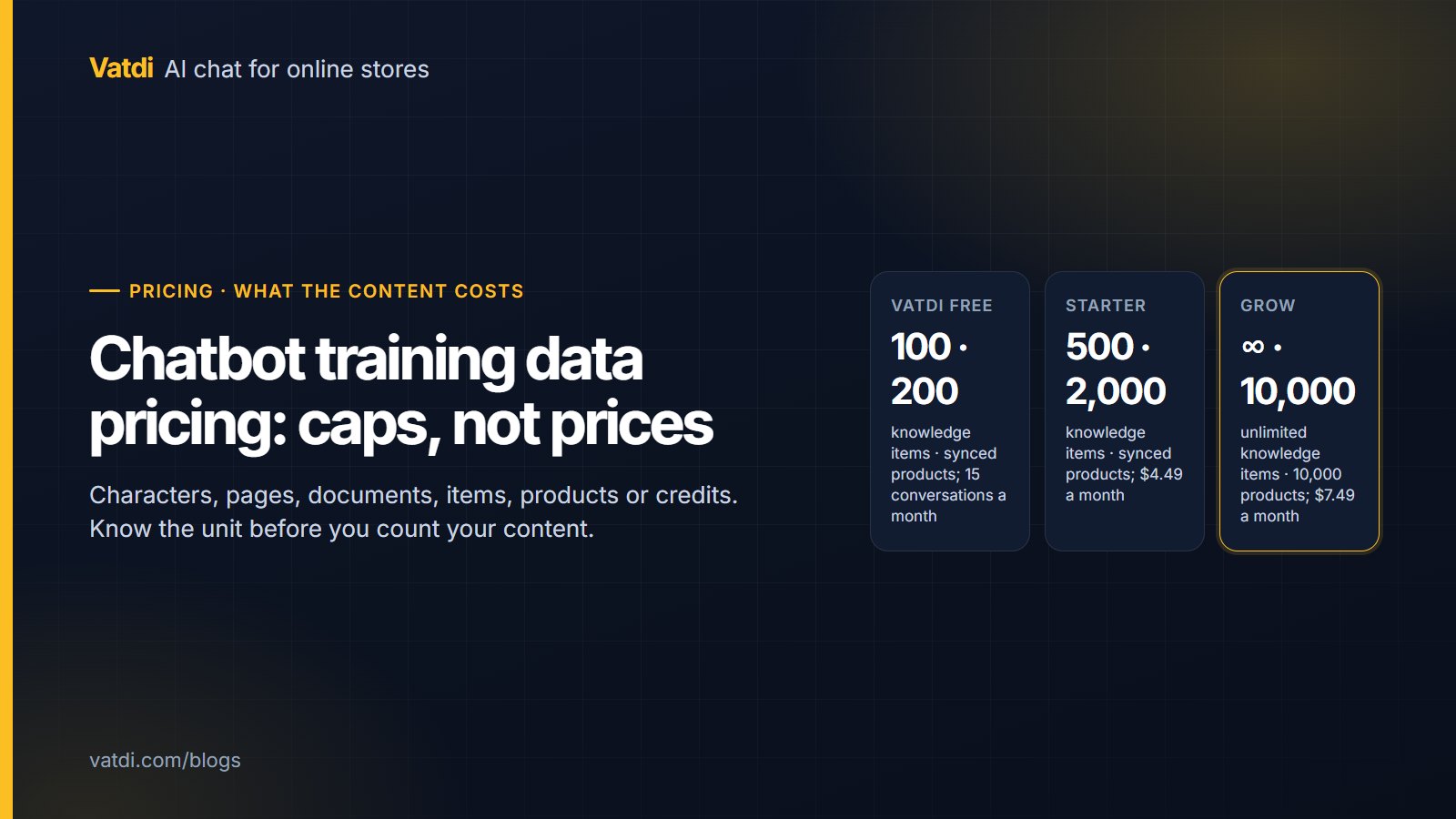
As of September 2026 Vatdi's plans are Free at $0 with 15 conversations a month and a "Powered by Vatdi" badge, Starter at $4.49 a month or $44.90 a year with 150 conversations, and Grow at $7.49 a month or $74.90 a year with unlimited conversations. Every feature is on every plan; the only paid-only change is removing the badge. See Vatdi pricing.
Top picks
Vatdi: best for small stores on WooCommerce, OpenCart and similar platforms
Vatdi is a website chat widget whose AI answers from the store's own catalog, pages, policies and uploads, and shows product cards with image, price, sale price while a sale is on, and optional stock. It has native plugins for WooCommerce, OpenCart 3 and 4, PrestaShop 8 and 9, Magento 2, Shopware 6, Joomla with VirtueMart or HikaShop, and Drupal Commerce, a Shopify app, and a one-line script for everything else; the full list is on the integrations page and the WordPress plugin is listed on WordPress.org. Through the plugins it can look up order status live when the customer gives an order number plus the email or phone on the order. Handover, lead capture, coupon offers in chat, per-conversation quality grades and analytics are on every plan, including Free.
Limitations to know before you sign up: it is the website widget only, so there is no Messenger, Instagram, WhatsApp or email inbox; the Free plan's 15 conversations a month is enough to test with real visitors, not to run a busy store; and on Shopify there is no live order lookup or catalog API sync, the AI trains on the store's pages, collections and policies instead. One store per plan.
Tidio: best if you also answer on Messenger, Instagram or WhatsApp
Tidio's strength is its shared inbox across the website widget, Messenger, Instagram, WhatsApp and email, with Shopify and WooCommerce apps. As of September 2026 the free plan covers 50 conversations a month but does not include AI answers; paid plans start at $29 a month (Starter) and from $59 a month (Growth), and higher tiers are priced per seat. The Lyro AI agent that actually answers customers is a separate, conversation-metered add-on from about $39 a month (source: Tidio pricing). For a store that lives on social DMs that trade-off is worth it; for a store that only needs website chat with AI answers, you are paying for channels you will not use. Comparison in Vatdi vs Tidio.
Intercom: best for a support team that wants a full help desk
Intercom is a complete customer-service platform: help center, product tours, email campaigns, and the Fin AI agent. As of September 2026 it costs $29 per seat a month on Essential, $85 on Advanced and $132 on Expert, with Fin billed at $0.99 per resolution on top; there is a 14-day trial and no free plan (source: Intercom pricing). If you have three or more agents, a help center to maintain and product onboarding to run, Intercom is the more capable choice. For a store with one person on chat it is a lot of platform, and per-seat plus per-resolution pricing makes a busy month expensive. Comparison in Vatdi vs Intercom.
Quick comparison table
| Tool | Free plan | Entry paid price | AI answers | Store connection | Best for |
|---|---|---|---|---|---|
| Vatdi | $0, 15 conversations a month, badge shown | $4.49 a month (150 conversations) | Included on every plan, trained on catalog, pages and uploads | Plugins for WooCommerce, OpenCart, PrestaShop, Magento, Shopware, Joomla, Drupal; Shopify app; script for any site | Small stores that want website chat with real product answers |
| Tidio | 50 conversations a month, no AI answers | $29 a month (Starter) | Lyro add-on from about $39 a month, metered per conversation | Shopify and WooCommerce apps | Stores that also answer on Messenger, Instagram and WhatsApp |
| Intercom | None (14-day trial) | $29 per seat a month | Fin at $0.99 per resolution | General web and app installation | Support teams that need a help center and tours |
Prices are as of September 2026; prices change, so check each vendor's pricing page before deciding. The short version: pick Vatdi for price and catalog answers on a plugin platform, Tidio for a multichannel inbox, Intercom when you are running a support team rather than a shop. Other options worth a look at the low end are Tawk.to (free live chat with unlimited agents, AI and branding removal are paid add-ons) and Zoho SalesIQ (free plan, Basic from $7 per operator a month). For a wider field, see our seven-tool ecommerce chatbot comparison.
Which one, in three questions
- Do customers already message you on Messenger, Instagram or WhatsApp? If yes, a single inbox matters more than price; Tidio is the fit, and budget for the Lyro add-on if you want AI answers.
- Do you run a support team with a help centre and product tours? If yes, Intercom's platform earns its seat price. If it is one person answering between orders, it does not.
- Is the store on WooCommerce, OpenCart, PrestaShop, Magento, Shopware, Joomla or Drupal? If yes, Vatdi's plugin gives you catalog answers and live order lookup on a flat plan. On Shopify it still answers from pages and policies, without order lookup.
Setup checklist for whichever you choose
- Connect the catalog first so product questions work on day one, then add the pages that answer policy questions (shipping, returns, sizing, warranty), then import your FAQ, then upload anything that only exists as a document.
- Ask the bot your ten most common questions and check two things: is each answer correct, and does it say it does not know when the answer is not in your content. A bot that guesses is worse than no bot.
- Set handover up before launch. Enter your real agent hours so the widget is honest when you are closed, turn on email and browser notifications, and decide which topics always go to a person: refunds already in progress, damaged goods, anything involving a payment dispute.
- Reduce friction in the widget. Hide the chat on the checkout page (separately for desktop and mobile), add quick replies for your top three questions, and keep the pre-chat form off unless you genuinely need the email before answering.
- Review the numbers monthly. Vatdi grades every conversation 0 to 10 with plain-English advice, shows visitor ratings and thumbs per answer, and forecasts conversation usage against the plan cap. Whatever tool you pick, low-rated conversations are your to-do list for new content.
- Check missed handovers weekly. Each one is a customer who asked for you and did not get you.
Common mistakes: launching with only the homepage crawled, leaving the fallback language unset, never testing the order-status path with a real order number, and forgetting that the catalog changes weekly while the uploaded PDFs do not. Plugin sync handles the catalog; the documents are on you.
Start with the questions you answer most and pick the tool that answers them from your own content at a price you can forecast. If that points to Vatdi, the Free plan needs no card and installs with a plugin or one line of script; create a free account to try it.
Frequently asked questions
Can I train my chatbot on product specs and PDFs without coding?
Yes, on any chatbot that accepts document uploads from a dashboard. Vatdi takes PDF, DOC, DOCX, CSV, TXT and Markdown files up to 10 MB each, imports FAQs from CSV or Excel, crawls your website, and syncs the catalog through its plugins. No developer is needed for any of that; the one-line script install is a copy and paste into your theme or tag manager.
How do AI chatbots handle order tracking or returns?
Order status needs a live connection to the store. With Vatdi the customer gives an order number plus the email or phone on the order and the AI answers from the store through the plugins for WooCommerce, OpenCart, PrestaShop, Magento, Shopware, Joomla and Drupal Commerce; it is not available on Shopify. Returns questions are answered from your returns policy page or uploaded document, so keep that content current. See how to track orders with a chatbot.
What is the cost difference between basic bots and enterprise chatbots?
As of September 2026 Vatdi runs from $0 (15 conversations a month) to $7.49 a month for unlimited conversations, flat per store. Intercom is $29 to $132 per seat a month plus $0.99 per Fin resolution, and Tidio's AI answers are a metered add-on from about $39 a month on top of a plan from $29. The gap is less about features and more about the unit you are billed on.
Is language support automatic, or do I need to translate content?
With Vatdi it is automatic: the visitor's language is detected and the answer is written in it, with a fallback language you set. You do not translate your product content. Widget labels are translated per store with an AI draft you can edit. Test your second-largest market's language during the trial with any tool, since label translation is where many chatbots fall short.
How often should I update my chatbot's training data?
The catalog updates itself through the plugin sync. Review everything else, policies, shipping tables, size guides and uploaded documents, whenever they change and at least once a quarter. A quick habit that works: each time you change a policy page, ask the bot the related question the same day and confirm the new answer appears in the reply.
Do I need a paid plan to remove the "Powered by" badge?
On Vatdi, yes: the badge shows on the Free plan and can be removed on Starter ($4.49 a month) and Grow ($7.49 a month). Every other feature is identical across all three plans, including handover, lead capture and analytics. Tawk.to also charges for branding removal; for other vendors, check the pricing page before you assume.