Chatfuel alternatives are usually searched for at the moment a business realises its questions have moved. Chatfuel is a flow builder for Messenger, Instagram and WhatsApp, from $19.99 a month as of September 2026, and it does that job. When customers start asking on the website about products, prices, policies and order status, in several languages, a button flow in a messaging app is the wrong machine. This guide separates the two jobs and lists the alternatives for each, with prices.
What Chatfuel is built for
Chatfuel belongs to the family of no-code builders for messaging apps, alongside ManyChat: you draw flows of buttons and messages that run inside Messenger, Instagram DMs and WhatsApp. That design suits campaigns, giveaways, appointment reminders and simple FAQs on those channels, where buttons beat typing and the platform limits what a bot may do. As of September 2026 Chatfuel starts at $19.99 a month; ManyChat has a free plan and Pro from $15 a month. Neither is a website chatbot in the sense a store needs, and neither claims to be. The difference between a builder and an assistant trained on your content is explained in no-code chatbot builder vs an AI trained on your own data; the head-to-head is on Vatdi vs Chatfuel.
The moment you outgrow it
- The questions arrive on the site. Shoppers on a product page ask about fit, stock and shipping there, not in a Messenger thread.
- The questions are open. "Does the 40L fit under a seat" cannot be drawn as a flow for 300 products; it needs an assistant that reads the catalogue.
- Order status. "Where is my order" needs a live lookup verified with the order number and email, which is a store integration rather than a flow.
- Languages. A flow exists in the languages you built it in; a retrieval-based assistant detects the visitor's language and answers from content in yours.
- Maintenance. Every price or policy change means editing branches; with an assistant, editing the page is enough.
If none of these applies and your customers genuinely live in Messenger or WhatsApp, the alternative to Chatfuel is another messaging builder, and the list below has them too.
The alternatives, by job, with September 2026 prices
| Tool | Job | Free plan | Entry price and unit | Notes |
|---|---|---|---|---|
| Vatdi | Website assistant trained on your catalogue, pages and uploads | Yes: 15 conversations, every feature | $4.49/mo (150); $7.49 unlimited; flat per store | Order lookup and catalogue sync through plugins; website widget only, no Messenger or WhatsApp |
| Chatbase | Website assistant trained on uploaded content | Yes | Hobby $40/mo | Documents rather than catalogue |
| ManyChat | Messaging-app flow builder | Yes | Pro from $15/mo | Closest like-for-like replacement for Chatfuel |
| Landbot | No-code flow builder | Check | Starter €40/mo; Pro €100/mo | Web and messaging flows |
| Tidio | Multichannel inbox with AI add-on | Yes: 50 conversations, no AI | Starter $29/mo; Lyro from about $39/mo | Website, Messenger, Instagram, WhatsApp, email in one inbox |
| Crisp | Multichannel inbox | Yes: Basic | Mini $45/mo per workspace | Check the AI terms |
| HubSpot | Rule-based builder plus CRM | Yes: free tools | Paid hubs from about $15–20 per seat | Fits sites already on HubSpot |
| Botpress | Builder with AI, developer-oriented | Yes: credits | Plus $89/mo | Building is your work |
Sources: Tidio pricing, Landbot pricing and Vatdi's pricing page; prices change, check each vendor. The full list is on Chatfuel alternatives, and the messaging-side comparison on ManyChat alternatives and Vatdi vs ManyChat.
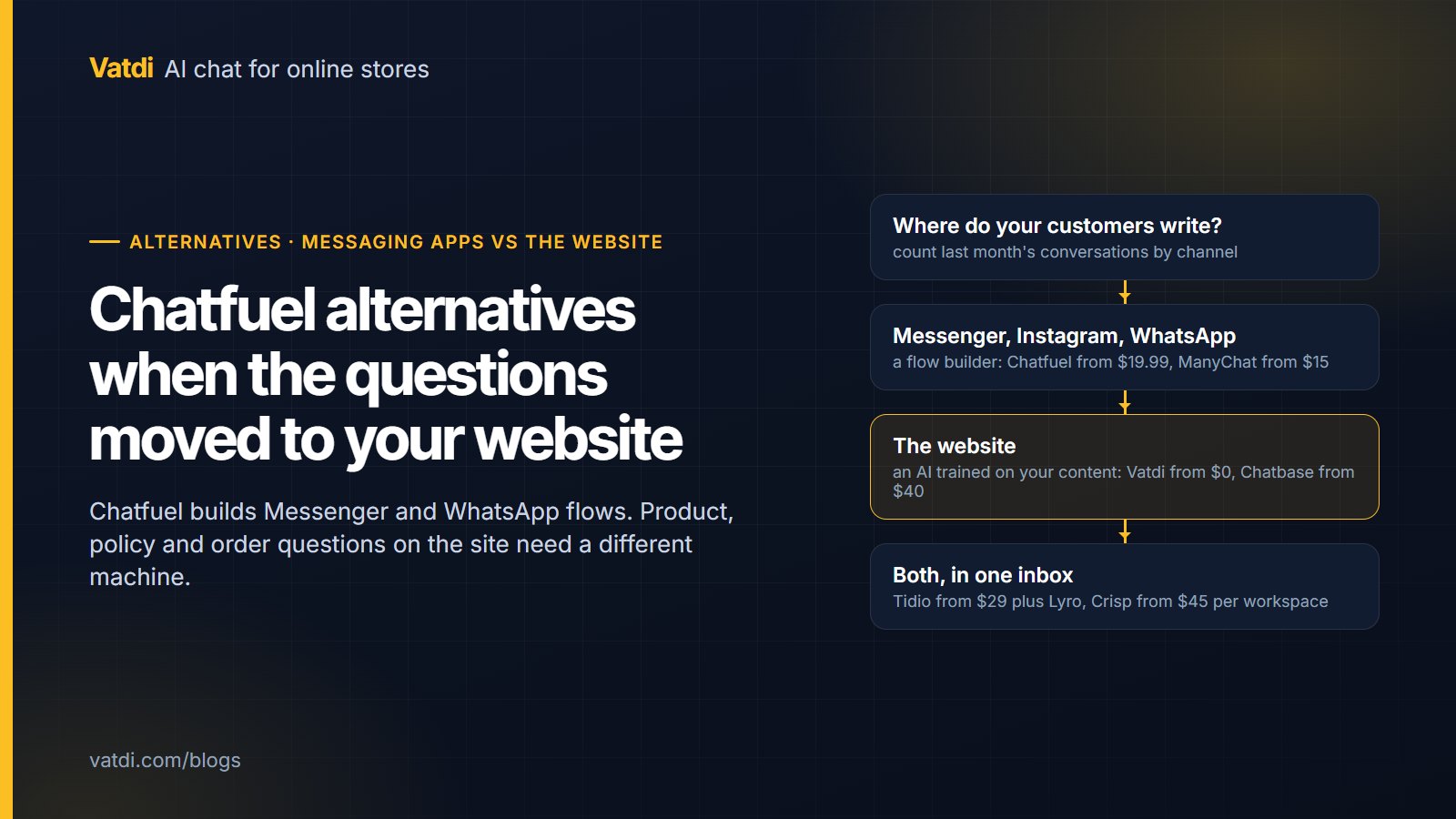
Which alternative, by where customers write
Running a messaging builder and a website assistant side by side
Many small businesses end up with two tools, and that is a reasonable design when the channels are genuinely different. The messaging builder keeps running campaigns and simple DM replies; the website assistant answers product, policy and order questions on the site and captures leads there. The cost of two tools is often lower than one multichannel inbox once the AI add-on is counted (ManyChat Pro at $15 plus Vatdi Grow at $7.49 is about $22 a month, against Tidio Starter plus Lyro from about $68, as of September 2026). The trade-off is two inboxes, which matters if the same person answers both. The pricing units behind those numbers are compared in chatbot pricing models explained.
What a website assistant adds that a flow cannot
- Answers from the catalogue: prices, variants, stock and attributes, shown as product cards, kept current by sync.
- Order lookup: order number plus the email or phone on the order, verified, answered live (Vatdi does this through its plugins on WooCommerce, OpenCart, PrestaShop, Magento, Shopware, Joomla and Drupal; not on Shopify).
- Policy answers with the numbers from your pages, and an honest "I don't know" when the page does not exist.
- Languages: detected per message, with widget labels translated.
- Lead capture at the moment of intent, with an instant email and CSV export.
- Handover to a person with the transcript, and agent hours so the offline notice is honest.
The setup for a general site is in AI chatbot for your website; for a store, in what an AI chatbot for ecommerce is.
Moving off Chatfuel without breaking the DMs
- Decide the channel split with last month's counts, not a guess.
- If DMs stay, migrate the flows that matter to ManyChat or keep Chatfuel; export subscriber lists where the platform allows.
- On the website, connect the content the assistant will answer from: catalogue through the plugin, shipping and returns pages, FAQs.
- Recreate the three most-used flow entry points as quick replies in the website widget.
- Set agent hours and handover rules, then test ten real questions and one impossible one on a staging page before going live.
Frequently asked questions
What is the best alternative to Chatfuel?
It depends on where your customers write. For Messenger, Instagram and WhatsApp flows, ManyChat is the closest like-for-like alternative (free plan; Pro from $15 a month as of September 2026). For questions on your website about products, policies and orders, a retrieval-based assistant such as Vatdi (free to $7.49 a month) is a different kind of tool that answers from your content. Many businesses run one of each.
Can Chatfuel put a chatbot on my website?
Chatfuel is built for messaging apps; its strength is flows inside Messenger, Instagram and WhatsApp. If your customers ask product, price and order questions on the site itself, you want an assistant that reads your catalogue and pages and answers typed questions, which is a different design from a button flow. Check the vendor's current channel list before assuming either way.
Is Vatdi a replacement for Chatfuel?
Only for the website part. Vatdi is a website widget that answers from your catalogue, pages and uploads, looks up orders on supported platforms and captures leads; it does not run on Messenger, Instagram or WhatsApp. If your DMs matter, keep a messaging builder alongside it. If the site is where your customers write, Vatdi replaces the need for a builder there entirely.
How much do Chatfuel alternatives cost?
As of September 2026: ManyChat free or Pro from $15 a month; Vatdi free with 15 conversations, $4.49 for 150 or $7.49 unlimited; Chatbase free or $40; Landbot from €40; Tidio $29 plus the Lyro AI add-on from about $39; Crisp from $45 per workspace. Compare the unit (flat, per seat, per conversation) and whether the AI is included, not just the entry number.
Can I run a Messenger bot and a website chatbot together?
Yes, and for many small businesses it is the cheapest honest setup: a messaging builder for DMs and campaigns, and a website assistant for product, policy and order questions. The cost is two inboxes. If the same person answers both and the volume is high, a multichannel inbox such as Tidio or Crisp consolidates them at a higher price; count the conversations per channel before deciding.
Will I lose my Chatfuel subscribers if I switch?
Subscriber lists belong to the messaging platform's rules; export what the platform allows before closing the account, and rebuild opt-ins on the new builder if you keep one. Website conversations are separate: a website assistant starts fresh from your content and does not need the messaging history. Keep the old account read-only for a month while the new setup proves itself.