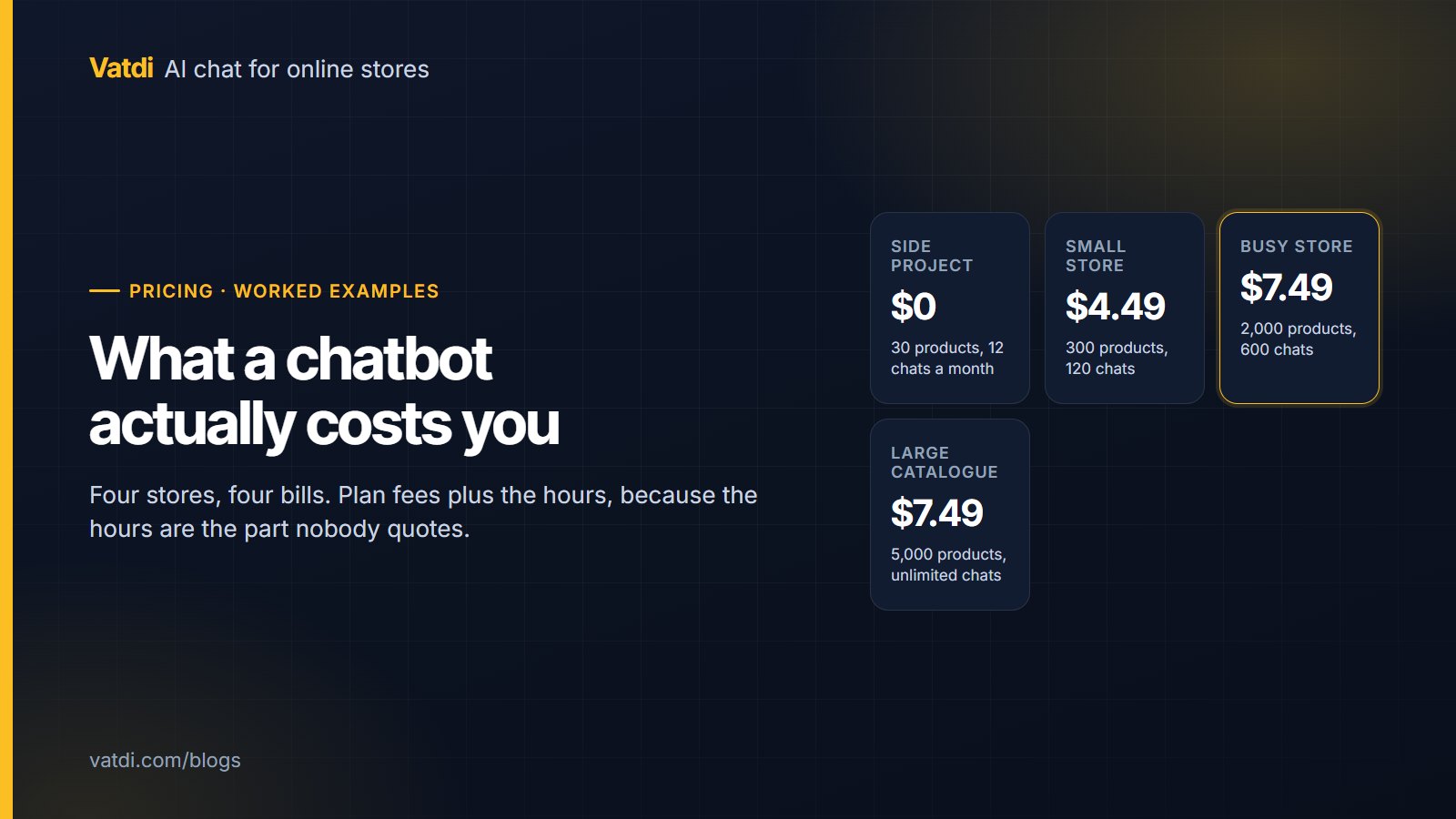
How much will a chatbot cost? Pricing pages give you the unit, not the bill, and the bill depends on your catalogue size, your conversation volume and how much content work you already have behind you. These four worked examples run from a side project to a five-thousand-product store, and they add the hours as well as the fees, because the hours are the part nobody quotes.
What goes into the total
- The plan fee, set by whichever unit the vendor meters: conversations, resolutions, seats, contacts or content.
- Setup hours, almost all of it writing or reformatting content you needed anyway.
- Recurring attention, typically thirty minutes a week reading conversations and fixing what failed.
- Occasional work, such as re-testing after a policy change or a plugin update.
- Nothing else, for a small store on a plugin platform. No developer, no integration project, no agency.
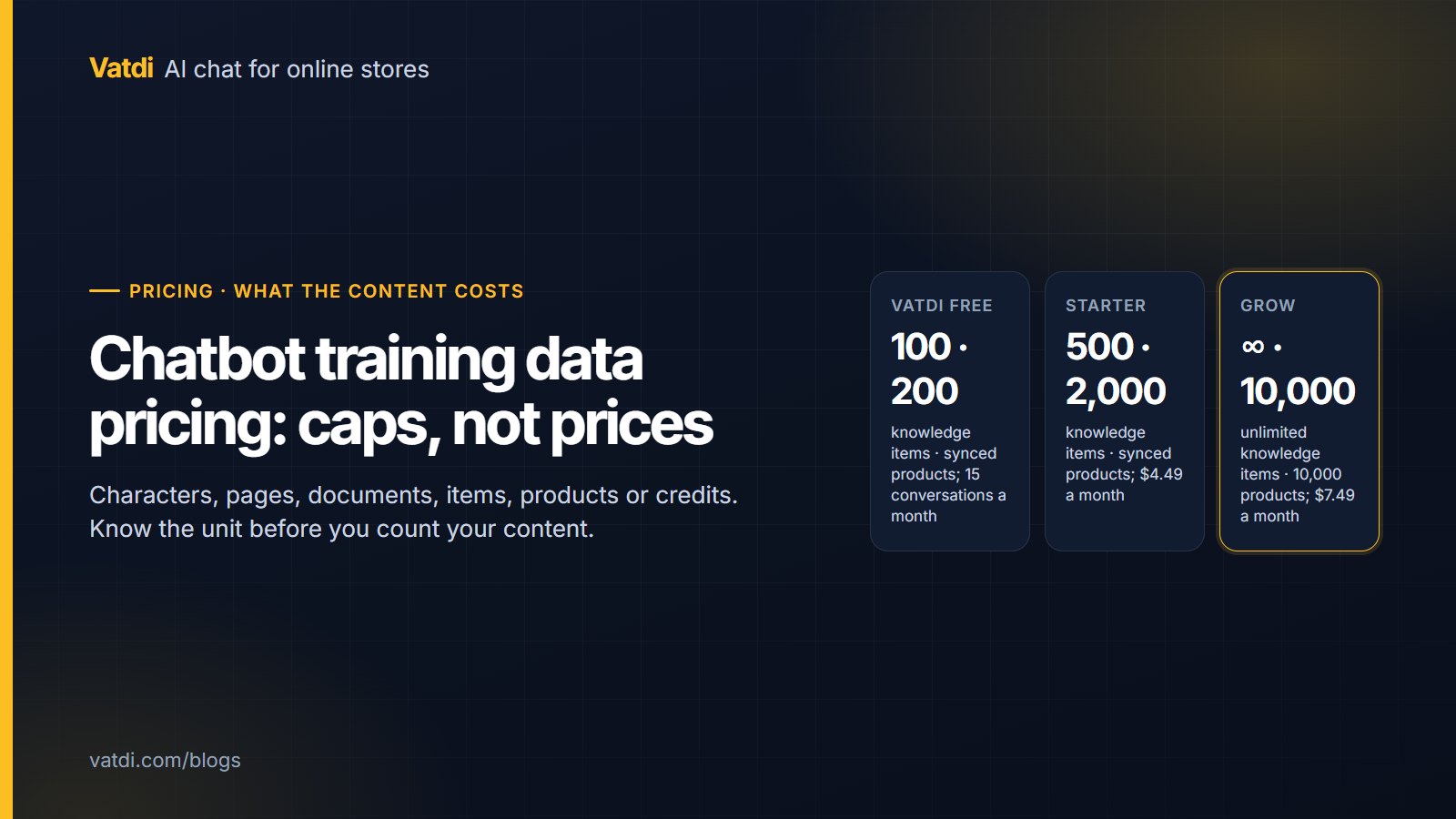
Vatdi's figures below are as of September 2026: Free with 15 conversations a month, Starter $4.49 for 150, Grow $7.49 for unlimited, every feature on every plan, badge removal the only paid extra. Current numbers are on the pricing page.
Example one: a thirty-product side project
A maker selling thirty products from a WooCommerce site, roughly a dozen chat conversations a month, mostly about shipping and made-to-order timings. Plan: free, since both the conversation count and the catalogue sit inside the free allowance. Setup: about three hours, because there are only two policy pages to write and thirty products to describe. Ongoing: fifteen minutes a week, often less. Total cash cost: nothing. This is the case where any paid tool is hard to justify, and where a per-seat product would cost more per month than the store makes in a slow week.
Example two: a three-hundred-product small store
A clothing store on OpenCart with 300 products, 120 conversations a month, and the usual mix of sizing, delivery and order-status questions. Plan: Starter at $4.49, driven by the product count rather than conversations. Setup: an afternoon for five policy pages, plus two hours filling size and material attributes on the top fifty products. Ongoing: thirty minutes a week. Total: under $60 a year plus about seven hours up front. On a per-resolution tool the same volume could cost more in a single busy month than this store pays in a year, which is why the unit matters more than the headline number; the models are compared in chatbot pricing models explained.
Example three: a busy two-thousand-product store
A homeware store with 2,000 products and around 600 conversations a month, including a December peak. Plan: Grow at $7.49, because conversations are well past 150 and the catalogue fits the 10,000-product allowance. Setup: roughly twelve hours, most of it attributes across several categories. Ongoing: two hours a month, since there is enough volume to produce a real unanswered-question list each week. Total: under $100 a year in fees. The December peak changes nothing, which is the practical argument for flat pricing: the month you most need the assistant is the month a metered tool bills you hardest.
Example four: a five-thousand-product catalogue
| Line | This store | Note |
|---|---|---|
| Plan | $7.49 a month | Within the 10,000-product allowance |
| Conversations | Unlimited | No overage to forecast |
| Setup hours | 15–20 | Attributes on best sellers, not all 5,000 |
| Monthly review | 2–3 hours | Enough volume for a weekly work queue |
| Developer time | None | Plugin platform, no custom integration |
| Agency | None | See the agency comparison for when it is justified |
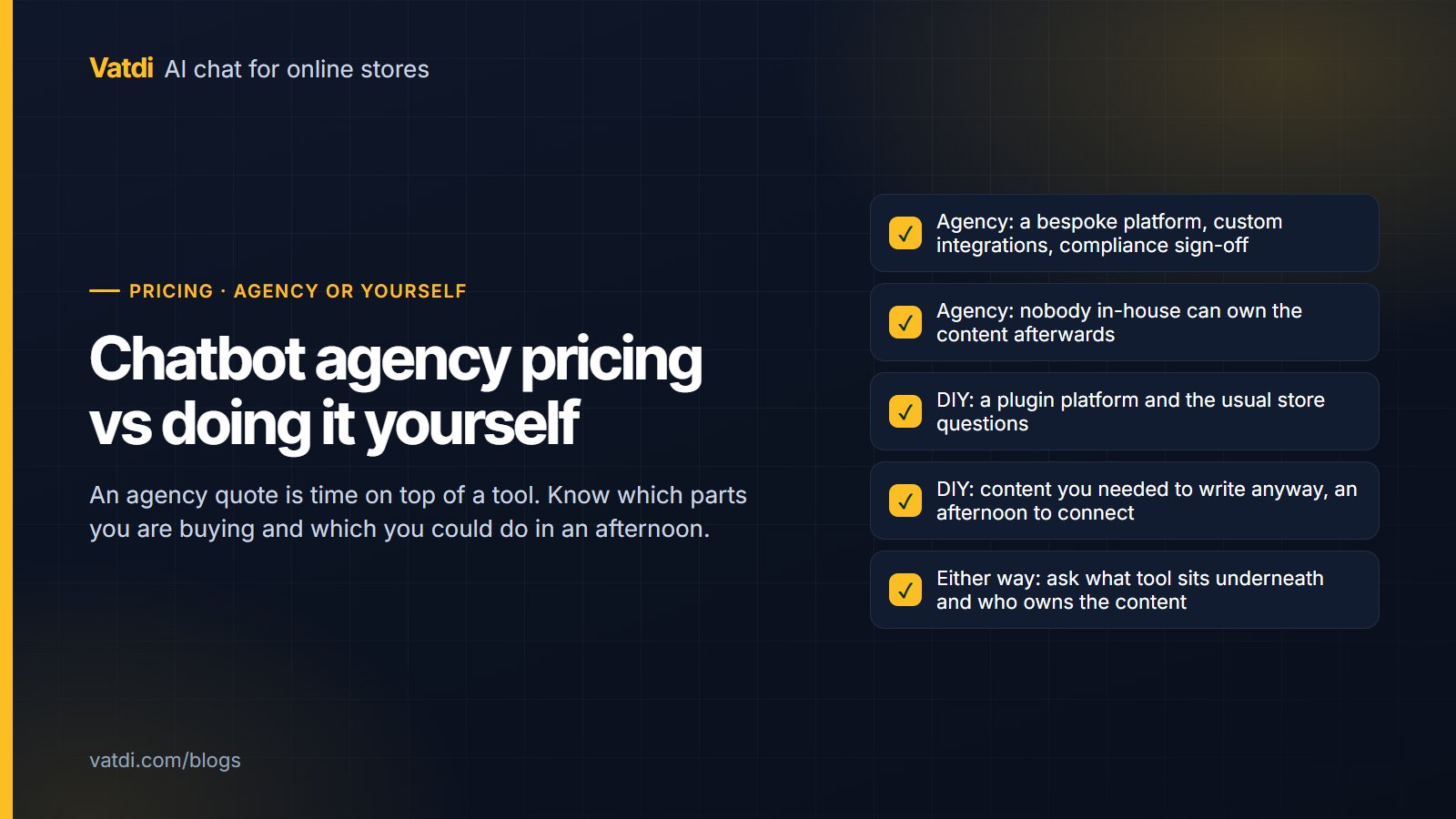
The lesson from this row is that catalogue size drives hours, not fees. Nobody describes five thousand products by hand; you fill the attributes customers actually ask about on the products that actually sell, and let the unanswered-question list tell you which others need work. When an agency genuinely earns its fee is set out in chatbot agency pricing vs doing it yourself.
Why content work dominates the total
In all four examples the hours outweigh the fees, and that is not an accident of this vendor's pricing. A grounded assistant answers from your pages and catalogue, so the quality of the answers tracks the quality of that material, which is the mechanism described in Lewis et al., 2020. There is no software purchase that substitutes for a shipping page that states the cut-off time. The consolation is that the same work pays twice: clearer policy pages reduce support email whether or not anyone opens the chat window, and they help shoppers who never ask a question at all.
Where the same stores land on other pricing models
- Per seat: fine for a solo store, expensive the moment two or three people need the dashboard.
- Per resolution: the bill rises exactly when the assistant is working well, and peaks in your busiest month.
- Per contact: costs grow with your list rather than with usage, which is uncomfortable if you also run email marketing.
- Credits: hard to forecast; ask for the conversion table before signing anything.
- Free tiers with AI removed: cheap until the feature you actually wanted turns out to be on a higher plan.
The cheapest options that include AI rather than gating it are compared in the cheapest AI chatbots for a small business, and the broader market view is in how much an AI chatbot costs.
The cost of not answering
Every comparison above treats the assistant as an expense, which misses half the arithmetic. Unanswered pre-purchase questions have a price too, and it is paid in abandoned baskets rather than invoices. Baymard's research on cart abandonment lists unclear delivery costs and returns terms among the reasons shoppers leave a checkout, and those are exactly the questions arriving in chat at ten at night. You do not need an attribution model to weigh this. Take your average order value, consider how many delivery or returns questions arrive outside working hours in a month, and ask what share of those people would have bought had the answer come immediately. Even a conservative guess usually dwarfs the plan fee, which is why the interesting budget question for a small store is the hours rather than the money.
Budgeting honestly
Put the plan fee in the accounts and the hours in the calendar. For most small stores the fee is trivial and the hours are the real commitment, which is why the useful question is not "can we afford it" but "who is spending the afternoon". That person also gets the benefit, because the content they write improves the storefront and search at the same time, which is the argument Google makes about helpful content. The full setup order is in the AI chatbot implementation guide.
Frequently asked questions
How much does a chatbot cost for a small store?
On a flat plan, from nothing to a few dollars a month: Vatdi is free for 15 conversations, $4.49 for 150 and $7.49 for unlimited as of September 2026. The larger cost is time, typically an afternoon of content work up front and about thirty minutes a week afterwards.
What drives the price up?
The metering unit more than the store size. Per-seat pricing rises with headcount, per-resolution pricing rises exactly when the assistant succeeds, and per-contact pricing rises with your list. On a flat plan the only thing that moves you up a tier is the catalogue or conversation allowance.
Do I need to budget for setup?
Budget hours rather than money. A small store needs roughly five to eight hours, a large catalogue fifteen to twenty, nearly all of it writing policy pages and filling product attributes. That work improves the storefront regardless, so it is rarely wasted even if you change tools later.
Are there hidden costs?
On plugin platforms, usually not: no developer, no integration project, no agency. Watch for tools that gate analytics, handover or languages behind higher tiers, and for overage charges that appear in your busiest month. Ask what happens at the plan ceiling before you commit.
Is a free plan enough?
For a small side project with a dozen conversations a month, often yes. The limit that usually bites first is the catalogue allowance rather than conversations. Start free, watch which cap you approach, and move up only when the store genuinely outgrows it.
How do I compare two quotes fairly?
Convert both to your busiest month rather than an average one, include every seat anyone will need, and add the cost of any feature you assumed was included. Then add your own hours to both sides. That comparison usually looks different from the pricing-page one.