The cheapest AI chatbot for a small business, as of September 2026, is a free plan that actually includes AI answers, followed by flat plans under $10 a month; several tools that look cheap sell the AI as a separate add-on or price per seat, so the sticker price is not the bill. This guide lists the cheapest published plans, shows what each leaves out, prices a 120-conversation month on each, and names the cases where cheap is a false economy.
What "cheapest" has to include
A chatbot price is only comparable once you know four things: whether AI answers are in the plan or an add-on, what unit is counted (seats, conversations, AI resolutions, tickets), what the free or entry tier caps, and which channel it covers. A $0 live-chat plan with no AI is not a cheap AI chatbot; a $29 plan that needs a $39 add-on before the bot answers anything is a $68 chatbot. Every figure below is the published price as of September 2026; prices change, so check the vendor's page before deciding. For the general cost picture see how much an AI chatbot costs.
The cheapest plans with AI answers, as of September 2026
| Tool | Free plan | Cheapest paid plan | Is the AI in the price? | What the low price leaves out |
|---|---|---|---|---|
| Vatdi | Yes: 15 conversations a month, every feature | $4.49/mo (150 conversations); $7.49/mo unlimited | Yes, on every plan | Free plan shows a "Powered by Vatdi" badge; website widget only, no WhatsApp or Messenger; no order lookup on Shopify |
| Chatbase | Yes | Hobby $40/mo | Yes | Document-trained, not built around a store's catalogue or orders |
| Botpress | Free tier with usage credits | Plus $89/mo | Yes, credit-metered | Developer-oriented; building the bot is your work |
| Freshchat | Yes: up to 10 agents (live chat) | Growth $19 per agent/mo (annual) | No: Freddy AI is an add-on | Per-agent price multiplies with the team |
| Tidio | Yes: 50 conversations, no AI answers | Starter $29/mo | No: Lyro AI is an add-on from about $39/mo | Two bills before the first AI answer; strength is the multichannel inbox |
| Zoho SalesIQ | Yes | Basic $7 per operator/mo (annual) | Check the AI terms on the pricing page | Per-operator pricing |
| HubSpot | Free chatbot builder in the free tools | Paid hubs from about $15–20 per seat/mo | Builder is rule-based; check AI terms | Per-seat once you leave the free tools |
| Tawk.to | Free live chat, unlimited agents | Add-ons | No: AI is a paid add-on | Branding removal is also paid |
| ManyChat / Chatfuel | ManyChat has a free plan | ManyChat Pro from $15/mo; Chatfuel from $19.99/mo | Varies | Built for Messenger, Instagram and WhatsApp, not a website widget |
Sources: Tidio pricing, Freshchat pricing, Chatbase pricing and Vatdi's pricing page, all as of September 2026. Our ranked pages, cheapest AI chatbot and best free AI chatbot, keep the same figures.
What the low price leaves out, by type
- AI as an add-on. The most common trap. The plan is live chat; the bot that answers is extra. Ask one question of any vendor: "on your cheapest plan, does the AI answer customers without a further purchase?"
- Seat multipliers. $19 per agent is $57 for a three-person shop, before AI. Flat per-store pricing with unlimited teammates removes the multiplication.
- Conversation or resolution caps. A cap is fine when you know your volume; a per-resolution price charges for every answer the bot gives on its own, which is the thing you want more of.
- The badge. Free plans usually show the vendor's branding. On Vatdi, removing it is the only paid-only change; everything else is on the free plan.
- The channel. Messenger and WhatsApp bots are cheap for what they do, but they are not a website chatbot. Decide which one you need before comparing prices.
- Store connections. Catalogue sync and order lookup are what make a chatbot useful on a store; a cheap plan without them answers policy questions and nothing else. Vatdi includes both through its plugins on WooCommerce, OpenCart, PrestaShop, Magento, Shopware, Joomla and Drupal, and not on Shopify.
A 120-conversation month, priced
Take a small business with 120 chat conversations a month, two people who might answer, and a need for AI answers on the website. Published prices as of September 2026; arithmetic only.
| Option | Monthly bill | How it is made up |
|---|---|---|
| Vatdi Free | $0 | 15 conversations included; the other 105 would need Starter |
| Vatdi Starter | $4.49 | 150 conversations, AI included, unlimited teammates, badge removable |
| Freshchat Growth, 2 agents | $38 + Freddy AI add-on | 2 × $19 on annual billing, plus the AI add-on |
| Tidio Starter + Lyro | about $68 | $29 plan plus Lyro from about $39, allowance-dependent |
| Chatbase Hobby | $40 | AI included; no catalogue or order features |
| Intercom Essential, 1 seat + Fin | about $108 | $29 seat plus roughly 80 AI resolutions at $0.99 |
When cheap is a false economy
- Your customers message you on WhatsApp, Instagram or Messenger. A website-only bot, however cheap, does not reach them; Tidio's or ManyChat's channel coverage is worth the higher price.
- You run a support team with tickets, SLAs and several brands. That is a helpdesk (Gorgias, Intercom, Zendesk), and a chat assistant is not a substitute.
- Your answers live in long documents rather than a catalogue. A document-trained assistant such as Chatbase may fit better than a store-focused one.
- You need a certification for procurement. Vatdi publishes its security practices on its trust page but does not hold SOC 2 or ISO 27001; if your buyer requires the certificate, price is not the deciding factor.
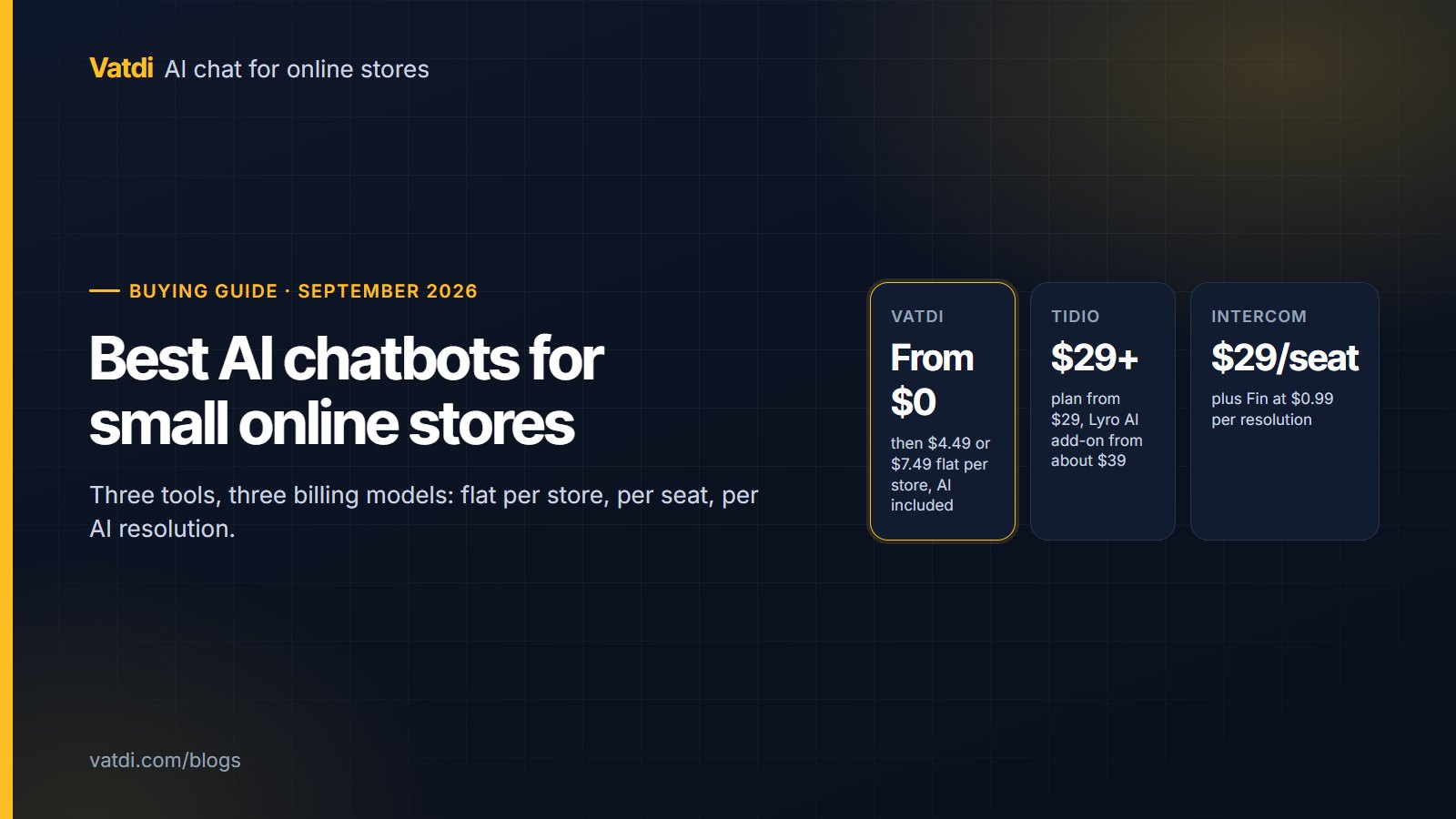
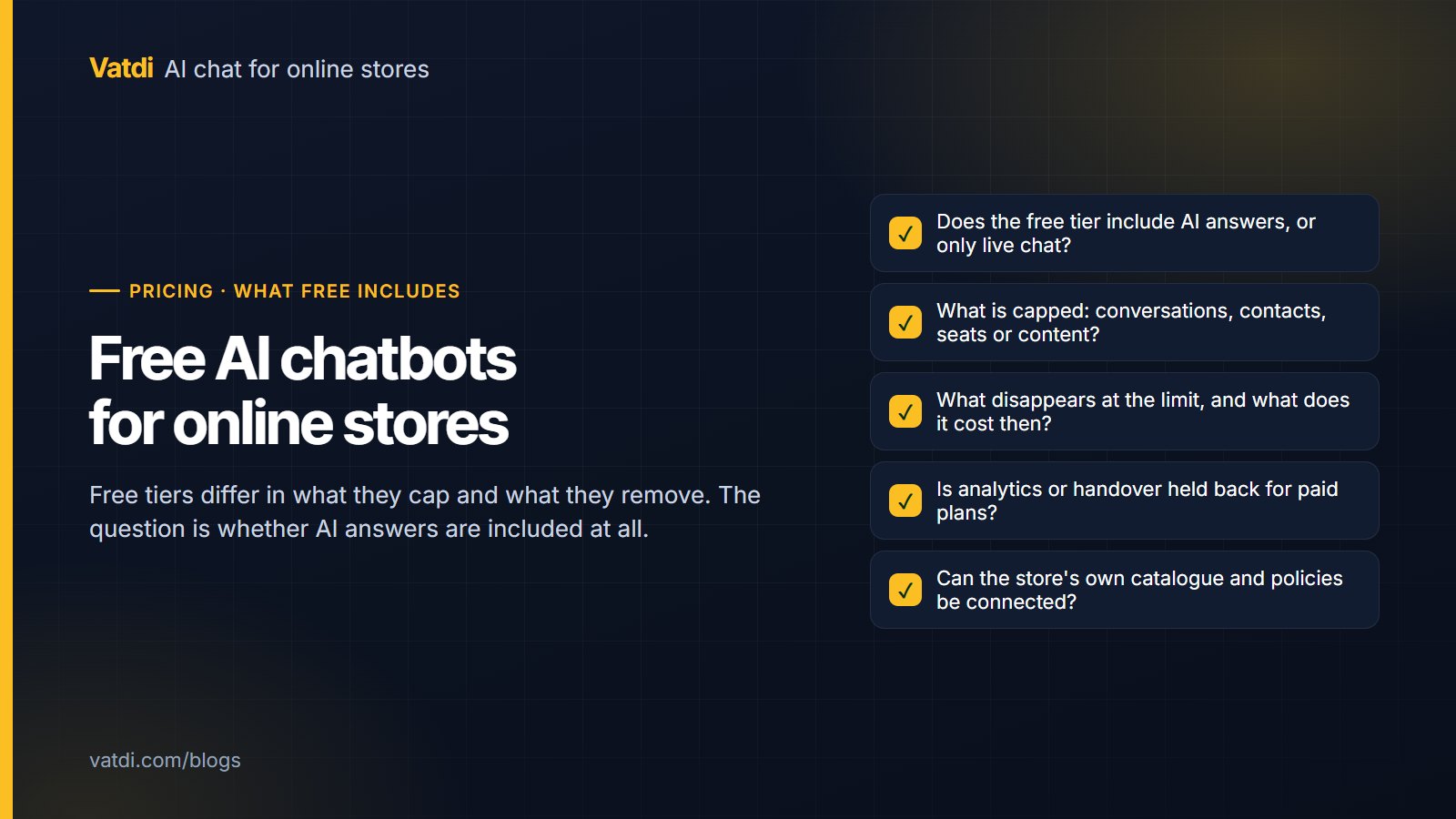
Outside those cases, a small store or service business usually gets the most from a flat plan that includes the AI, syncs the catalogue where there is one, and does not multiply by seats. That is the profile Vatdi is built for, and the free plan is enough to test it with real visitors; the small-store comparison is in best AI chatbots for small online stores and the free tiers are compared in free AI chatbots for online stores.
How to check a "cheap" plan in ten minutes
- Open the pricing page and find the unit: seat, conversation, resolution, ticket or flat.
- Find the sentence that says whether AI answers are included on that plan.
- Multiply by your people and your monthly conversations; do it again for your busiest month.
- Check the channel: website widget, or messaging apps.
- Check what the free plan caps and whether the badge can be removed.
- Run the two negative tests on the free plan: a product or service you do not offer, and an exact delivery date. A cheap bot that guesses is expensive.
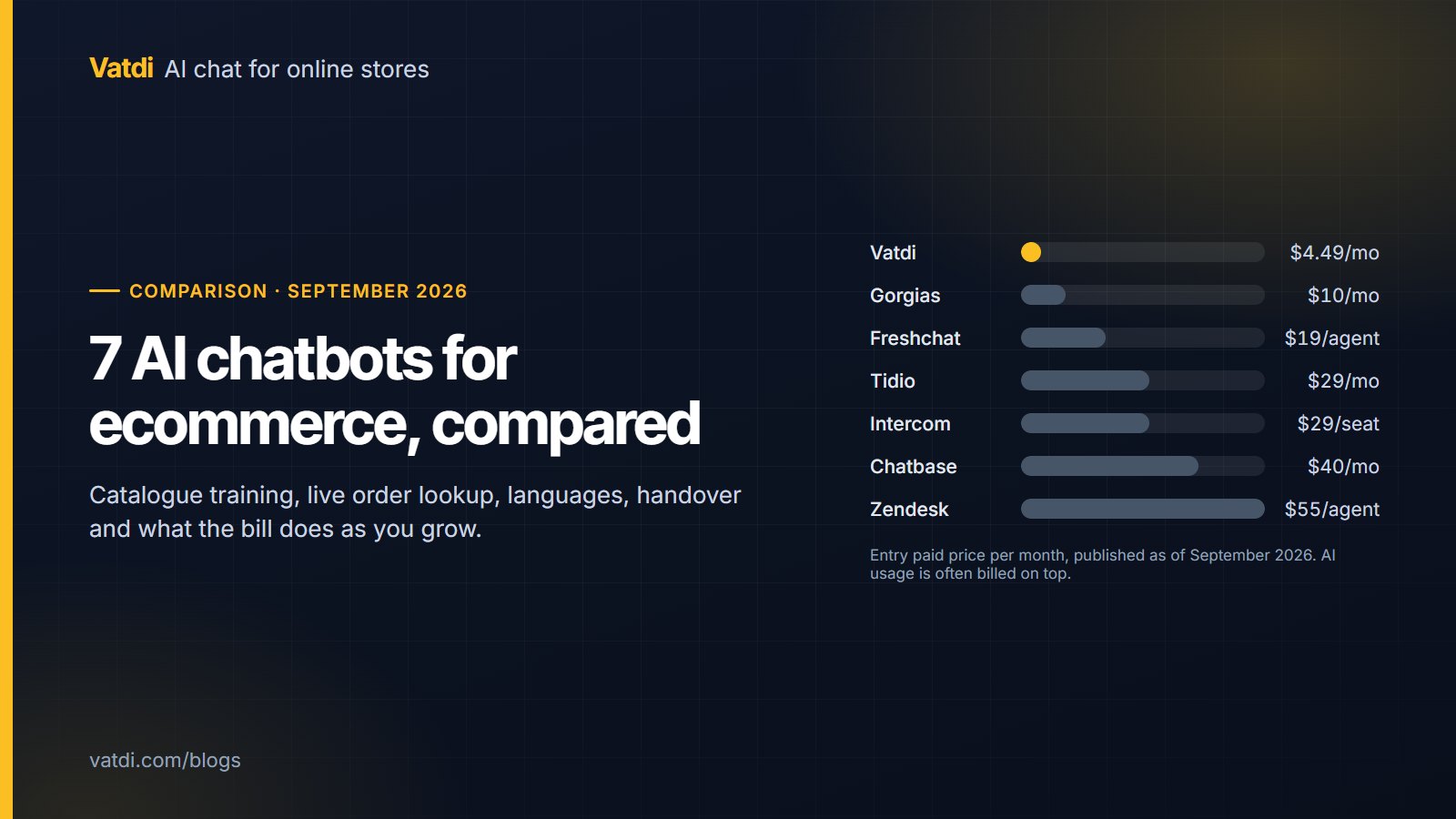
The pricing models themselves are compared in seven AI chatbots for ecommerce compared, and the small-business plans specifically in AI chatbot pricing for small business.
Frequently asked questions
What is the cheapest AI chatbot that actually answers customers?
As of September 2026, a free plan that includes AI answers: Vatdi's Free plan covers 15 conversations a month with every feature, and Chatbase and Botpress also offer free tiers with AI. The cheapest paid plan with AI included is Vatdi Starter at $4.49 a month for 150 conversations. Several tools with lower-looking entry prices sell the AI as a separate add-on, so confirm that sentence on the pricing page first.
Is a free AI chatbot good enough for a small business?
For testing with real visitors, yes, provided the free plan includes AI answers and the features you need. Vatdi's free plan has catalogue sync, order lookup through the plugins, handover, languages and lead capture, capped at 15 conversations a month with a badge. Once you pass the cap, $4.49 a month lifts it to 150. Free plans that exclude AI answers only test the live-chat part.
Why do some chatbots charge per seat?
Because they began as live-chat tools where each agent needs a login, and the pricing stayed when AI arrived. Per-seat pricing suits a support team of a few full-time agents; for a small business where three people occasionally glance at the inbox it triples the bill for no extra capacity. Flat per-store pricing with unlimited teammates, which Vatdi uses, fits that pattern better.
What does "AI add-on" mean on a pricing page?
That the plan price buys the inbox, widget and rules, and the component that writes answers from your content is billed separately, often metered by conversation or resolution. Tidio's Lyro (from about $39 a month) and Freshchat's Freddy are examples as of September 2026. Add the add-on to the plan before comparing, and check the add-on's own allowance and overage.
Does a cheaper chatbot give worse answers?
Not necessarily. Answer quality on a retrieval-based bot depends on the content it reads (your catalogue, policies and FAQs) far more than on the plan price; the same model can be behind a $4 plan and a $400 one. What a higher price usually buys is channels, helpdesk features, seats and compliance packaging. Test answers on the free plan with your own ten questions and two negative cases.
Are there hidden costs beyond the subscription?
The main one is your time on content: an afternoon to structure the shipping, returns and FAQ pages so the bot can quote them, and thirty minutes a week reviewing low-rated conversations. There is no setup fee or contract on Vatdi and you cancel from the billing page. Some vendors charge for branding removal, extra seats or AI overage; read the pricing page footnotes.