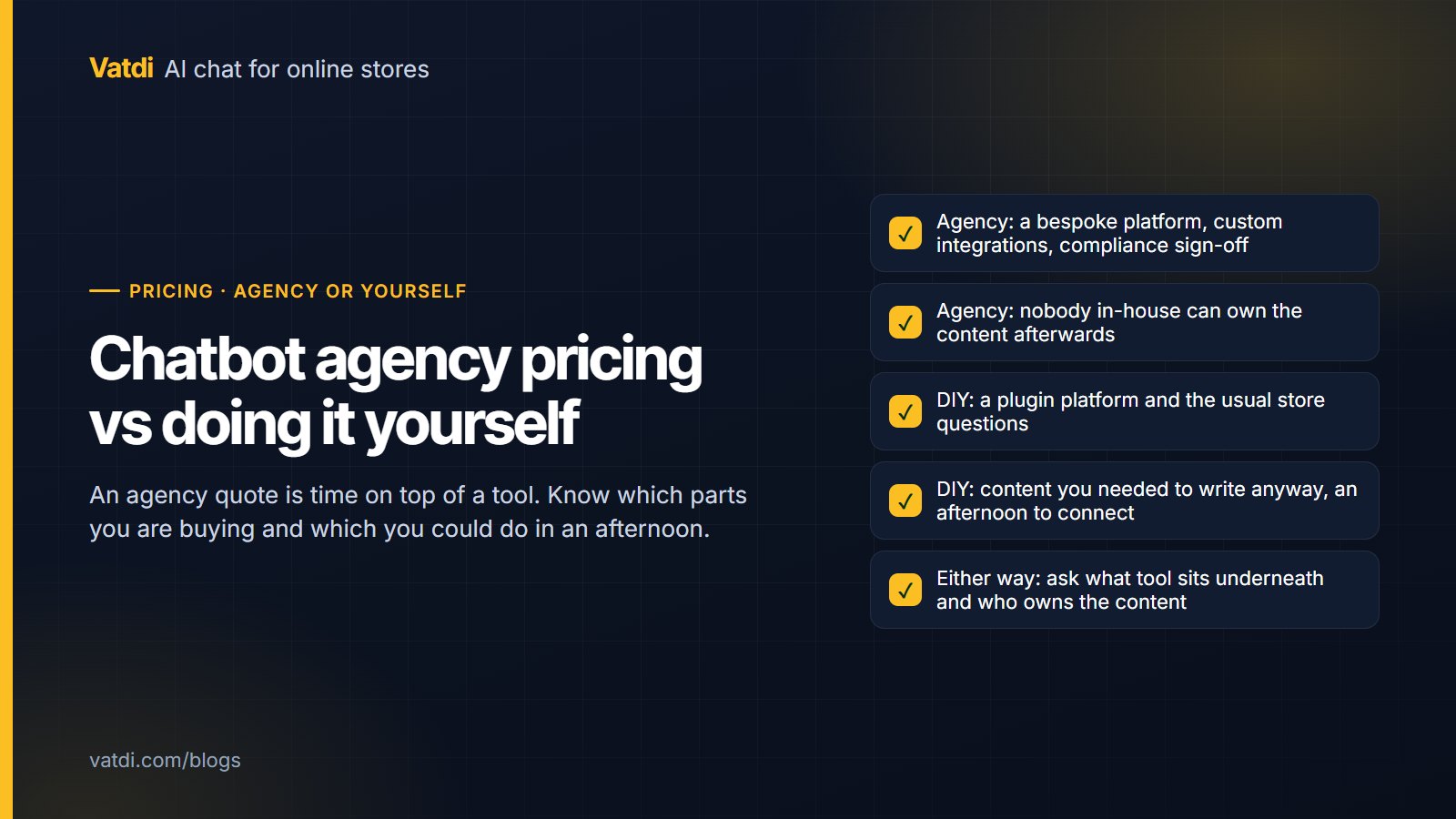
Chatbot agency pricing is a quote for time: discovery, conversation design, integration work, content preparation and a monthly retainer, layered on whatever software the agency deploys underneath. Doing it yourself on a retrieval-based platform is a plan fee plus your own hours, most of them on content you needed anyway. Below: what an agency is actually charging for, when that is worth it, what DIY really costs, and the questions that stop you paying twice.
What an agency quote is made of
Agencies rarely publish rate cards, and we will not invent one. What can be said with confidence is what the quote contains, because it is the same set of tasks whoever does them:
| Line item | What it covers | Who could do it instead |
|---|---|---|
| Discovery | Interviews, reading your inbox, listing the questions and channels | You, with last month's support inbox and an afternoon |
| Conversation design | Flows, scripts, tone, escalation rules | Mostly unnecessary on a retrieval-based tool; escalation rules take an hour |
| Integration | Connecting the catalogue, orders, CRM, helpdesk, custom systems | A plugin on WooCommerce, OpenCart, PrestaShop, Magento, Shopware, Joomla or Drupal; an agency for bespoke platforms |
| Content preparation | Rewriting policies, structuring FAQs, filling product attributes | You; it is your content and it improves the store regardless |
| Testing and launch | Question sets, staging, go-live | You, with the ten-question test |
| Retainer | Monthly monitoring, content updates, reporting | Thirty minutes a week on low-rated conversations |
| The tool underneath | A SaaS subscription passed through, sometimes marked up | The same subscription bought directly |
The honest summary: on a plugin platform with the usual store questions, five of the seven rows are an afternoon of your time. The two that can justify an agency are integration with something bespoke and the retainer when nobody in-house will own the content.
What doing it yourself actually costs
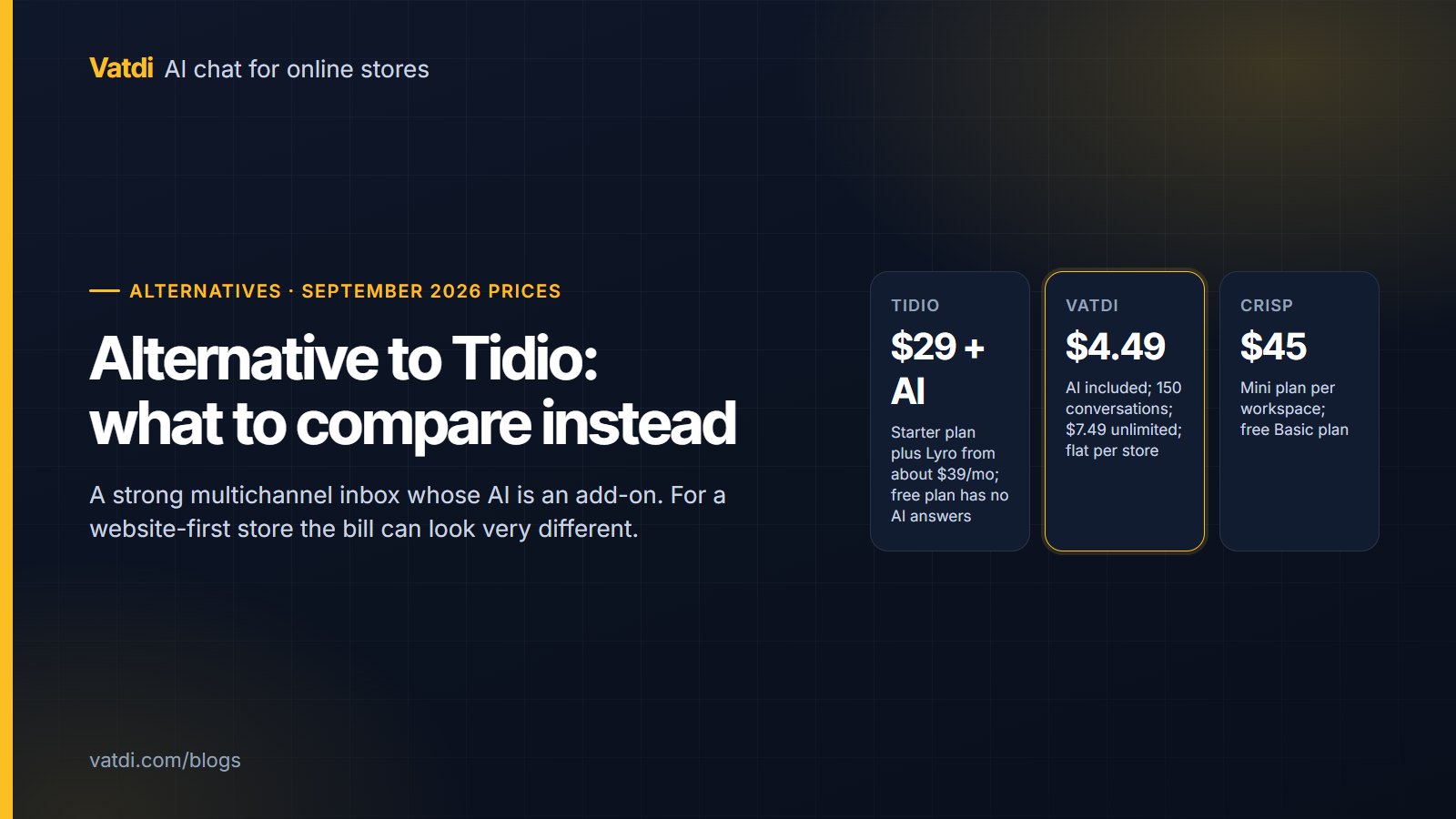
Two components: the plan and the hours. As of September 2026 the plan side ranges from free to a few dollars on flat tools (Vatdi: Free with 15 conversations a month, $4.49 for 150, $7.49 unlimited, every feature included; see pricing) to per-seat and per-resolution bills on platform tools; the models are compared in chatbot pricing models explained. The hours side, for a typical small store on a plugin platform:
- Install and connect: minutes, no keys to copy.
- Content: an afternoon to rewrite shipping, returns and sizing pages one question per heading and fill attributes for the top fifty products. This is work the store benefits from with or without a bot; the format is in how to write a chatbot knowledge base.
- Rules and settings: an hour for agent hours, handover rules, quick replies and the welcome message.
- Testing: an hour for ten real questions and two negative cases.
- Running it: thirty minutes a week reviewing low-rated conversations and fixing the page behind each.
Put a value on your own hour and you have the DIY cost. For most small stores it is one working day up front and two hours a month, on top of a plan that costs less than a coffee a week. The step list is in the AI chatbot implementation guide and how to build an AI chatbot without coding.
When an agency is worth it
Custom platforms are the clearest case. If your store or internal system has no plugin and the bot needs to read orders or accounts from it, someone has to build that connection, and an agency or a developer is the right buyer. Vatdi's own bespoke work sits under custom AI agent development; for everything with a plugin, the DIY path above is the intended one.
Questions to ask any agency before signing
- Which tool sits underneath, and what is its pricing unit? You will pay that unit for years after the project ends. If it is per seat or per resolution, ask for the bill at your busiest month.
- Do I own the account and the content? The subscription should be in your name and the content in your systems, so leaving the agency does not mean starting again.
- Is the bot retrieval-based or a flow? A flow needs the agency for every change; a retrieval-based assistant follows your pages. The difference is explained in no-code chatbot builder vs an AI trained on your own data, and the underlying method in Lewis et al., 2020.
- What does the retainer buy each month? Ask for the specific tasks. If it is "monitoring", ask what changes when a low-rated conversation appears.
- What is the exit? Handover documentation, admin access, and no dependency on agency-hosted flows.
The middle path: buy the tool, hire for the hard part
Many stores do best with a split: the assistant on a flat plan in the store's own name, the content done in-house, and a developer or agency hired only for the one integration that has no plugin. That keeps the recurring bill small and the knowledge in the business, and it means the agency's invoice is for the part that genuinely needed expertise. Flow-builder platforms price their own tiers separately (Landbot from €40 a month, for example; Landbot pricing), so if an agency proposes one, add that subscription to the quote.
A quick decision
- Plugin platform, standard questions, someone can edit a page: DIY. Start on a free plan; the cheapest options with AI included are in the cheapest AI chatbots for a small business.
- Bespoke platform or custom order system: buy the tool yourself, hire for the integration.
- Regulated answers or many brands: an agency with a retainer, on a tool you own.
- Not sure: spend one afternoon on the DIY path first. If the ten-question test passes, you have your answer; if it fails on integration, you know exactly what to hire for. The full cost picture is in how much an AI chatbot costs.
Frequently asked questions
How much does a chatbot agency charge?
Agencies quote per project and rarely publish rates, so any figure you see online is one agency's example rather than a market price. What the quote contains is predictable: discovery, design, integration, content, testing and a retainer, plus the software subscription underneath. Price each line against doing it yourself, and remember that the subscription's unit is what you keep paying after the project.
Is it cheaper to build a chatbot myself?
On a plugin platform with the usual store questions, yes by a wide margin: a flat plan (free to $7.49 a month on Vatdi as of September 2026) plus about a working day of your time up front and two hours a month after. The exception is a bespoke platform or custom integration, where a developer's time is genuinely needed and worth paying for once.
What is "chatbot as a service" pricing?
Usually an agency or reseller bundling a software subscription with setup and a monthly retainer into one fee. Ask which tool is underneath, what its own pricing unit is, and whether the account is in your name. The bundle is convenient if nobody in-house will own the content; it is expensive if the underlying tool is one you could run yourself in an afternoon.
Do I need an agency for a WooCommerce or OpenCart store?
Almost never. The plugins install in minutes, sync the catalogue and look up orders without custom work, and the remaining tasks are content and settings. Where a store might want help is a heavily customised checkout or an external order system with no plugin. Run the ten-question test on a free plan first; it tells you whether anything genuinely needs a developer.
What should be in a chatbot retainer?
Named tasks, not "monitoring": a weekly review of low-rated conversations, the content edits that follow, a monthly report of answered-without-a-person, missed handovers and ratings, and updates when policies or catalogue structure change. On a retrieval-based tool those tasks take a few hours a month; if the retainer is priced like a project, ask what the hours are spent on.
Who should own the chatbot account and content?
You. The subscription in your business's name, the knowledge base in your store and dashboard, and admin access held by you with the agency as a collaborator. That way a change of agency, or bringing the work in-house, is a permissions change rather than a rebuild. Any proposal that keeps the account or the flows on the agency's side should be priced with the exit cost included.