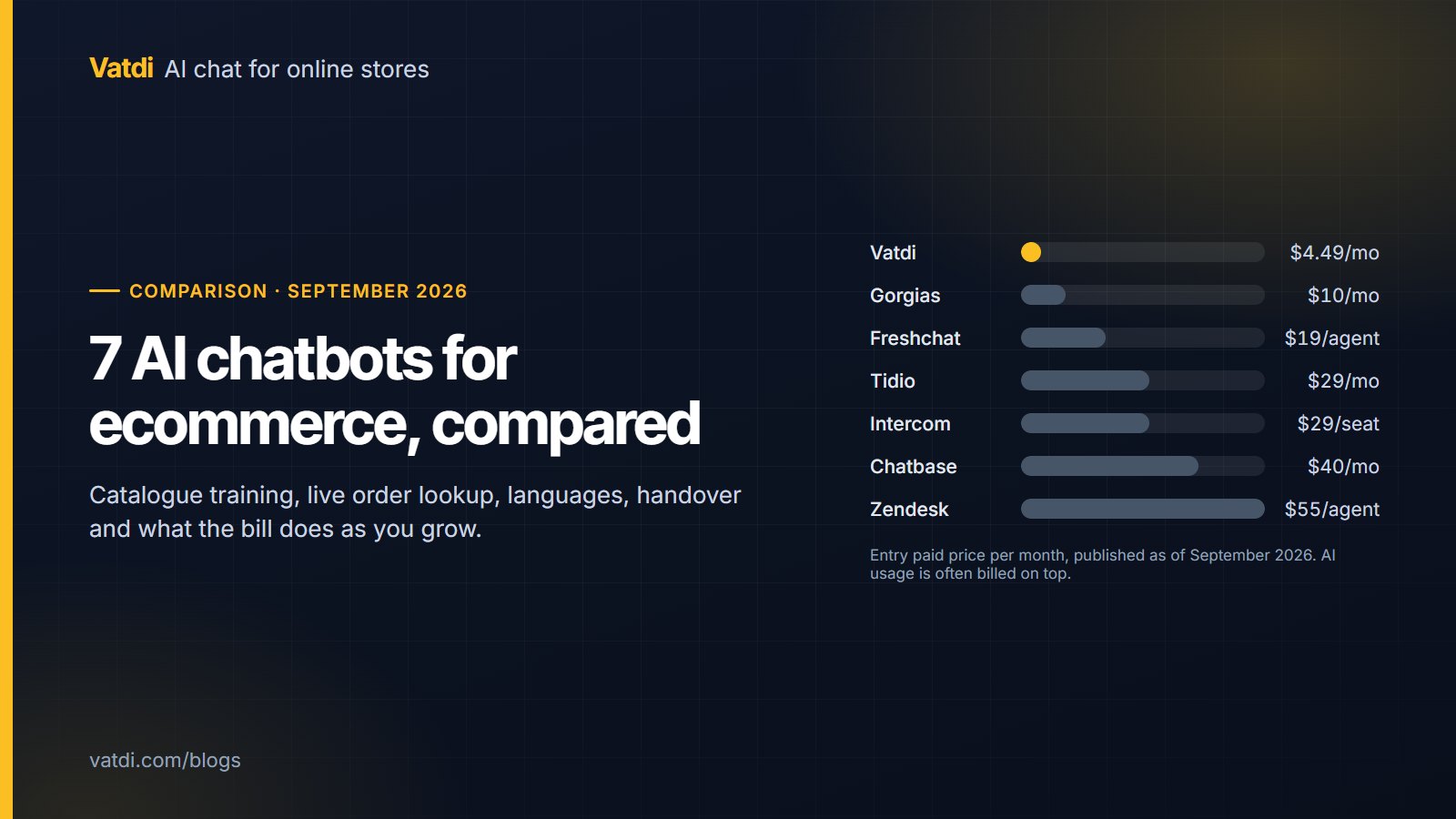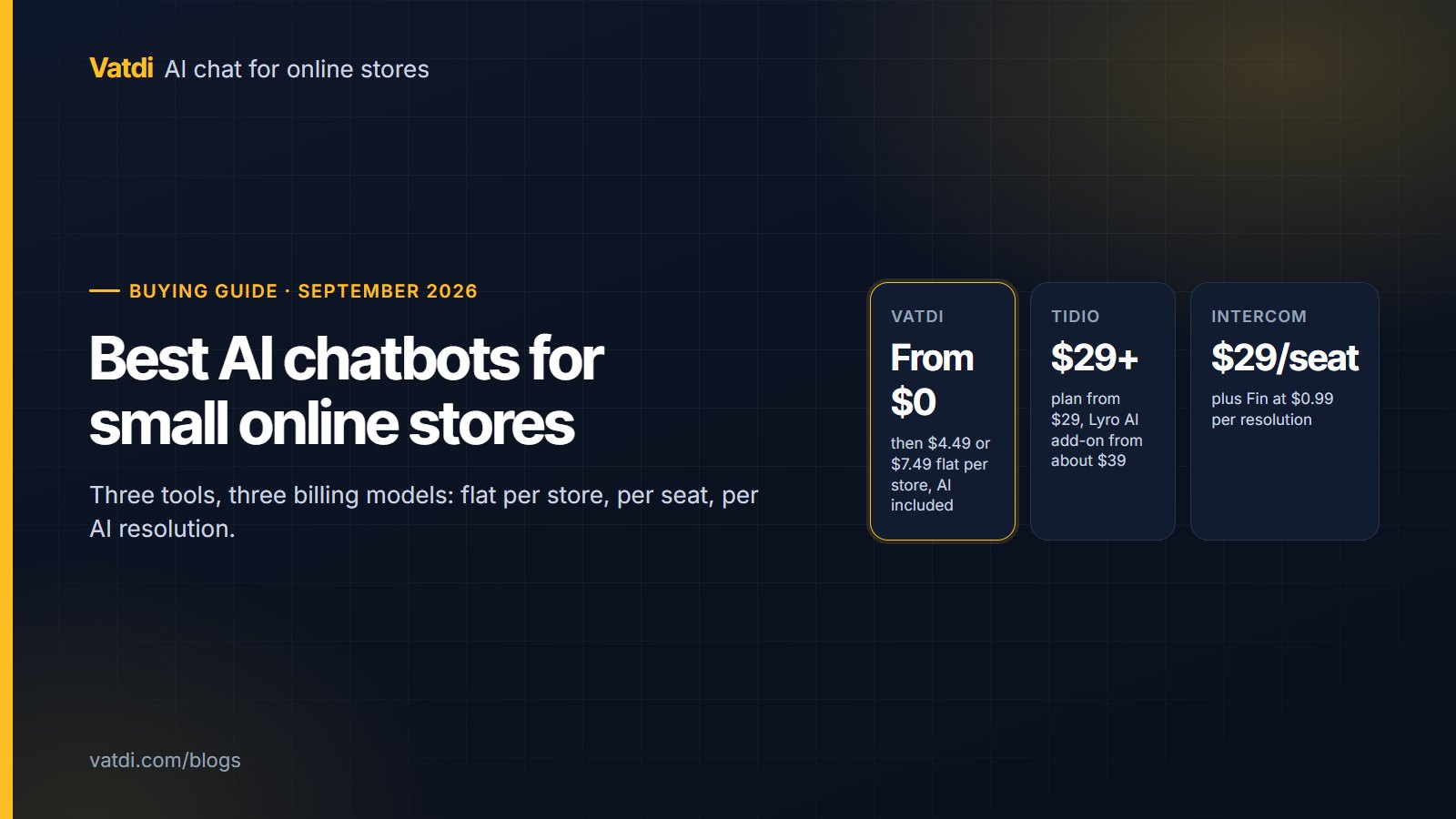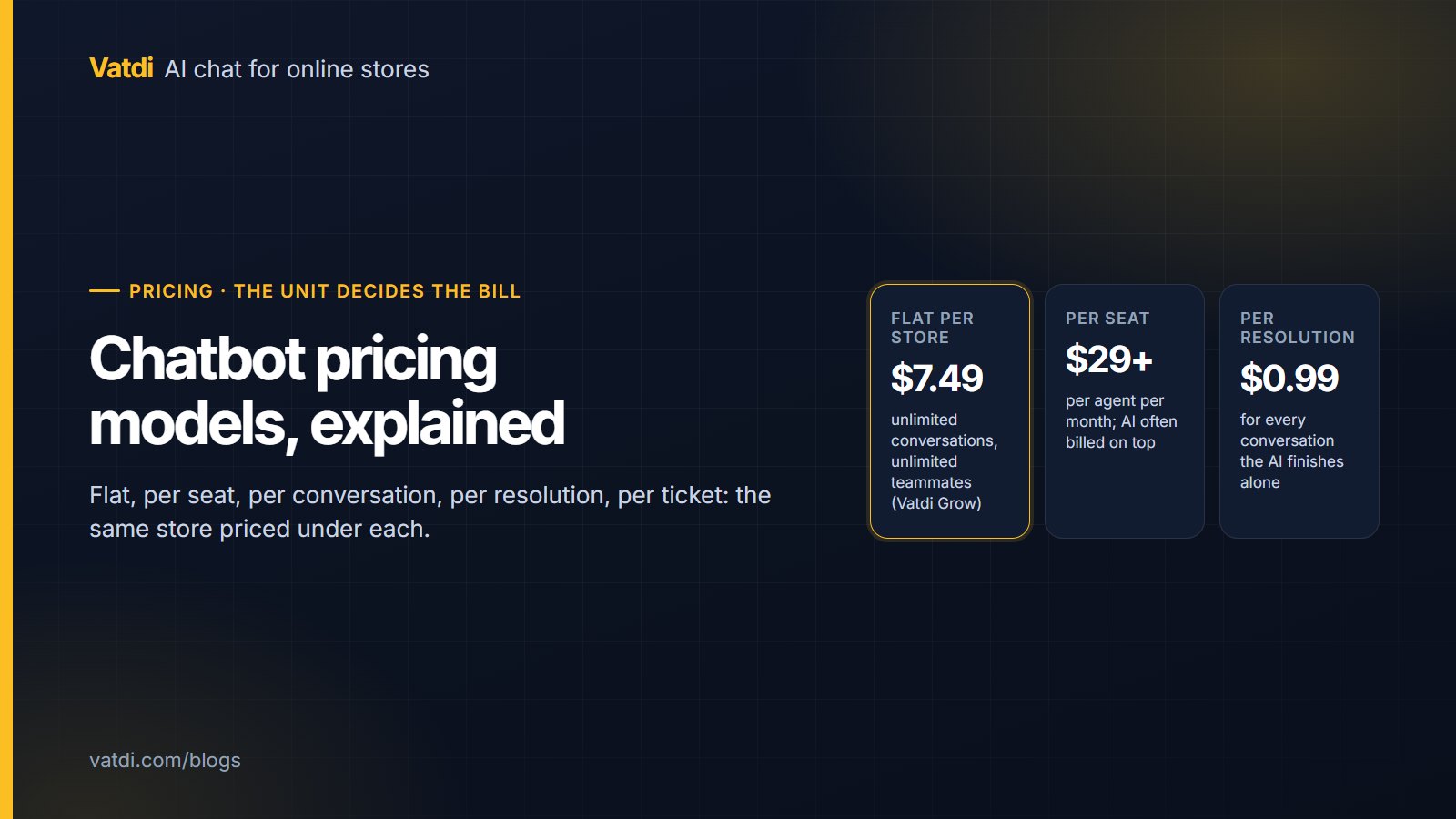
Chatbot pricing models differ in what they count: a flat fee per store, a price per agent seat, a price per conversation, a price per AI resolution, a price per ticket, or a metered AI add-on on top of a plan. The unit decides your bill far more than the headline price, because it decides what grows when your store grows. Below: each model, who uses it as of September 2026, and the same store priced under each at three volumes.
The six models
| Model | What is counted | Used by (as of September 2026) | What makes the bill grow | Good fit |
|---|---|---|---|---|
| Flat per store | Nothing beyond a monthly fee; a conversation cap on lower tiers | Vatdi: Free (15 conversations), Starter $4.49 (150), Grow $7.49 (unlimited); unlimited teammates | Crossing a cap on the lower tiers | Small and mid-sized stores that want a predictable bill |
| Per seat | People who log in | Intercom $29–$132 per seat; Zendesk from $55 per agent; Freshchat $19–$79 per agent; LiveChat from $20 per agent; Olark $29 per seat | Adding teammates | Support teams where a few agents handle everything |
| Per conversation | Conversations the bot handles, often with an allowance | Tidio's Lyro add-on (from about $39/mo, metered); Vatdi's lower tiers as a cap rather than a meter | Volume, including sale weeks | Teams that can forecast volume |
| Per AI resolution | Conversations the AI finishes without a person | Intercom Fin $0.99 per resolution; Gorgias AI Agent per automated resolution | Every successful AI answer | Teams that want cost tied to outcomes |
| Per ticket | Tickets created, whatever the channel | Gorgias from $10/mo for 50 tickets, Basic $60/mo for 300 | Short pre-sales chats count like support cases | Stores whose contacts are mostly real cases |
| Metered AI add-on | A plan plus a separately billed AI | Tidio (Starter $29 + Lyro), Freshchat (Freddy add-on), Tawk.to (AI add-on on free chat) | AI usage above the add-on allowance | Teams already on the platform |
Sources: Intercom pricing, Gorgias pricing, Tidio pricing and Vatdi's pricing page, all as of September 2026. Prices change; check the vendor's page before deciding.
Each model in plain words
Flat per store
One price for one store, regardless of who logs in or how many questions the bot answers. Lower tiers cap conversations rather than metering them, so the only event that changes the bill is crossing a cap and moving up a tier. The trade-off is that unlimited teammates and unlimited conversations are priced into a number the vendor has to keep low, which is why flat plans tend to come from tools focused on one channel. Vatdi's caps are 15 conversations on Free and 150 on Starter, then unlimited on Grow; the plan differences are the cap and the badge, nothing else (monthly plans, unlimited messages).
Per seat
The price multiplies by the number of people who log in. It comes from live-chat and helpdesk tools where each agent needs a login, and it suits a support team of a few full-timers. For a small store where three people occasionally glance at the inbox it triples the bill for no extra capacity, and the AI is often an add-on on top of the seats.
Per conversation
You pay for the conversations the bot handles, usually as an allowance with an overage. Predictable if you know your volume; punishing in a sale week if you do not. Ask how a "conversation" is defined (one session, one day, one shopper?) and what happens at the allowance.
Per AI resolution
You pay for every conversation the AI resolves without a person. It aligns the vendor's revenue with outcomes, which is attractive to larger teams, and it means the bill rises with precisely the thing you want more of. At $0.99 per resolution, 700 resolved conversations are $693 before the seat price. Ask how a resolution is decided and whether a shopper's "thanks, bye" after a wrong answer counts.
Per ticket
Helpdesk pricing: every ticket counts, whether it was a two-line pre-sales question or a week-long return. Fine when most contacts are real cases; expensive on a store where most contacts are quick questions the AI answers in seconds.
Metered AI add-on
The plan buys the inbox and widget; the component that writes answers is billed separately with its own allowance. Add the add-on to the plan before comparing anything, and read the add-on's overage terms.
The same store, priced under each model
Assumptions, stated so you can change them: two people who might answer; the AI takes 70% of conversations on its own (so at 1,500 conversations, 1,050 are AI resolutions); prices are the published September 2026 figures; add-on allowances vary, so those rows show "from". Arithmetic only.
| Model and example | 300 conversations / month | 1,500 / month | 5,000 / month |
|---|---|---|---|
| Flat per store (Vatdi Grow $7.49, unlimited) | $7.49 | $7.49 | $7.49 |
| Flat per store, capped tier (Vatdi Starter $4.49, 150) | needs Grow | needs Grow | needs Grow |
| Per seat (Intercom Essential, 2 seats, no AI) | $58 | $58 | $58 |
| Per seat + per resolution (Intercom Essential 2 seats + Fin at 70%) | $58 + $208 = $266 | $58 + $1,040 = $1,098 | $58 + $3,465 = $3,523 |
| Per ticket (Gorgias) | Basic $60 (300 tickets), AI per resolution on top | Above the Basic tier; higher tiers not on our sheet | Above the Basic tier |
| Plan + metered AI (Tidio Starter + Lyro) | from $29 + $39 = $68 | from $68, allowance-dependent | from $68, allowance-dependent |
The hidden multipliers
- Seats you forgot: the owner, the weekend helper, the accountant who checks the inbox once a month.
- Sale weeks: a metered or per-resolution model turns Black Friday into the most expensive week of the year, in the same week margins are thinnest.
- Definitions: what counts as a conversation, a resolution or a ticket differs between vendors; the same store can be 800 conversations on one and 1,300 on another.
- Add-ons for basics: branding removal, AI answers and extra languages are add-ons on some tools and included on others. On Vatdi the only paid-only change is removing the badge.
- Annual lock-in: per-agent prices are often quoted on annual billing; the monthly rate is higher. Vatdi's yearly plans ($44.90 and $74.90) save about 17% and are optional (annual discount).
Five questions to ask before you sign
- What exactly is the unit, and how is it defined in writing?
- Is the AI included on this plan, or an add-on with its own allowance?
- What is the bill at my busiest month, not my average one?
- What happens at the cap or allowance: hard stop, overage, or forced upgrade?
- Which of the things I need (languages, order lookup, branding removal, teammates) cost extra?
Run the answers through the three-volume table above with your own numbers. The broader tool comparison is in seven AI chatbots for ecommerce compared; the cheapest plans that still include AI are in the cheapest AI chatbots for a small business; the cost per contact against a human team is in AI vs human customer support; and the overall picture is in how much an AI chatbot costs. Enterprise quote-based pricing, which is a seventh model with no public number, is covered in AI chatbot enterprise pricing.
Frequently asked questions
Which chatbot pricing model is best for a small online store?
Usually flat per store with the AI included and unlimited teammates, because a small store's volume swings with sales and its team is a few people who log in occasionally. Per-seat pricing multiplies for no extra capacity, and per-resolution pricing charges for the answers you want the bot to give. As of September 2026 Vatdi's Grow plan is $7.49 a month for unlimited conversations; run your own volume through the table before deciding.
What does "per resolution" mean in chatbot pricing?
You pay a fixed amount for each conversation the AI resolves without a human taking over; Intercom's Fin is $0.99 per resolution as of September 2026, and Gorgias bills its AI Agent per automated resolution. The model ties cost to outcomes, which suits teams that can forecast volume. Ask how a resolution is detected, because a shopper who leaves after a wrong answer may still count as one.
Why do live chat tools charge per seat?
Because they began as tools where each agent needs a login, and a seat is a clean unit to bill. When AI arrived it was usually added as a metered extra rather than replacing the seat. Per-seat pricing suits a team of full-time agents; for a store where the owner and two helpers share an inbox it costs three seats for one person's worth of work.
How is a "conversation" defined?
It varies, and the definition is worth reading. Common definitions are one visitor session, one visitor per day, or one thread until it is closed. Vatdi counts a shopper's session as one conversation however many questions they ask, and never counts individual messages or AI replies. Two vendors can report very different conversation counts for the same store, so compare units before prices.
Are flat-rate chatbots worse because they are cheaper?
Not in answer quality, which depends on the content the bot reads rather than the price. What a higher price usually buys is breadth: more channels, helpdesk features, seats, compliance packaging. If you need Messenger, ticketing or a certification for procurement, a flat two-channel tool is not the right fit at any price; if you need website chat that answers from your store, it usually is.
What is the cost of a chatbot during a sale like Black Friday?
Under a flat plan, unchanged. Under per-conversation, per-resolution or metered add-on pricing, the busiest week of the year is also the most expensive; at $0.99 per resolution, 2,000 extra resolved chats are $1,980. If your volume is seasonal, price the peak month rather than the average and prefer a model where the peak costs staff time rather than licence fees.