AI vs human customer support is the wrong framing for a store; the useful question is which contacts each should handle and what that costs per contact. Humans cost time per conversation and cover limited hours; AI costs a licence and covers every hour, but only for questions your content answers. This guide prices human-only, AI-only and hybrid support with assumptions you can replace, shows what each does well, and sets the handover rules that make hybrid work.
The three models
- Human-only. Every contact is read and answered by a person, during the hours a person is available. Quality depends on the person; cost scales with volume.
- AI-only. A chatbot answers everything it can from your content and the rest goes to an email queue or nowhere. Cheap, always on, and wrong for refunds, disputes and anything needing judgement.
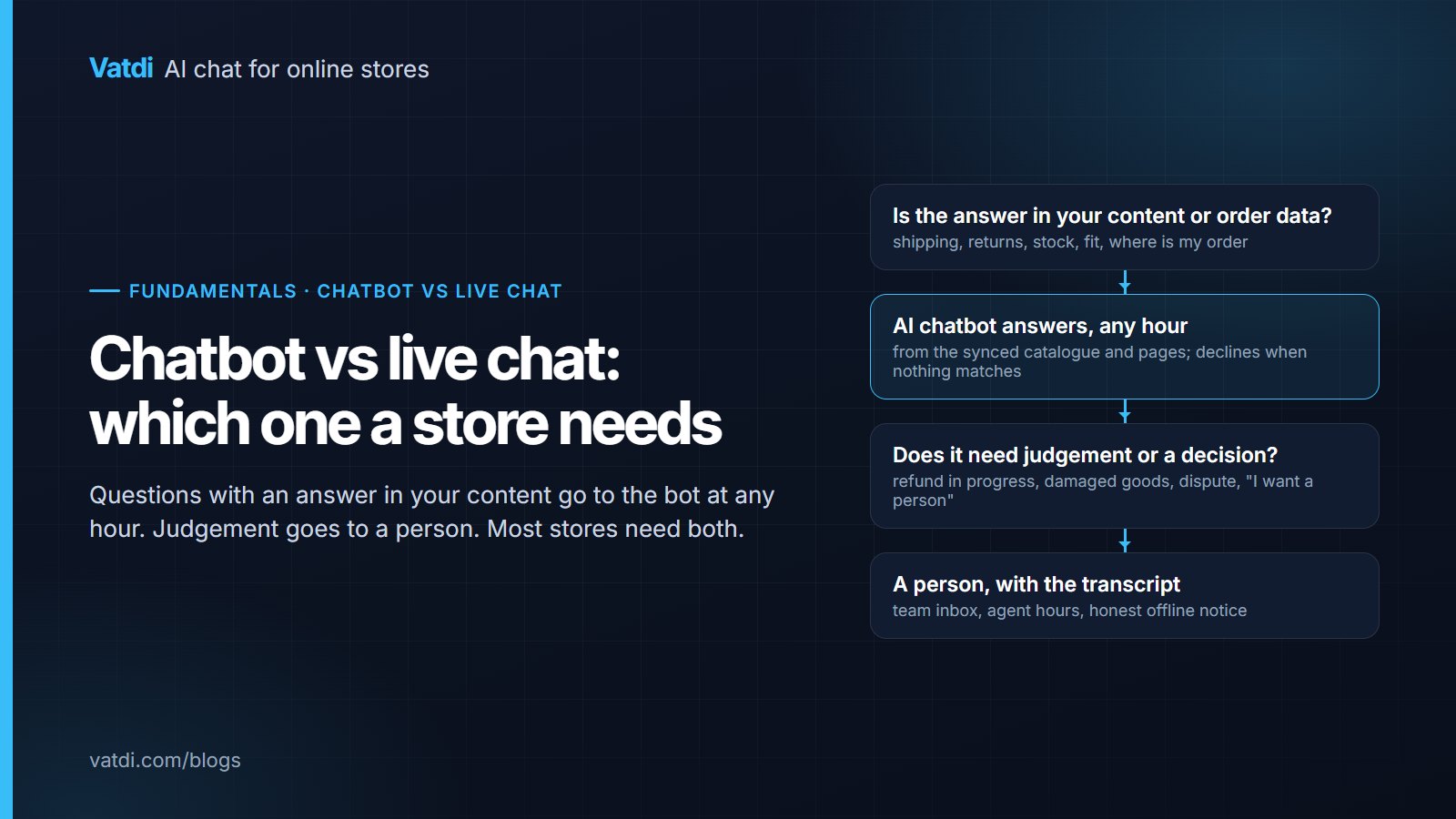
- Hybrid. The AI takes the repetitive questions with an answer in your content or order system; a person takes the rest, with the transcript, under explicit rules. This is the model most stores end up with, and the one worth costing carefully.
What each side actually does well
| Contact type | AI (retrieval-based) | Human | Who should take it |
|---|---|---|---|
| Where is my order? | Live lookup with order number + email/phone, any hour | Same answer, slower, only in hours | AI, when the store is connected |
| Shipping time, cost, zones | From the shipping page, in the shopper's language | Same, from memory | AI |
| Returns policy questions | From the returns page | Same, plus discretion | AI for the rule; human for the exception |
| Product fit, compatibility, stock | From catalogue attributes, with a product card | From experience, often better on nuance | AI first; human when attributes are missing |
| Refund in progress, damaged goods | Should decline and hand over | Judgement, apology, action in the store admin | Human, always |
| Payment disputes, chargebacks | Should decline and hand over | Required | Human, always |
| Angry customer | Can de-escalate slightly; cannot resolve | Required | Human, quickly |
| Question not in your content | Says "I don't know", offers a person | Finds out | Human, then fix the content |
The pattern is that AI wins on anything with a written answer or a database lookup, and loses on anything needing discretion. A retrieval-based bot is designed for exactly that split: it answers from your pages and declines otherwise (the approach is described in Lewis et al., 2020). Whether it can safely replace people on any given contact is covered in can an AI chatbot replace customer service.
Cost per contact: a worked example you can edit
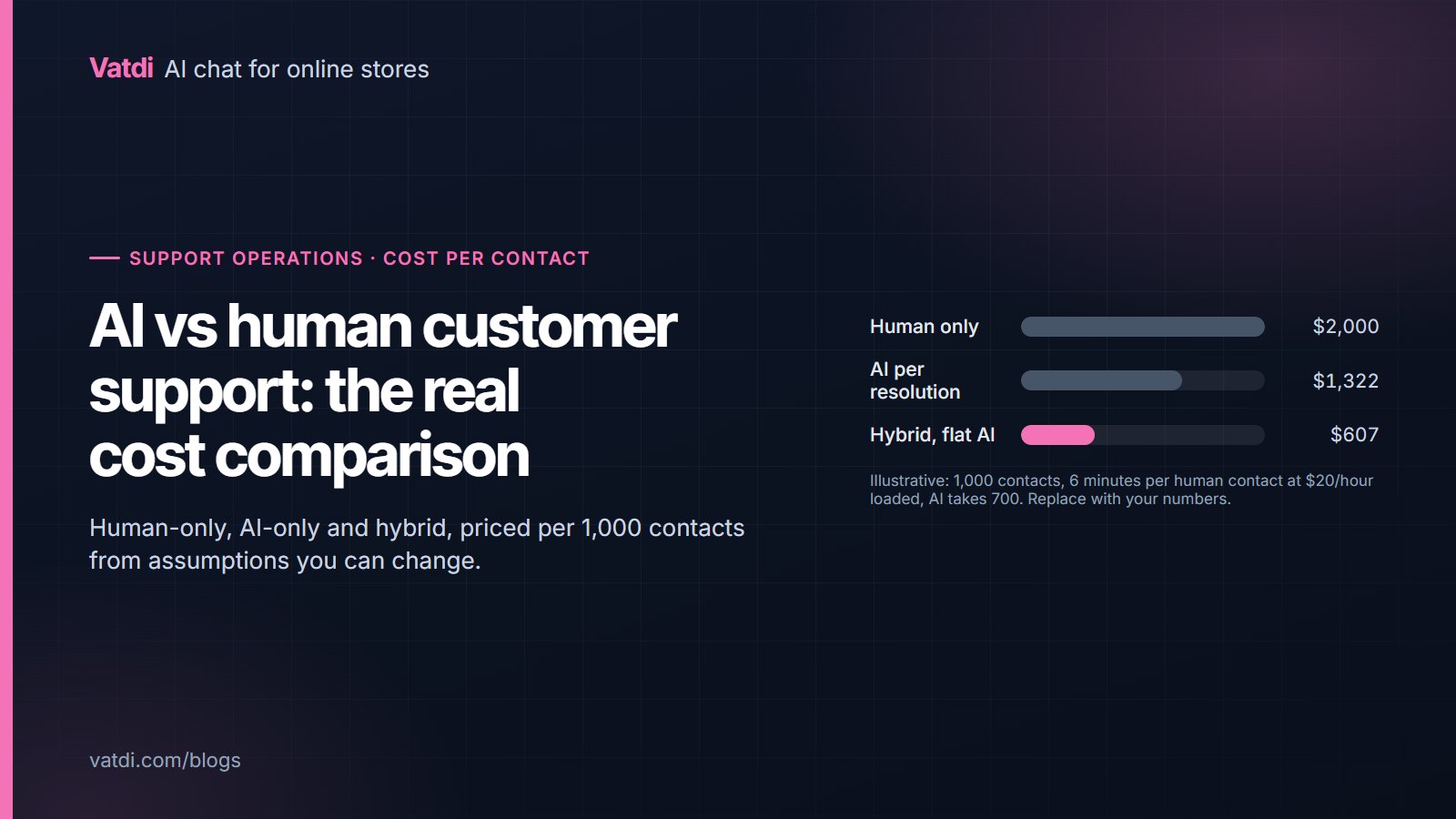
There are no reliable industry averages for a small store's cost per contact, so this example states its assumptions and you should replace them with your own. Assume 1,000 contacts a month; a person spends 6 minutes on average per contact (reading, checking the order, replying); loaded cost of that person's time is $20 an hour, so a human contact costs $2. Assume the AI can take 700 of the 1,000 (order status, shipping, returns rules, product questions) and 300 need a person. Tool prices are published figures as of September 2026.
| Model | Human contacts | Human cost | Tool cost | Total per 1,000 contacts |
|---|---|---|---|---|
| Human-only | 1,000 | 1,000 × $2 = $2,000 | $0 (email) or a live-chat seat | about $2,000 |
| Hybrid, flat-priced AI | 300 | 300 × $2 = $600 | Vatdi Grow $7.49/mo, unlimited conversations | about $607 |
| Hybrid, per-resolution AI | 300 | $600 | Intercom Essential $29 per seat + Fin 700 × $0.99 = $722 | about $1,322 |
| Hybrid, metered AI add-on | 300 | $600 | Tidio Starter $29 + Lyro from about $39 (allowance-dependent) | about $668 or more |
Two things stand out once the arithmetic is on the table. First, the saving comes from the human contacts the AI removes, not from the tool being cheap; 700 contacts at $2 is $1,400 a month of a person's time. Second, the pricing model decides whether the tool eats that saving: a per-resolution price charges you for every contact the AI takes, which is precisely the thing you want more of. Sources for the tool prices: Intercom pricing and Vatdi's pricing page; prices change, check them before deciding. The pricing models are compared in more depth in our seven-tool comparison.
The costs the table leaves out
- Coverage. Human-only support has hours; contacts outside them wait, and some shoppers do not. AI answers at 2 a.m. within your content and collects details for the rest. Put a value on that from your own analytics: how many sessions happen outside support hours.
- Error cost. A person occasionally misquotes a policy; a badly set up bot can invent one. Retrieval-based bots with a real "I don't know" reduce this, but you must test the negative cases before launch.
- Content time. The AI's answers are only as good as your pages. Budget an afternoon to rewrite shipping and returns pages one question per heading, and thirty minutes a week to fix the content behind low-rated conversations.
- Handover friction. If the person receiving a handover has to ask the customer to repeat everything, the hybrid model leaks its saving. The transcript must travel with the conversation; Vatdi's team inbox does this.
Handover rules that make hybrid work
- Always escalate: refunds already in progress, damaged goods, payment disputes, and any explicit request for a person, without a second bot attempt.
- Escalate on uncertainty: when the bot cannot find the answer in your content, it says so and offers a person rather than guessing.
- Be honest about hours: outside agent hours the widget says when someone will reply and collects contact details.
- Measure the misses: review missed handovers weekly; each is a customer who asked for you and did not get you.
The mechanics are in what chatbot human handover is; the wider cost picture is in how AI chatbots reduce support costs and AI chatbot vs hiring support agents.
Run your own numbers: a five-line worksheet
- Contacts per month across chat, email and phone.
- Minutes per contact: time a sample of twenty, including the lookup and the reply.
- Loaded hourly cost of the people who answer, including your own time if it is you.
- Share the AI can take: count last month's contacts that were order status, shipping, returns rules, stock or product questions. Be conservative the first month.
- Tool cost under the pricing model you are considering: flat, per seat, per resolution or metered add-on, at your volume.
Human cost = contacts × minutes ÷ 60 × hourly cost. Hybrid cost = (contacts × (1 − AI share)) × minutes ÷ 60 × hourly cost + tool cost. Run it for two or three tools and the answer is usually obvious. Then re-run it after a month with the real AI share from your conversation reports; Vatdi shows the share answered without a person and grades each conversation 0–10, so the second pass uses measured numbers rather than assumptions. A fuller method is in measuring chatbot ROI.
Who should stay human-only, and who should not
Stay human-only if your contacts are mostly bespoke: custom orders, complex B2B quotes, high-value items where every conversation is a negotiation. The AI would decline most of them and the licence buys little. Move to hybrid if your inbox is dominated by the same fifteen questions, if you sell into more than one language, or if you lose sessions outside support hours; those are the three conditions where the arithmetic above turns strongly in the AI's favour. Almost nobody should run AI-only on a store; refunds and disputes need a person, and a bot that cannot hand over will eventually cost you a customer that a $2 human contact would have kept.
Frequently asked questions
Is AI customer support cheaper than human support?
Per contact, for questions with a written answer or a database lookup, yes by a wide margin: a flat-priced AI handles unlimited conversations for a fixed monthly fee while a human contact costs minutes of paid time. Overall it depends on the pricing model and on the share of contacts the AI can genuinely take. Run the worksheet above with your own minutes, hourly cost and contact mix rather than trusting a vendor's headline saving.
Which support questions should never go to a chatbot?
Refunds already in progress, damaged or missing items, payment disputes and chargebacks, complaints, and anything where the customer has asked for a person. These need discretion and access to your store admin, and a bot attempting them damages trust. Set these as explicit handover rules before launch, and have the bot decline and route immediately rather than trying once first.
How does per-resolution pricing change the comparison?
It charges you for each contact the AI resolves on its own, so the tool cost rises with exactly the outcome you want. In the worked example, 700 resolutions at $0.99 plus a $29 seat cost $722 a month against $7.49 for a flat unlimited plan, as of September 2026. Per-resolution pricing suits teams that want cost tied to outcomes and can forecast volume; small stores usually prefer a flat bill.
Does a hybrid model need more staff to manage the bot?
No, but it needs a habit: about thirty minutes a week reviewing low-rated conversations and fixing the content behind them, plus an afternoon at the start rewriting the shipping and returns pages so the bot can quote them. The people who answered the repetitive contacts are the same people who now answer the exceptions; the difference is the share of their day the inbox takes.
How fast does an AI chatbot respond compared with a person?
The bot answers within seconds at any hour, within the limits of your content. A person answers when they see the message, which during hours might be minutes and outside hours might be the next morning. The comparison that matters is not speed alone but speed on the right contacts: instant for order status and shipping, and a clear "a person will reply by 9 a.m." for the rest.
What happens to quality when the AI answers most contacts?
It tracks the quality of your content. Answers from a current, well-structured returns page are consistent every time; answers from a stale promotion page are consistently wrong. Test the ten most common questions and two negative cases before launch, review the conversation grades weekly, and treat every low-rated answer as a content fix. Human quality varies by person and day; AI quality varies by page.