These ecommerce chatbot examples cover the eight conversations a store has every day, with the exact wording that works and the content each one needs behind it. Copy the pattern rather than the script: a grounded assistant writes its own sentences from your pages, so the useful part is knowing what a good answer contains and which page has to exist for it to be possible.
What makes an answer good
| Element | Why it matters |
|---|---|
| The specific fact first | The number, date or yes/no in the opening sentence, not after a preamble |
| The exception named | Sale items, international orders, bulky goods: the thing that causes the follow-up email |
| A next step or link | The product, the tracking page, the returns form |
| Honesty when unsure | "I don't have that" plus a route to a person beats a plausible guess |
| The customer's language | Reply in the language they wrote in, not the store's default |
1. Stock and variants
Customer: "do you have the grey hoodie in large"
Assistant: "Yes, the grey hoodie is in stock in large. It is £45 and ships within one working day. Here is the product page."
Needs: catalogue sync with variants and stock. Without it the honest answer is a link to the product page and nothing more.
2. Sizing and fit
Customer: "im 5'9 and usually a medium, will the jacket fit"
Assistant: "Our medium fits a 38–40 inch chest and has a 27 inch back length. If you are between sizes we suggest sizing up, as the jacket is a slim fit. Here is the full size guide."
Needs: a size guide written as questions, with measurements in the text rather than only in an image. An image-only chart is invisible to the assistant, which is one of the most common gaps in fashion stores.
3. Order status
Customer: "order 10482 hasnt arrived"
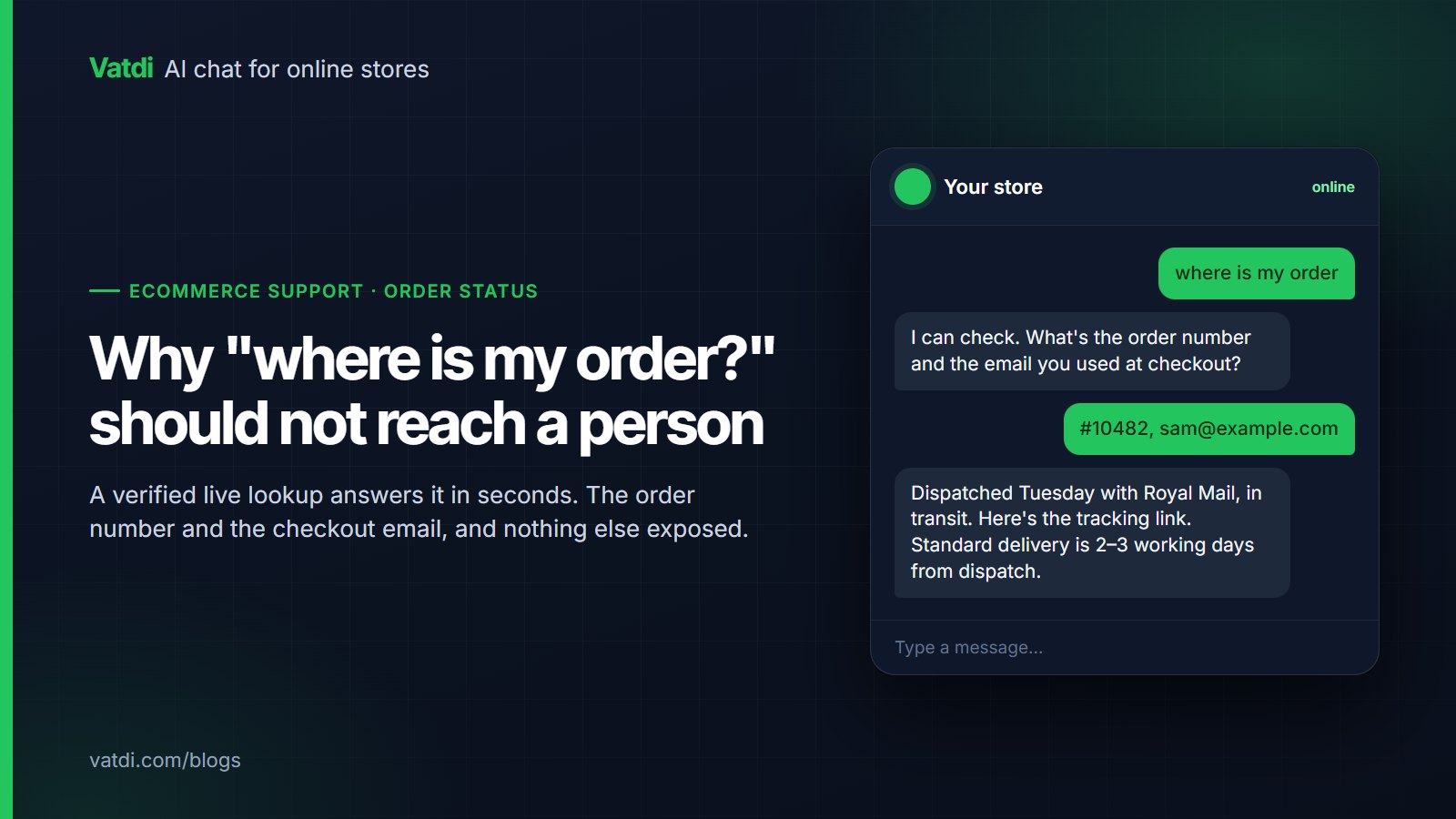
Assistant: "Order #10482 was dispatched on Tuesday and tracking shows it out for delivery today. Here is the tracking link. If it has not arrived by tomorrow, reply here and I will pass it to the team."
Needs: the store plugin connected for live lookup, plus a rule about what to ask for when the order number alone is not enough.
4. Returns and refunds
Customer: "can i send back the boots if theyre too tight"
Assistant: "Yes, you have 30 days from delivery to return unworn items in their original box. UK returns are free with the label in your confirmation email. Refunds reach your card 3–5 working days after we receive them. Sale items are final."
Needs: a returns page with the window, the conditions, the cost, the timing and the exclusions each stated plainly. The exclusion is the part most stores bury.
5. A question with no answer
Customer: "is this jacket warm enough for skiing"
Assistant: "I don't have a temperature rating for this jacket, so I would rather not guess. The team can tell you how it performs; they reply Monday to Friday 9–6. Shall I pass this on, with your question attached?"
Needs: an assistant that declines rather than improvising. This is the single most valuable behaviour in the list, and the reason to test it deliberately, as set out in how to test AI chatbot accuracy.
6. A complaint
Customer: "parcel arrived smashed, this is unacceptable"
Assistant: "I'm sorry, that should not have happened. I can see order #11207 was delivered yesterday. I am passing this to the team now with photos if you can attach them by email; they reply within a few hours during 9–6. You will not need to repeat any of this."
Needs: a handover rule for complaint language and a transcript that travels with the escalation. The rules worth setting are in chatbot human handover.
7. A recommendation
Customer: "something like the blue running shoe but under £80"
Assistant: "Three options under £80 in the same category: the Trail 2 at £72, the Road Lite at £65 and last season's blue runner at £78. All are in stock in most sizes. Here are the links."
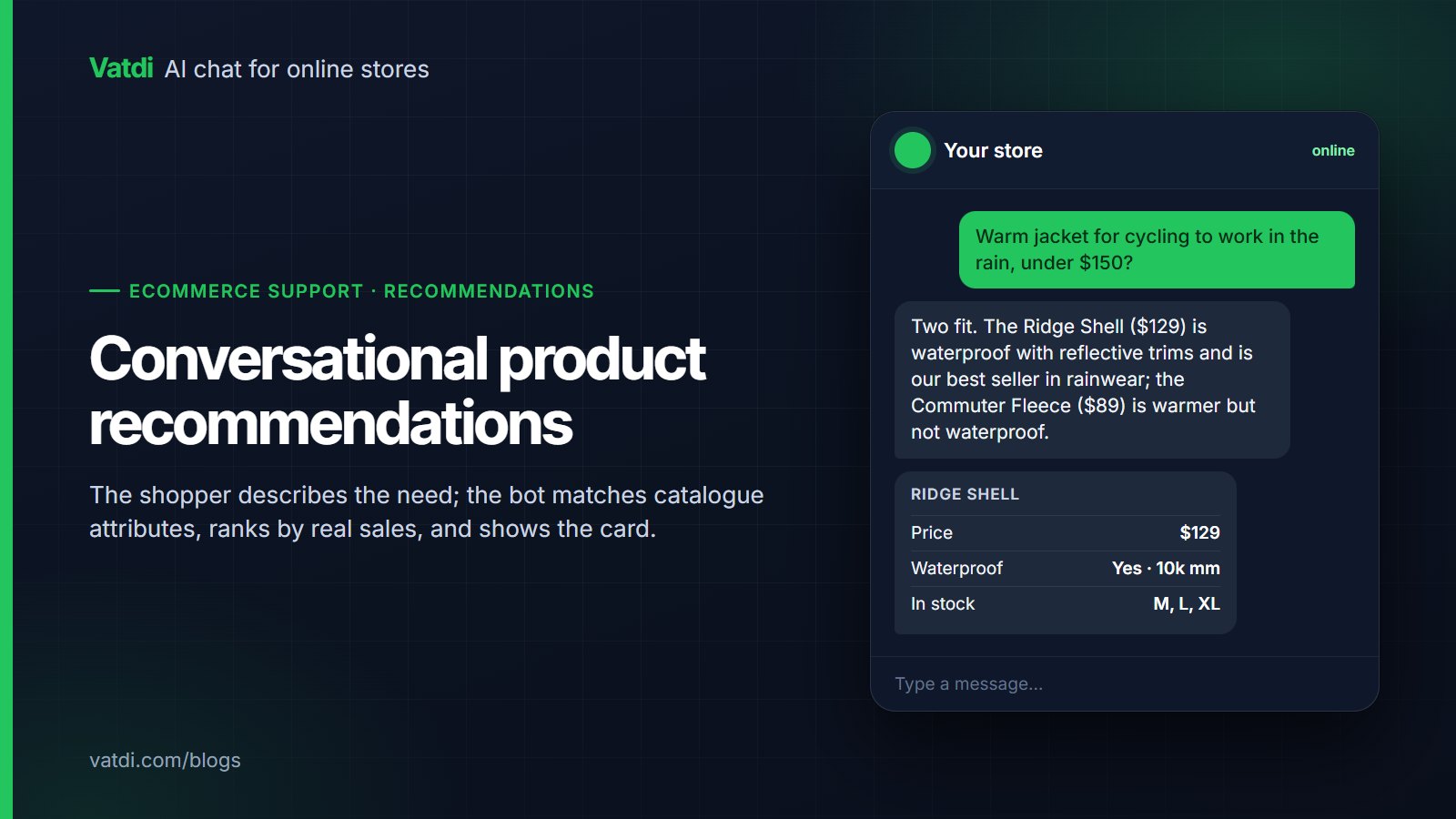
Needs: a catalogue with categories, prices and stock, and attributes filled on the products you want recommended. The approach is covered in conversational product recommendations.
8. A lead capture, done without nagging
Customer: "do you restock the sold out sizes"
Assistant: "This style is usually restocked within a few weeks, though I cannot promise a date. If you leave an email address I will pass it to the team so they can tell you when it lands. Otherwise the product page is the fastest place to check."
Needs: a restocking statement in your content and a rule that asks once, accepts no for an answer, and never blocks the answer behind the email.
Four wordings that make an answer worse
- The preamble. "Thanks for getting in touch, that is a great question, let me check that for you" delays the fact the customer came for. Put the number or the yes first.
- The policy dump. Pasting four paragraphs of returns policy instead of the one line that answers the question forces the customer to do the reading you were supposed to do.
- The false certainty. "It will arrive Thursday" when your content only supports "2–3 working days" turns an estimate into a promise, and a promise into a complaint.
- The dead end. "I'm afraid I can't help with that" with nothing after it. Every decline should carry a route: a person, an email, a page, or the hours when someone can answer.
Each of these is fixable in content rather than in settings. A page that states the fact in its first sentence produces an answer that does the same.
Turning the examples into your own
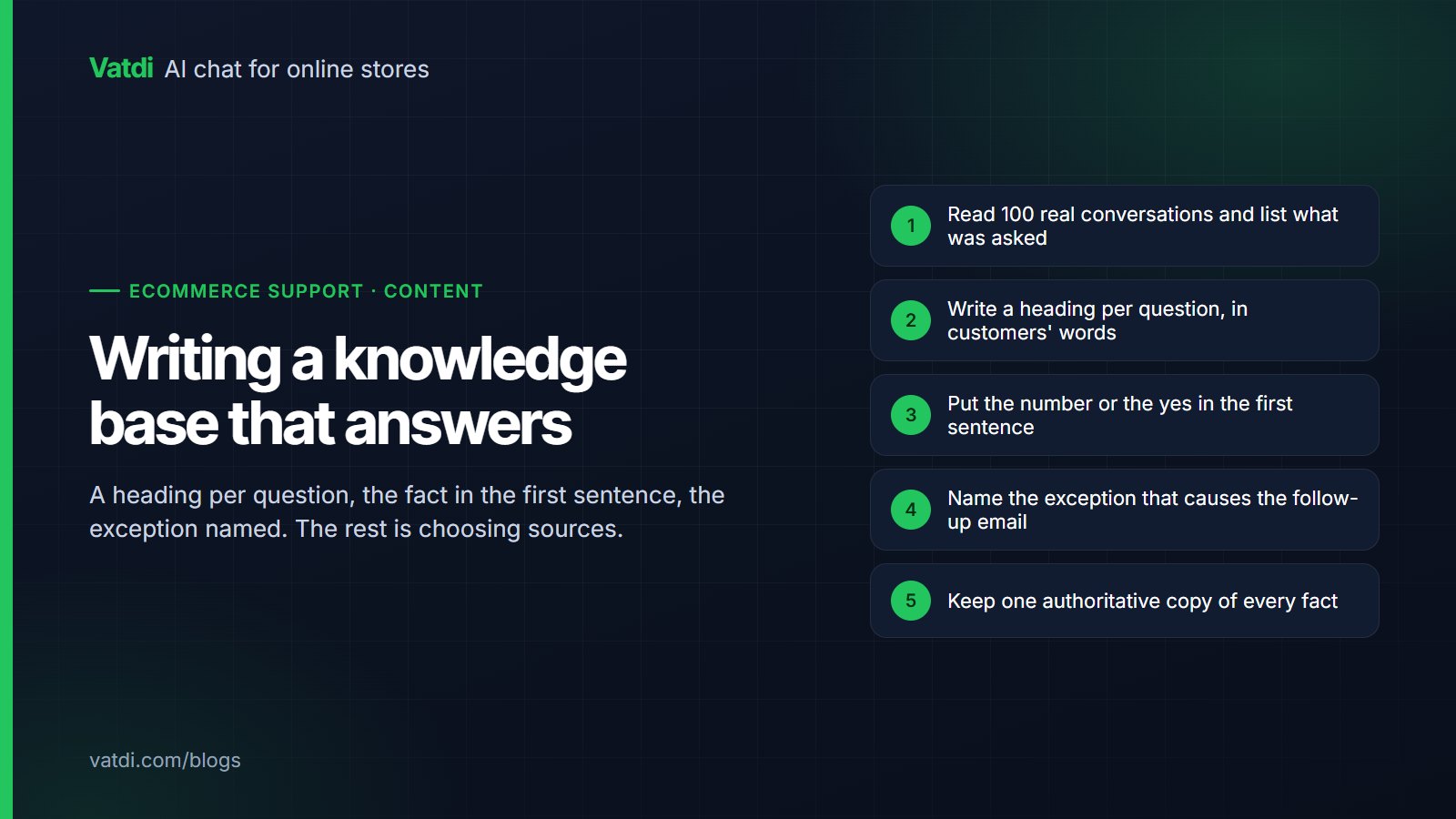
- Write the five pages behind these answers: shipping, returns, sizing, payment and contact, one question per heading.
- Fill attributes on your top fifty products so stock, material and compatibility answers are possible.
- Connect the plugin so order lookup works; the platforms are listed on the integrations page.
- Set handover rules for complaints and for anything the assistant lacks.
- Test the eight above in your own words and read the replies as a customer would.
The full sequence is in the AI chatbot implementation guide, the writing format is in how to write a chatbot knowledge base, and the reason a grounded assistant can produce this range of answers without a script is the retrieval method described in Lewis et al., 2020. For why the delivery and returns answers matter beyond support, Baymard's research on cart abandonment is worth a read. Vatdi's allowances, with every feature on every plan as of September 2026, are on the pricing page.
Frequently asked questions
What are good ecommerce chatbot examples to copy?
The eight everyday conversations: stock and variants, sizing, order status, returns, a question the assistant cannot answer, a complaint, a product recommendation and a light-touch lead capture. Copy the shape of the answers rather than the words, since a grounded assistant writes its own sentences from your pages.
Should I write chatbot scripts?
Not for a retrieval-based assistant. Scripts belong to flow builders, where someone has to draw every path. Write the underlying content well instead, with a heading per question and the specific fact in the first sentence, and the assistant composes the answer for wording you never anticipated.
What should the bot say when it does not know?
That it does not have the answer, followed by a route to a person and your agent hours. Declining honestly protects the sale far better than a confident guess, because a wrong promise about warmth, fit or delivery becomes a return, a refund and a bad review.
How does the assistant know my stock levels?
Through the store plugin, which syncs the catalogue including variants and stock. Without that connection the assistant should point at the product page rather than state availability. Order status works the same way, as a live lookup rather than a stored copy.
Can it reply in other languages?
Yes, in the language the customer wrote in, using your content as the source. The quality depends on what your pages say rather than on a separate translation of the bot, which is why a single well-written policy page serves shoppers in several languages at once.
How long do these examples take to set up?
Installing and connecting is minutes on a supported platform. The content behind these eight answers is an afternoon if your policies exist and need reformatting, longer if the size guide only exists as an image. After launch, the weekly review of unanswered questions keeps the set current.