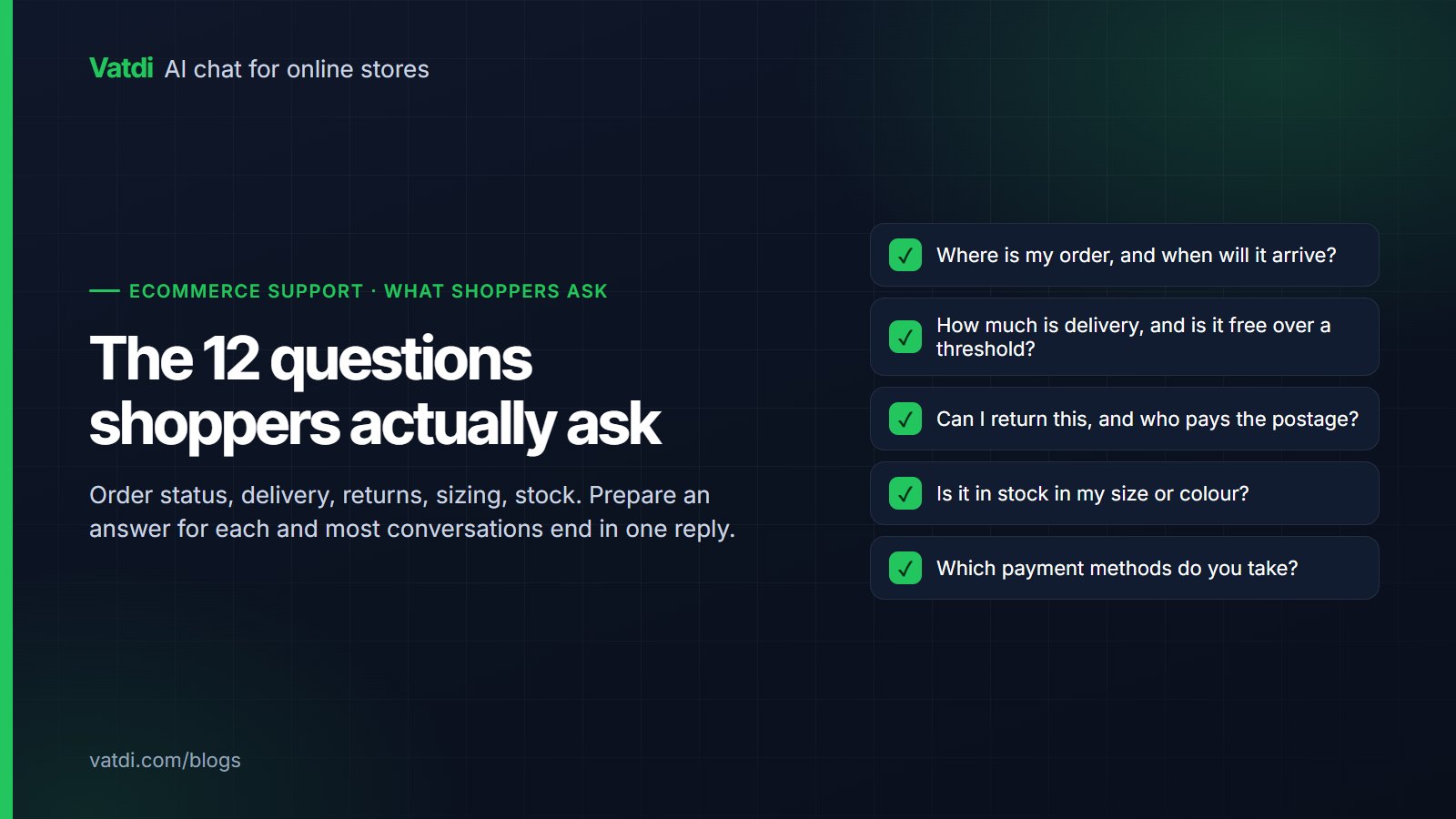
The questions shoppers ask a store chatbot are the same twelve in rotation: order status, shipping time and cost, returns, stock, sizing, product comparison, discount codes, payment methods, delivery to their country, warranty, cancelling or changing an order, and reaching a person. Nine of them can be answered from pages you already have. Order status needs a live lookup, and two of them should end with a person.
Three kinds of answer, three kinds of data
Sort the twelve by where the answer lives. A retrieval-based chatbot (one that reads your own pages and catalogue before it writes; see what a RAG chatbot is) handles the first group as soon as the content exists. The second needs your store's order records. The third needs a person, and the bot's job is to collect the details and hand over.
| Question | Where the answer lives | Who should answer |
|---|---|---|
| Where is my order? | The order record in your store | Bot with live order lookup; otherwise a person |
| Shipping time and cost | Shipping policy page, rate table | Bot |
| Returns and exchanges | Returns policy | Bot |
| Is it in stock? | Catalogue stock field | Bot, when stock is synced |
| Sizing and fit | Size guide, product attributes | Bot |
| Product comparison | Catalogue attributes and descriptions | Bot |
| Discount codes | Coupon rules, promotion page | Bot |
| Payment methods | Payment or checkout FAQ page | Bot |
| Delivery to my country | Shipping zones list | Bot |
| Warranty | Warranty page, product attribute | Bot |
| Cancel or change an order | Order policy plus the order record | Bot explains the rule; a person makes the change |
| Talk to a human | Agent hours, handover rule | Person |
1. Where is my order?
How shoppers phrase it: "Where is my order #10482?" and "I ordered a week ago and nothing has arrived."
Data the bot needs: the order record itself: current status, ship date, carrier and tracking reference if your platform stores one, plus a way to verify the asker. The safe pattern is order number plus the email or phone on the order, and nothing is shown until both match.
Answer pattern: "Order 10482 was shipped on 4 September. Tracking: [reference, where your platform stores one]. The estimated delivery window is 6 to 8 September. If it has not arrived by 10 September, tell me here and I will pass it to the team."
Failure to avoid: answering from the shipping policy as if it were the order. "Orders usually take 3 to 5 days" is not an answer to "where is mine". Without live lookup, the bot should say so, collect the order number and email, and hand over. See how order tracking in chat works.
2. How long does shipping take, and what does it cost?
How shoppers phrase it: "How much is delivery to Manchester?" and "If I order today, when will it arrive?"
Data the bot needs: a rate table by zone and service, the free-shipping threshold, the order cut-off time, and whether delivery days are working or calendar days.
Answer pattern: "Standard delivery within the UK is £3.95, or free on orders over £50, and takes 2 to 4 working days. Orders placed before 14:00 on a working day are dispatched the same day."
Failure to avoid: a shipping page that only says "fast delivery". If the answer depends on the destination, the bot should ask for the country before quoting.
3. How do returns and exchanges work?
How shoppers phrase it: "Can I return this if it doesn't fit?" and "How do I exchange for a different colour?"
Data the bot needs: the return window in days, the condition required, who pays return postage, refund timing, exclusions (underwear, personalised items, sale items) and the steps to start a return.
Answer pattern: "You can return most items within 30 days of delivery if they are unworn with tags attached. Return postage is £2.99, deducted from the refund. Refunds reach your card 5 to 7 working days after we receive the parcel. To start, go to Account, Orders, Return."
Failure to avoid: promising a refund for a specific order. The bot states the policy; whether an unusual case qualifies is a person's call.
4. Is this in stock, and when is it back?
How shoppers phrase it: "Do you have the blue one in medium?" and "When will the X200 be back in stock?"
Data the bot needs: the catalogue's stock quantity per variant, synced often enough to be trusted, and any published restock date. A chatbot that shows product cards with a stock flag answers this directly when the plugin sends stock; see the feature list.
Answer pattern: "The Harbour Jacket in blue is in stock in S, M and L. XL is sold out and we have not published a restock date. Would you like me to show the closest alternatives?"
Failure to avoid: quoting stock from a day-old crawled page. With no live stock, the bot should link to the product page for current availability rather than guess.
5. What size should I get?
How shoppers phrase it: "I'm normally a 10, what size is this?" and "Does this run small?"
Data the bot needs: a size guide with measurements in centimetres and inches, per brand if you sell several, and a fit note on the product itself ("runs half a size small", "relaxed fit, consider sizing down").
Answer pattern: "This style runs small. If you usually wear a 10, we suggest a 12. Chest measurement for a 12 is 96 to 100 cm. You can return it within 30 days if it does not fit."
Failure to avoid: a confident recommendation with no measurements behind it, or a generic chart when the product has its own fit note. With no size data for the item, say so and link the guide that exists.
6. What is the difference between these two?
How shoppers phrase it: "What's the difference between the Pro and the Lite?" and "Is the more expensive one worth it?"
Data the bot needs: structured catalogue attributes (capacity, material, dimensions, weight, warranty) and a description that says what each model is for. Comparison fails when the differences only exist in a marketing image.
Answer pattern: "The Pro has a 2 litre tank and a 24-month warranty; the Lite has 1.2 litres and 12 months. The Pro costs £40 more. If you make more than four cups a day, the Pro is the better fit; otherwise the Lite does the same job."
Failure to avoid: comparing against a product you no longer sell or a competitor's model. The bot compares only your own catalogue and says plainly when a spec is not listed.
7. Do you have a discount code?
How shoppers phrase it: "Any discount codes?" and "My code WELCOME10 isn't working."
Data the bot needs: the coupons it is allowed to offer, each with its conditions: minimum spend, excluded categories, one use per customer, expiry date.
Answer pattern: "WELCOME10 gives 10% off a first order over £30 and does not apply to sale items. If your basket includes a sale item, that is why it is being rejected. Remove it or use the code on a future order."
Failure to avoid: inventing a code, or offering one to every visitor who asks. Give the bot a short, real list with conditions. A bot with no coupon data should say "I don't have a code to offer" rather than hint that one exists.
8. Which payment methods do you accept?
How shoppers phrase it: "Can I pay with PayPal?" and "Do you do pay in three?"
Data the bot needs: a single page listing accepted methods (cards, PayPal, Apple Pay, bank transfer, instalment providers), the currencies you charge in, and any country restrictions on a method.
Answer pattern: "We accept Visa, Mastercard, American Express, PayPal and Apple Pay. Instalments through Klarna are available on orders between £35 and £1,000 for UK addresses. All prices are charged in GBP."
Failure to avoid: leaving this to the checkout. A missing answer reads as "probably not".
9. Do you deliver to my country?
How shoppers phrase it: "Do you ship to Ireland?" and "Can I order from Canada and what about customs?"
Data the bot needs: the countries you ship to, written out by name rather than "EU" or "worldwide", the service and price per zone, and a plain sentence on duties: included, collected at the door, or not applicable.
Answer pattern: "Yes, we ship to Ireland. Tracked delivery is €9.95 and takes 4 to 6 working days. Import duties are not included and may be collected by the carrier on delivery."
Failure to avoid: "we ship worldwide" when you do not, and silence on duties.
10. What does the warranty cover?
How shoppers phrase it: "How long is the guarantee?" and "It broke after 4 months, is that covered?"
Data the bot needs: duration per product or category, what is covered and excluded, how to claim, who pays claim shipping, and the proof required.
Answer pattern: "The blender has a 24-month warranty covering manufacturing defects. Accidental damage and blade wear are not covered. To claim, reply with your order number and a photo of the fault and a team member will arrange collection."
Failure to avoid: ruling on a specific claim. The bot states the terms and collects the evidence; a person decides. Keep your own warranty separate from statutory consumer rights, which differ by country and should not be improvised.
11. Can I cancel or change my order?
How shoppers phrase it: "I need to change the delivery address on order 10482." and "Cancel my order please, I ordered the wrong size."
Data the bot needs: the rule (for example, changes are possible until the order is picked, usually within 2 hours) and the order record to see whether that window is still open. The change itself is an action in your store admin, so this ends with a person.
Answer pattern: "Address changes are possible until the order is packed, usually within 2 hours of ordering. Order 10482 is still processing, so a change is likely possible. I have passed the new address to the team and someone will confirm by email within the hour."
Failure to avoid: saying "done" when nothing has been done. The bot confirms what it passed on and gives a realistic time for confirmation.
12. Can I talk to a real person?
How shoppers phrase it: "Can I speak to a human?" and "This isn't helping, is there someone I can talk to?"
Data the bot needs: your agent hours, who gets alerted, and a rule for when to offer a person unprompted (a complaint, a refund dispute, a question it has failed twice). Outside hours it needs a truthful message and a way to capture contact details.
Answer pattern: during hours: "Of course. I am connecting you with the team now; the chat stays open here." Outside hours: "The team is available Monday to Friday, 9:00 to 17:30. Leave your email and someone will reply on the next working day."
Failure to avoid: the loop of "I did not understand, could you rephrase?" A shopper who has asked for a person twice should get one, or a clear statement of when one is available. See how chatbot human handover works.
Where to start
Tag your last 100 support conversations against this list. A handful of questions usually dominate the volume; write those pages first, as short self-contained paragraphs with the numbers spelled out, then test the bot with the exact phrases customers used. The guide on how to train a chatbot on your own data covers the formats that load cleanly: crawled pages, pasted URLs, PDF and CSV uploads, and FAQ imports.
Two rules keep the bot honest across all twelve: quote your content rather than summarising a policy from memory, and when the answer is not in your content or needs an action in your store, say so and hand over.
Preparing the twelve in one afternoon
- Connect the store so the catalogue, variants and stock sync, and switch on order lookup where the platform supports it.
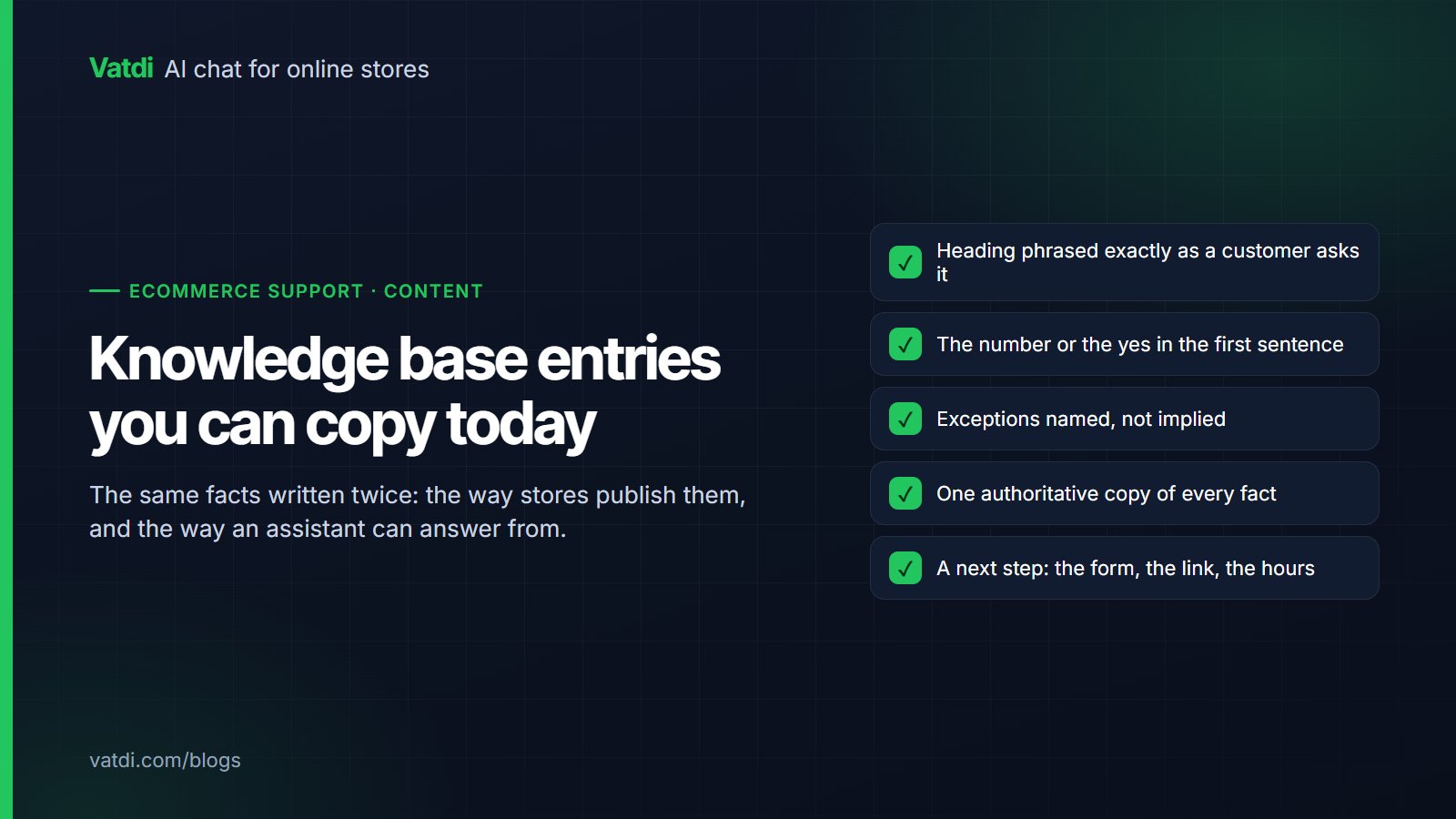
- Rewrite five pages as questions: shipping, returns, sizing, payment and contact, with the number in the first sentence.
- Fill the attributes customers ask about on your best-selling products.
- Set the handover rules for complaints, damage and anything the assistant cannot answer.
- Ask all twelve yourself in a customer's wording, and fix whatever comes back vague.
Where the preparation pays off
- Before the sale: delivery, stock, sizing and returns answers remove the hesitations that end a visit, which Baymard documents in its research on cart abandonment.
- After the sale: order status and returns answers remove the largest category of routine contact.
- For the team: the questions that remain are the ones that genuinely need judgement.
- For search: the same clear pages serve visitors who never open the chat window, which is the argument behind Google's guidance on helpful content.
The mechanism underneath is retrieval: the assistant searches your content for each question and writes from what it finds, the approach described in Lewis et al., 2020. That is why the preparation is content work rather than configuration.
Frequently asked questions
Which of these questions can an AI chatbot answer without any integration?
Shipping, returns, sizing, product comparison, payment methods, delivery countries and warranty terms can all be answered from your own pages. Stock needs a synced catalogue. Order status needs live order data from your store, and cancellations or address changes need a person to act.
What data does a chatbot need to answer "where is my order"?
Read access to the order record (status, ship date, tracking reference if stored) and a way to verify the customer, usually the order number plus the email or phone on the order. Without both, the bot should show no order details.
How should a chatbot handle a discount code request?
Give it a short list of real coupons with their conditions (minimum spend, exclusions, expiry) and let it offer one only when the conversation fits. It should never invent a code. When a code is failing, the most useful answer names the condition that is probably being broken.
When should the chatbot hand a shopper to a human?
When the shopper asks for one, when the request needs an action in your store (cancel, change address, approve a refund), when it is a complaint or dispute, or when the bot has failed the same question twice. Outside agent hours it should say when a person is available and collect contact details.
Can a chatbot answer "is this in stock" accurately?
Only when it reads stock from a synced catalogue rather than a crawled page. With a native plugin the stock field updates with the store, so the bot can show it on the product card where you enable that. Without a sync, the safest answer links to the product page for current availability instead of quoting a number that may be a day old.
Should a chatbot answer sizing questions?
Yes, if the size guide and any per-product fit notes are in its content, with measurements in centimetres and inches. It should quote those measurements rather than guess, and when a product has no size data it should say so and link the guide that exists. Keep the returns rule in the same answer so the shopper can decide with the risk in view.