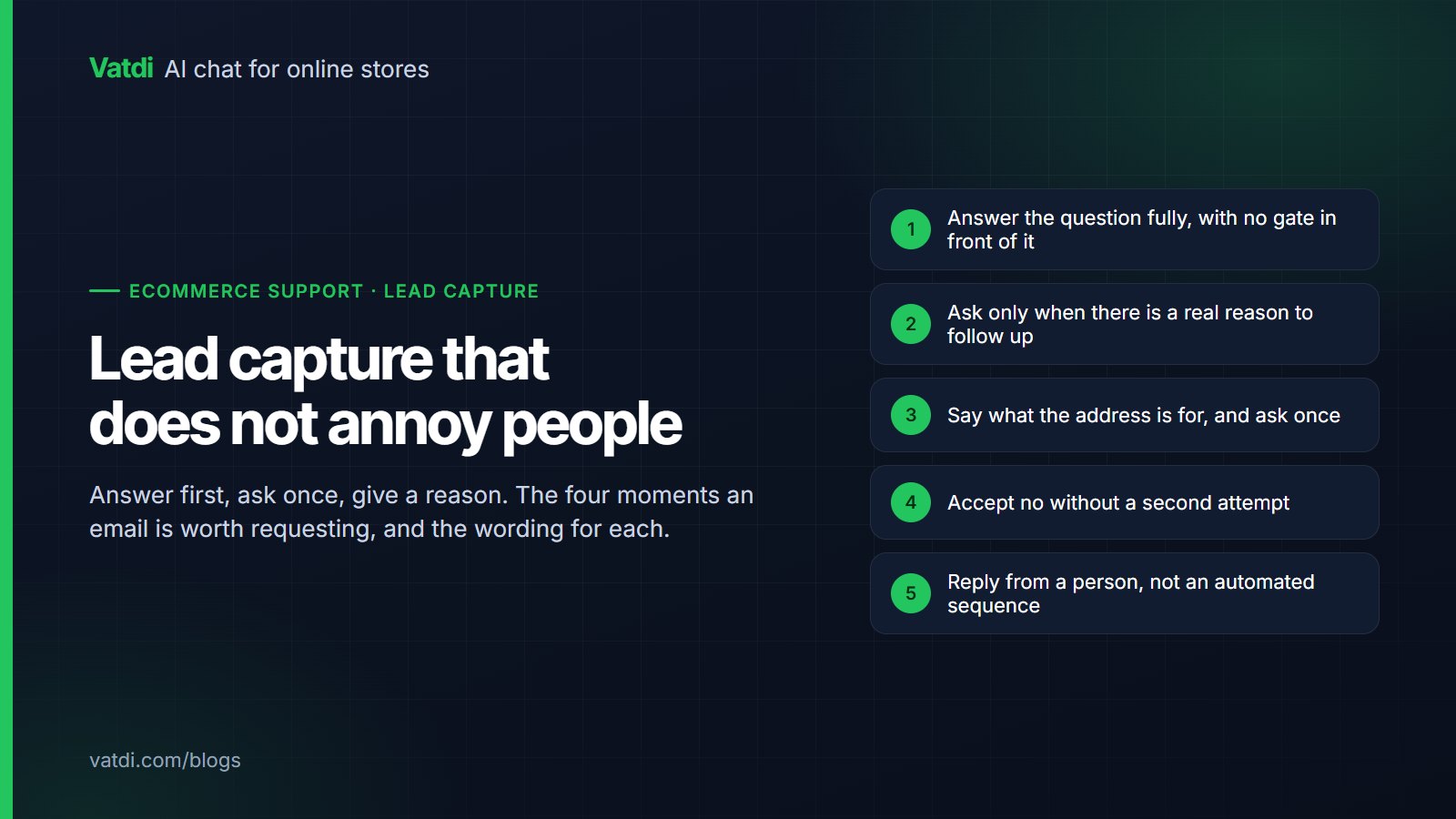
Chatbot lead capture goes wrong in one specific way: asking for an email before answering the question. The shopper came for a fact, hit a form, and left. Reverse the order and the same person gives you an address willingly, because by then you have been useful. The rule is simple and almost universally broken: answer first, ask once, and only when there is a reason.
The four moments worth asking
| Moment | Why the ask makes sense | What to say |
|---|---|---|
| Out of hours handover | Nobody can reply now, so an address is the only route | "The team is offline until 9am. Leave an email and they'll reply first thing with all of this attached." |
| Out of stock item | The shopper wants something you cannot sell today | "I can pass your email to the team so they can tell you when it's back. No promises on a date." |
| A question you cannot answer | Someone needs to look into it | "I don't have that. If you leave an address, the team will come back to you with a proper answer." |
| A quote or bulk enquiry | The conversation is genuinely a sales lead | "For twenty units or more we quote individually. What's the best email for the team to send it to?" |
Outside those four, do not ask. A shopper who got their answer and left happy is a better outcome than a captured address and a bad memory.
What makes the ask work
- The answer comes first, complete, with no gate. Anything else reads as a toll booth.
- A reason attached. "So the team can reply" is a reason. "To better serve you" is not.
- One attempt. If the shopper ignores it or says no, continue helping and never raise it again in that conversation.
- Nothing else requested. Name, phone number and company turn a reply into a form. The email is enough.
- A privacy link visible, so it is clear what happens to the address.
- A real reply afterwards. An address collected in a support conversation and fed to a promotional sequence is the fastest route to an unsubscribe and a complaint.
The patterns that cost you both
- Email gates before the conversation. The most common and the most costly; it converts curiosity into a bounce.
- Asking twice. A second request after a no reads as pressure and ends the conversation.
- Bundling a newsletter signup into a support answer. If you want subscribers, ask for subscribers, clearly and separately.
- Auto-opening the widget with a form. An interruption that also demands data is the worst combination on a product page.
- Collecting an address and never replying. This converts a warm lead into someone who tells other people about it.
Two conversations, word for word
The out-of-hours case is the one worth getting right, because it is the most common. A shopper asks at 23:40 whether a jacket runs small. The assistant answers from the size guide, then adds: "If you want the team to check anything else before you order, leave an email and they'll reply from 9am." That is an offer, not a gate, and the shopper can ignore it and still have their answer. Compare it with the version that opens "Before I can help, what's your email address?", which produces no answer, no address and one fewer visitor.
The out-of-stock case is similar but needs one extra piece of honesty. "That size sold out last week. I don't have a restock date, and I would rather not guess. If you leave an email I'll pass it to the team so they can tell you when it lands." The admission that no date exists is what makes the offer credible; a confident "back in two weeks" that turns out to be wrong loses the customer twice.
What to do with the address
Treat it as a support commitment first and a marketing asset second, if at all. The person who left it expects a reply about their specific question, so the reply should come from a person and reference the conversation. Adding them to a promotional list requires consent appropriate to your market, and the GDPR overview is a reasonable orientation for European customers; your own privacy policy and legal advice govern. Keep the widget's privacy link visible, store only what you need, and delete what you no longer use.
Where it fits with everything else
Lead capture is a small feature sitting on top of a much larger one. If the assistant answers the delivery, stock and returns questions well, most conversations never need an address at all, and the ones that do feel natural. If it answers badly, no amount of clever wording will make a form welcome. That is why the work order matters: content first, handover rules second, lead capture last. The content format is in how to write a chatbot knowledge base, the escalation rules are in chatbot human handover, and the shape of a good store conversation is shown in ecommerce chatbot examples. Baymard's research on cart abandonment underlines what the gate-first pattern throws away: the shopper was mid-decision, and an obstacle at that moment ends the visit.
How to tell whether it is working
Two checks, once a month, and neither needs a report. First, count how many addresses you collected and how many of those received a reply from a person. If the second number is smaller, fix that before changing any wording, because an unanswered address is worse than none. Second, read five conversations where the assistant asked and the shopper declined. If the ask looks reasonable in context, leave it alone; if it looks like it interrupted a finished conversation, tighten the rule that triggered it. What you are optimising is not the count of addresses but the share of them that turn into a genuine exchange, which is the only version of this that helps the business twice.
Setting it up
In Vatdi, the out-of-hours behaviour, the handover rules and the widget wording are settings on every plan, and the conversations with addresses appear in the same dashboard as everything else; the allowances are on the pricing page. Set agent hours honestly, write the four wordings above in your own voice, and test them by asking a question at a time when nobody is online. The full setup order is in the AI chatbot implementation guide.
Frequently asked questions
Should a chatbot ask for an email address?
Only when there is a real reason: nobody is available to reply, the item is out of stock, the question needs a person, or the enquiry is genuinely a sales lead. Asking in any other situation trades a completed answer for an abandoned conversation, which costs more than the address is worth.
Where should the email request go in the conversation?
After the answer, never before it. A gate in front of a simple question converts an interested visitor into a bounce. Once the shopper has something useful, an ask with a stated reason is accepted far more often, and refusing it costs nothing because they already have what they came for.
How many times should it ask?
Once. If the shopper ignores the request or declines, carry on helping and do not raise it again. A second ask reads as pressure and is the point at which people close the window, taking both the lead and the potential sale with them.
Can I add these addresses to my newsletter?
That depends on the consent rules in your market and what you told the person when you asked. A support address given to get a reply is not automatically a marketing opt-in. If you want subscribers, ask for subscription explicitly and separately, and keep your privacy policy linked from the widget.
Does lead capture hurt the support experience?
Done badly, yes, and visibly. Done in the four moments listed above, it improves it, because each one is a case where the alternative is the shopper leaving with nothing. The test is whether the ask makes sense from the customer's side of the screen.
What about phone numbers and names?
Leave them out. Every extra field lowers the number of people who finish, and the email is enough to continue a conversation. If a bulk enquiry genuinely needs a phone call, ask for the number in that specific conversation rather than as a standing requirement.