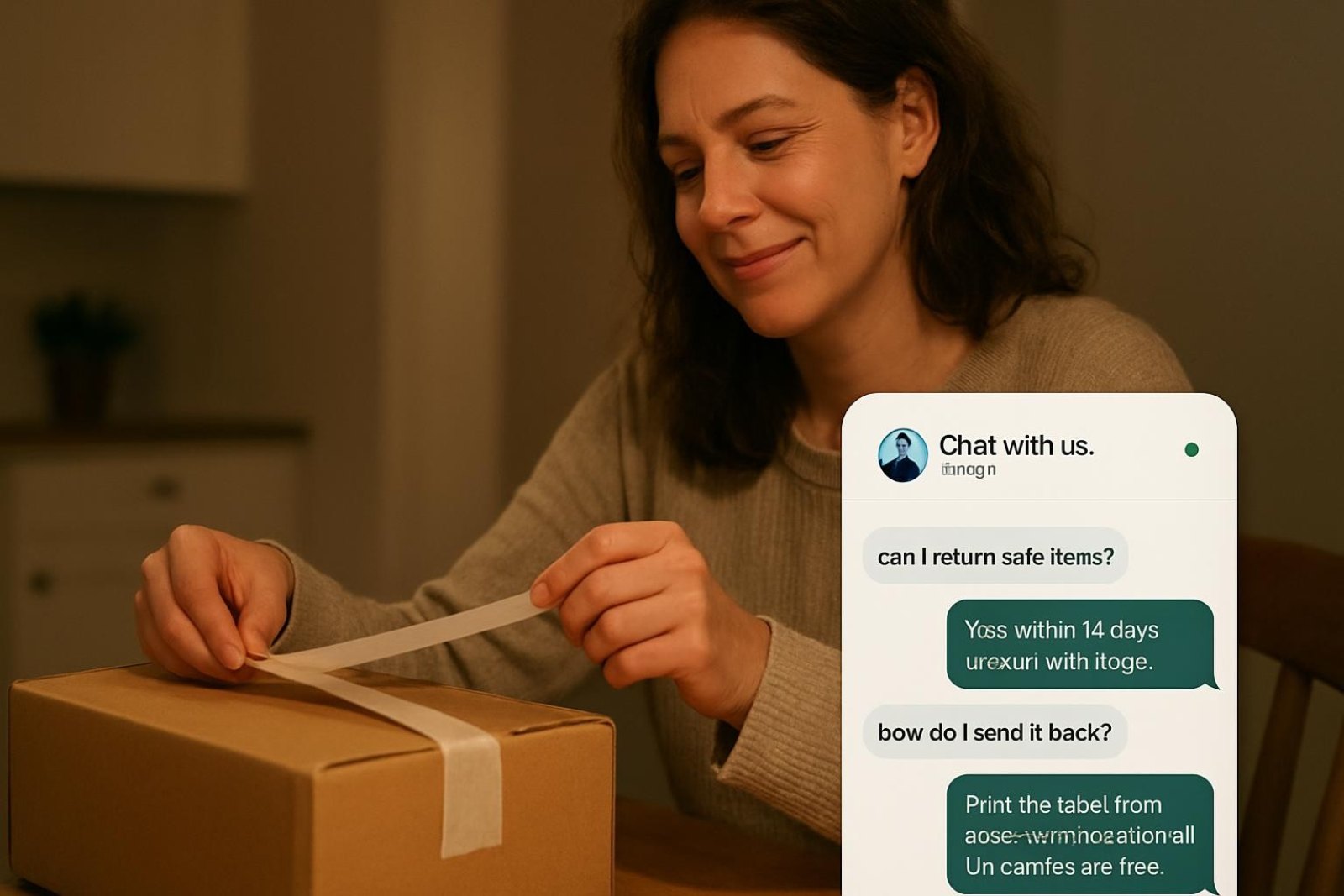
A chatbot for returns and refunds should settle five facts without involving anyone: the window, the conditions, who pays for postage, the steps, and when the money arrives. Those five cover the large majority of returns questions. Anything that requires a judgement, an exception or a dispute belongs with a person, because those are decisions about your business rather than lookups in your policy.
The five facts every returns answer needs
| Fact | What customers ask | What your page must state |
|---|---|---|
| The window | "How long do I have?" | The number of days and what it counts from: delivery, dispatch or purchase |
| The conditions | "Does it have to be unworn?" | Condition, packaging, tags, and every exclusion by name |
| Who pays | "Is return postage free?" | Free label, deducted cost, or the customer pays, per destination |
| The steps | "How do I actually do it?" | Where the form is, what to print, where to drop it |
| The money | "When will I get my refund?" | Days after you receive the item, and to which payment method |
Most returns pages state two or three of these and bury the rest. Every missing one becomes an email, and the exclusions are the item most often hidden, which is why they cause the angriest follow-ups.
Writing the policy so it can be answered from
- A heading per question, phrased as a customer would ask it: "Can I return sale items?" rather than "Exclusions".
- The answer in the first sentence, with the number. "You have 30 days from delivery" beats "We are happy to accept returns within a reasonable period".
- Exclusions named individually. Pierced jewellery, underwear, personalised items, final-sale lines: each as its own line.
- Destinations separated. Domestic, EU and rest of world have different costs and often different windows.
- One copy of the truth. If the returns window appears in the FAQ, the footer and the terms, three copies will eventually disagree and the assistant will quote whichever it finds.
The general format is in how to write a chatbot knowledge base. Returns is the page where it pays off fastest, because the questions are so repetitive.
Where the line sits
Two rules keep this line clean. First, a policy question containing the word refund is still a policy question: "how long do refunds take?" should be answered, not escalated. Second, anything about a specific refund that has not arrived is a person's job, because it requires checking a payment record and possibly chasing a provider. The escalation mechanics are covered in chatbot human handover.
Returns questions asked before buying
A large share of returns questions arrive from people who have not ordered yet, and they deserve a different emphasis. The shopper is checking whether the risk of buying is acceptable, so the useful answer leads with the reassurance and keeps the conditions short: the window, whether postage is free, and how quickly the money comes back. Save the exclusion list for items it applies to, mentioned when the shopper is asking about one of them. An answer that opens with three caveats reads as a warning, which is the opposite of what a hesitant shopper needs, while an answer that hides a genuine exclusion produces a return you then have to refuse.
Refund status questions
"Where is my refund?" is the hardest of these, because the honest answer depends on data the assistant may not have. What it can do reliably: confirm the return was received if that state is in the order data, restate the expected timing from your policy, and explain that card refunds appear on the statement rather than as a new transaction, which is a genuine source of confusion. What it should not do: assert that the money was sent, or predict a date. If the timing has passed, hand over with the order reference attached, and let the person look at the payment record.
Awkward cases and the wording that works
- Outside the window: "Our policy is 30 days from delivery, and this order was delivered in June. I can pass this to the team, who decide these case by case."
- Faulty goods: "That is not a normal return, it is a fault, and the team handles those directly. I have their details ready, or I can pass this on now with your order number."
- Excluded item: "Earrings cannot be returned for hygiene reasons once the seal is opened, which is why they are listed as final sale. If the item arrived damaged, that is different and the team can help."
- Refund smaller than expected: "Return postage of £3.95 is deducted for non-UK returns, which may explain the difference. If the figures still do not match, I will pass this to the team to check."
- Change of mind mid-delivery: "It is already with the courier, so it cannot be stopped. You can refuse delivery or return it once it arrives, and the 30-day window starts from delivery either way."
In each case the pattern is the same: state the policy plainly, avoid sounding like a rulebook, and offer the person when a decision is required.
Why this is worth doing carefully
Returns questions arrive before the purchase as often as after it. A shopper deciding between two stores frequently asks about returns first, so the clarity of that answer affects the sale, not just the support load. Baymard's research on cart abandonment documents unclear returns and delivery terms among the reasons people leave a checkout. In our own conversation data across real stores, returns and shipping sit among the largest topic buckets; the figures and method are in our ecommerce chatbot statistics. Consumer law in your market may also set minimum rights, and for European customers the EU guidance on guarantees and returns is a reasonable orientation; your published policy and your legal advice govern, not a chatbot's phrasing.
Setting it up
Rewrite the returns page as questions, list the exclusions individually, connect the store plugin so order state is available, and set a handover rule for faults, disputes and anything outside the window. Then test the five facts and the five awkward cases above, scoring each as correct, incomplete, wrong or declined well, using the method in how to test AI chatbot accuracy. Vatdi includes handover, order lookup and the dashboard on every plan; the allowances are on the pricing page, and the wider setup order is in the AI chatbot implementation guide.
Frequently asked questions
Can a chatbot handle returns?
It can settle the policy side: the window, the conditions, who pays for postage, the steps and how long a refund takes. It should not decide exceptions, judge whether an item is faulty or confirm that a specific refund was sent. Those need a person with access to the payment record and the authority to make a call.
Should the bot answer refund status questions?
Only as far as your data supports. Confirming that a return was received and restating the expected timing is fine; asserting that money has been sent is not. When the stated timing has passed, hand over with the order reference so a person can check the payment record rather than guess.
What do most returns pages leave out?
The exclusions and the destination differences. Stores usually state the window and the condition, then bury which items cannot be returned and what happens for international orders. Those two omissions produce the majority of angry follow-ups, so name every excluded category on its own line.
Can it tell customers about their statutory rights?
It should state your published policy and, where relevant, point to the official guidance rather than interpret the law. Consumer rights vary by market and your obligations may exceed your policy, which is a matter for your legal advice. An assistant that improvises legal advice creates risk that a clear policy page avoids.
Does answering returns questions reduce sales?
The evidence points the other way: unclear returns terms are among the reasons shoppers abandon a checkout. A quick, specific answer before the purchase removes a reason to hesitate, and a quick answer afterwards reduces the email that would have followed anyway.
How do I stop contradictory answers?
Keep one copy of each fact. If the window appears on the returns page, in the FAQ and in the terms, they will eventually diverge and the assistant will quote whichever it finds first. Put the detail in one place, link to it from the others, and update that one page when the policy changes.