These chatbot knowledge base examples show the same information written twice: the way most stores publish it, and the way an assistant can answer from. The difference is rarely length. It is a heading phrased as the question, the number in the first sentence, and the exception named rather than implied. Rewriting six pages this way takes an afternoon and changes the answers the same day.
Why the wording matters
A grounded assistant searches your content and composes a reply from what it finds, the approach described in Lewis et al., 2020. It cannot state what your pages do not say, and it struggles when the relevant fact is buried under a heading that does not match the question. Writing for the assistant is therefore writing for the customer: the same edits make your help pages better for people, and for search, which Google describes in its helpful content guidance.
Six entries, before and after
| Topic | How stores usually write it | How to write it instead |
|---|---|---|
| Shipping | "We aim to dispatch orders promptly using a range of trusted carriers." | "How long does UK delivery take? Standard is 2–3 working days from dispatch, £3.95, free over £50. Orders placed before 3pm UK time go out the same working day." |
| Returns | "Returns are accepted in line with our terms and conditions." | "How long do I have to return something? 30 days from delivery, unworn and in original packaging. Sale items and pierced jewellery are excluded." |
| Sizing | "Please consult the size chart." (chart is an image) | "What size am I? Medium fits a 38–40 inch chest with a 27 inch back length. If you are between sizes, size up: this style is a slim fit." |
| Payment | "We accept all major payment methods." | "Which payment methods do you take? Visa, Mastercard, Amex, PayPal and Apple Pay. We do not accept cheques or bank transfer for orders under £500." |
| Stock | "Items are subject to availability." | "When will sold-out sizes come back? Core colours are usually restocked within four weeks. Seasonal lines are not restocked once sold out." |
| Contact | "Get in touch and we'll be happy to help." | "When can I speak to someone? The team replies Monday to Friday, 9am–6pm UK time, at help@example.com. Outside those hours, leave a message here and they reply first thing." |
The pattern behind all six
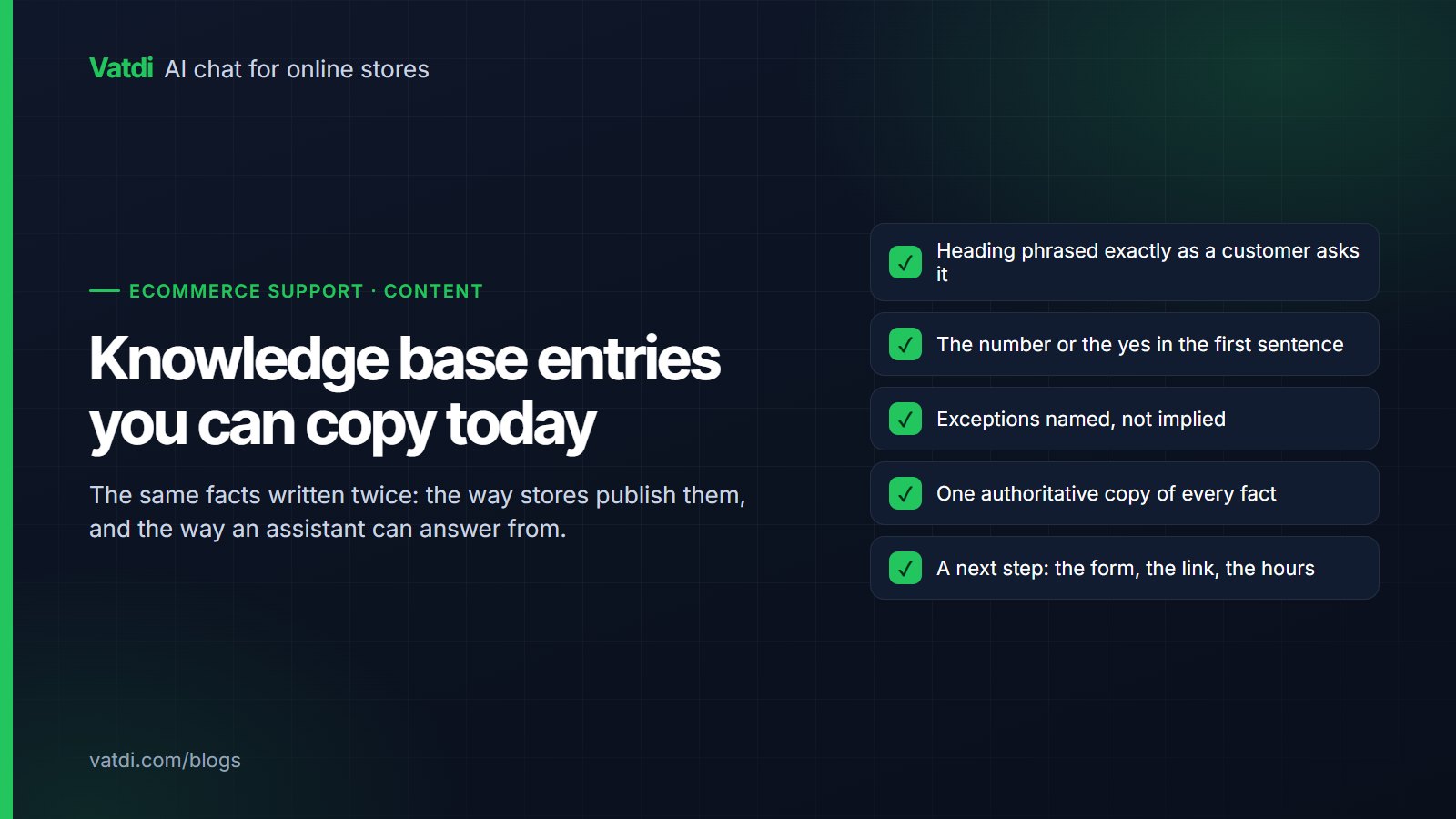
- Heading as the question, in the words a customer uses. "Can I return sale items?" not "Exclusions".
- Answer first, with the number, date or yes. No preamble about valuing your custom.
- Exception named, because the exception is what generates the complaint.
- Next step, so the answer ends somewhere useful.
- One copy of each fact, so the FAQ, the footer and the terms cannot disagree.
Entries worth adding that most stores lack
- The daily dispatch cut-off, with a time zone.
- Which countries you do not ship to, stated explicitly so the assistant can say no.
- Who pays customs duties on international orders.
- What happens if a parcel is marked delivered but missing.
- Whether online orders can be returned in a physical shop, if you have one.
- How long a refund takes to appear, and that card refunds show as a credit rather than a new transaction.
Each of these is a question your inbox already receives. Writing the entry is faster than answering it twice more.
A product entry, before and after
Policy pages get the attention, but product descriptions are usually the weaker half. The typical entry reads "A beautifully crafted jacket, designed with the modern commuter in mind, combining style and practicality for everyday wear." Nothing in that sentence answers a question. The version an assistant can work with keeps the sentence and adds the facts underneath it: fully waterproof with taped seams rather than showerproof, 420 grams, fits true to size with a slim cut, packs into its own pocket, machine washable at 30 degrees, available in four colours up to XXL. Those six facts answer perhaps a dozen different questions, including the comparison ones where a shopper is deciding between this jacket and another. Do it for your fifty best sellers and leave the rest until the unanswered-question list tells you which one to write next.
Where the entries live
Three places, all of which the assistant can read: your published pages, uploaded documents, and knowledge-base entries in the dashboard. Prefer published pages for anything customers should also be able to find on their own, which is most of it. Use documents for material that genuinely belongs in a file, such as a manual or a spec sheet. Use dashboard entries for the questions that have no natural page, such as the cut-off time or a seasonal note. Vatdi counts pages, documents and entries together as knowledge items, with the allowance shown on the pricing page, and how vendors meter this content is explained in chatbot training data pricing.
What to leave out
Do not crawl the whole site. Old promotions, tag pages and thin blog archives compete with the returns page for relevance and add nothing, which is the most common reason a well-configured assistant gives vague answers. Leave out duplicated price lists, since prices belong in the catalogue where they stay current. And leave out internal policy documents that were never written for customers; they contain caveats that read badly when quoted back. The broader method is in how to write a chatbot knowledge base, and the effect of these edits shows up immediately when you re-run the question set from how to test AI chatbot accuracy.
An afternoon's plan
Take the six topics in the table, rewrite each page with a heading per question and the fact first, add the six missing entries above, and delete nothing else. Then ask the assistant the ten questions your inbox receives most, using customers' wording, and note which answers changed. The whole exercise is content work you own, not configuration, which is why it survives any change of vendor. The sequence around it is in the AI chatbot implementation guide, and the conversations it produces are shown in ecommerce chatbot examples.
Frequently asked questions
What should a chatbot knowledge base contain?
The questions your inbox actually receives, each as its own entry with the answer in the first sentence: shipping costs and times, the dispatch cut-off, returns window and exclusions, sizing with real measurements, payment methods, stock and restocking, and how to reach a person. Everything else is optional until a customer asks for it.
How long should each entry be?
Short enough that the answer is the first sentence and long enough to name the exception. Two to five sentences is typical. Length is not the problem with most store policies; ordering is, because the fact customers want sits three paragraphs below a heading that does not match their question.
Should I upload my whole website?
No. Crawling everything adds old promotions and tag pages that compete with your policy pages and make answers vaguer. Choose the pages that answer questions, add documents that genuinely belong in a file, and leave the rest out. Fewer, better sources produce better answers.
Can I use my existing FAQ page?
Usually with edits. Most FAQ pages group several questions under one heading and answer them in a paragraph, which makes retrieval imprecise. Split it so each heading is one question, put the specific in the opening sentence, and the same content starts producing much sharper answers.
How often should the knowledge base be updated?
Whenever a policy changes, and weekly in response to the list of questions the assistant could not answer. That list is the shortest route to a better knowledge base, because it names exactly what customers asked and you had not written down.
Do product descriptions count as knowledge?
Yes, and they are often the weakest part. Attributes such as material, size range and compatibility are what let an assistant answer "is it waterproof?" or "will it fit a 42?". Filling those fields on your best-selling products does more for answer quality than any amount of policy rewriting.