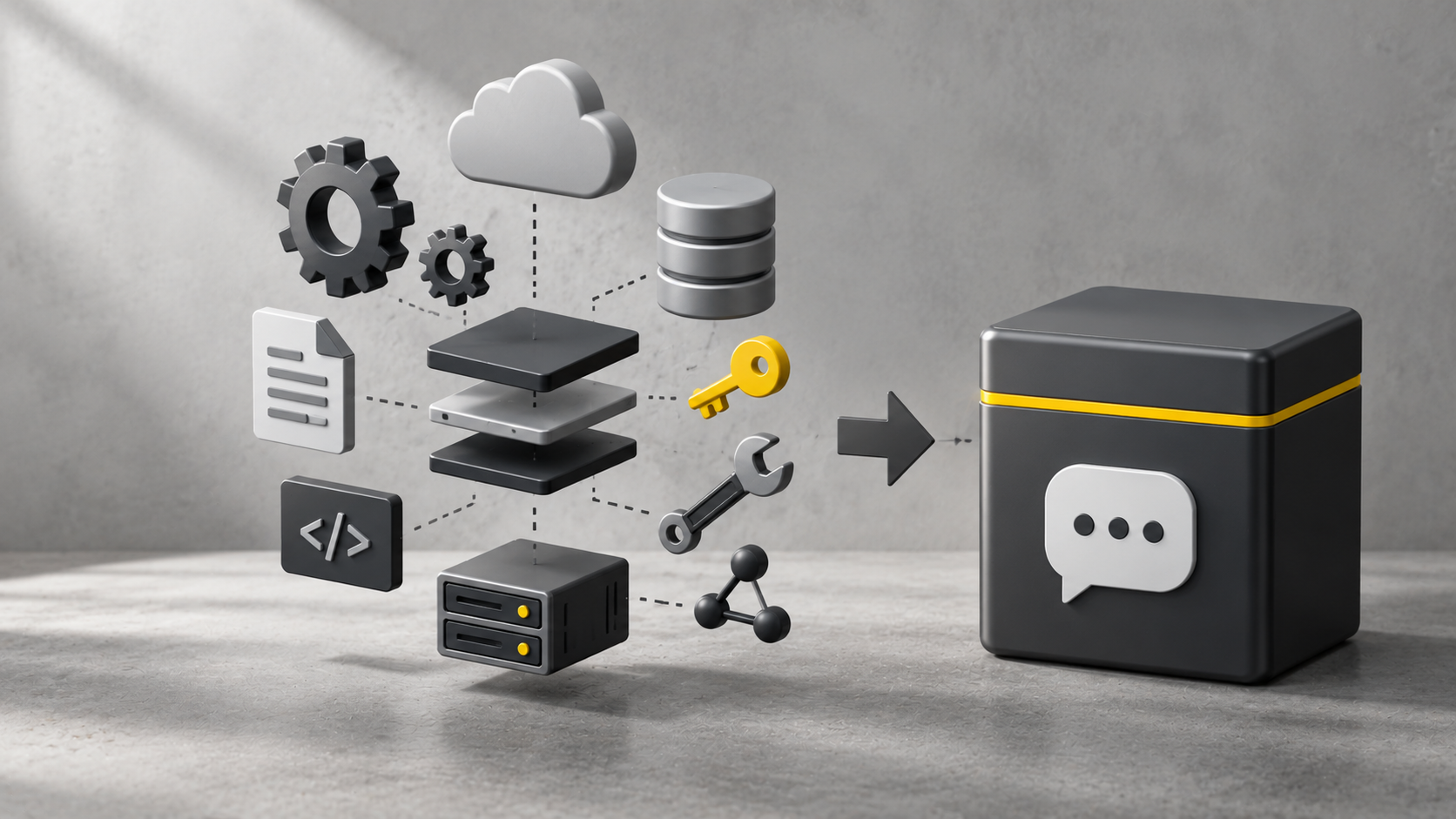
Build vs buy an AI chatbot looks like an easy decision after a first prototype, because calling a model with a prompt takes an afternoon and the result is impressive. The parts that follow are the product: ingestion, retrieval, a widget, handover, a dashboard, and the maintenance that never stops. This guide lists them honestly and names the cases where building is genuinely right.
What a build actually contains
| Part | What it involves | Ongoing cost |
|---|---|---|
| Ingestion | Fetching pages, products, documents; handling formats | Breaks when a site or feed changes |
| Chunking | Splitting content so retrieval finds the right passage | Tuning, per content type |
| Embeddings and storage | Generating vectors, running a store, re-indexing | Hosting, plus re-embedding on change |
| Retrieval quality | Ranking, filtering, handling short and ambiguous queries | Where most of the real work lives |
| Answer composition | Prompting, refusal behaviour, citation of sources | Regression testing after every change |
| Widget | Loading, mobile layout, accessibility, themes | Browser and platform changes |
| Handover | Routing to a person with the transcript and context | Realtime plumbing, presence, agent hours |
| Dashboard | Conversations, ratings, unanswered questions | The thing that makes improvement possible |
| Order lookup | A connector per platform, with verification | Per platform, per version |
| Safety | Preventing fabrication, data leaks, prompt abuse | Continuous |
| Cost control | Rate limits, caching, model spend monitoring | Bills scale with success |
| On-call | Someone responsible when it stops answering | Forever |
The retrieval row is the one most teams underestimate. Getting a plausible answer is easy; getting the right passage for a short, badly typed question is the engineering, and it is the subject of the method described in Lewis et al., 2020.
Why the prototype is misleading
When building is the right answer
- The assistant is your product, or a differentiating part of it, rather than support infrastructure.
- Your data cannot leave your environment for regulatory reasons that a vendor cannot satisfy.
- The workflow is genuinely unusual, so no product models it and adapting one would cost more than building.
- You already run this kind of system and the marginal cost of one more is small.
- You have a team that will still be here in two years to maintain it.
That last condition disqualifies more builds than the others combined. A system built by one enthusiastic developer who then changes role becomes a liability the day something breaks, and it breaks when a supplier changes a feed or a browser changes a behaviour.
When buying is obviously right
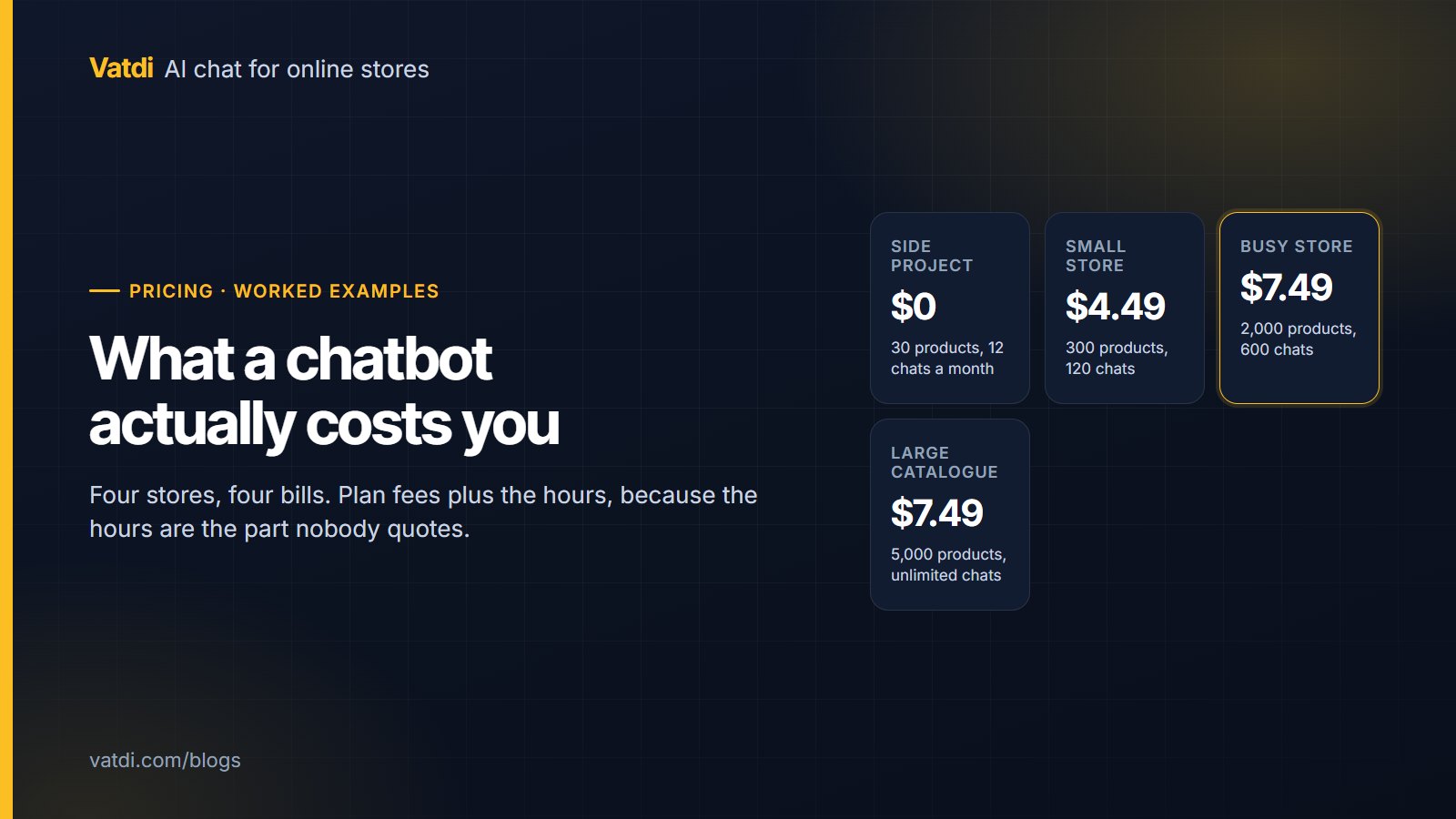
For a store whose questions are delivery, returns, sizing, stock and order status, buying is not a compromise. Those questions are identical across thousands of stores, which is precisely the situation products are good at. The differentiator is your content rather than your software, and content is the part you keep whichever route you take. A flat plan at a few dollars a month, as of September 2026 Vatdi is free for 15 conversations, $4.49 for 150 and $7.49 for unlimited, costs less than a single afternoon of developer time; see pricing. The worked cost examples are in four worked chatbot cost examples.
The failure mode nobody plans for
Built assistants rarely fail loudly. They fail by drifting: an ingestion job stops picking up a changed page, a supplier feed alters a field name, an embedding model is deprecated, and the answers quietly become last quarter’s. Nothing errors, nobody is paged, and the first sign is a customer complaint weeks later. That is why monitoring and a regression test matter more than the initial build quality. At minimum a build needs a fixed set of questions run automatically with the answers compared over time, an alert when ingestion returns fewer documents than expected, and a named person who sees both. Products fail in the same ways, with the difference that the vendor notices first and fixes it for every customer at once.
The middle path
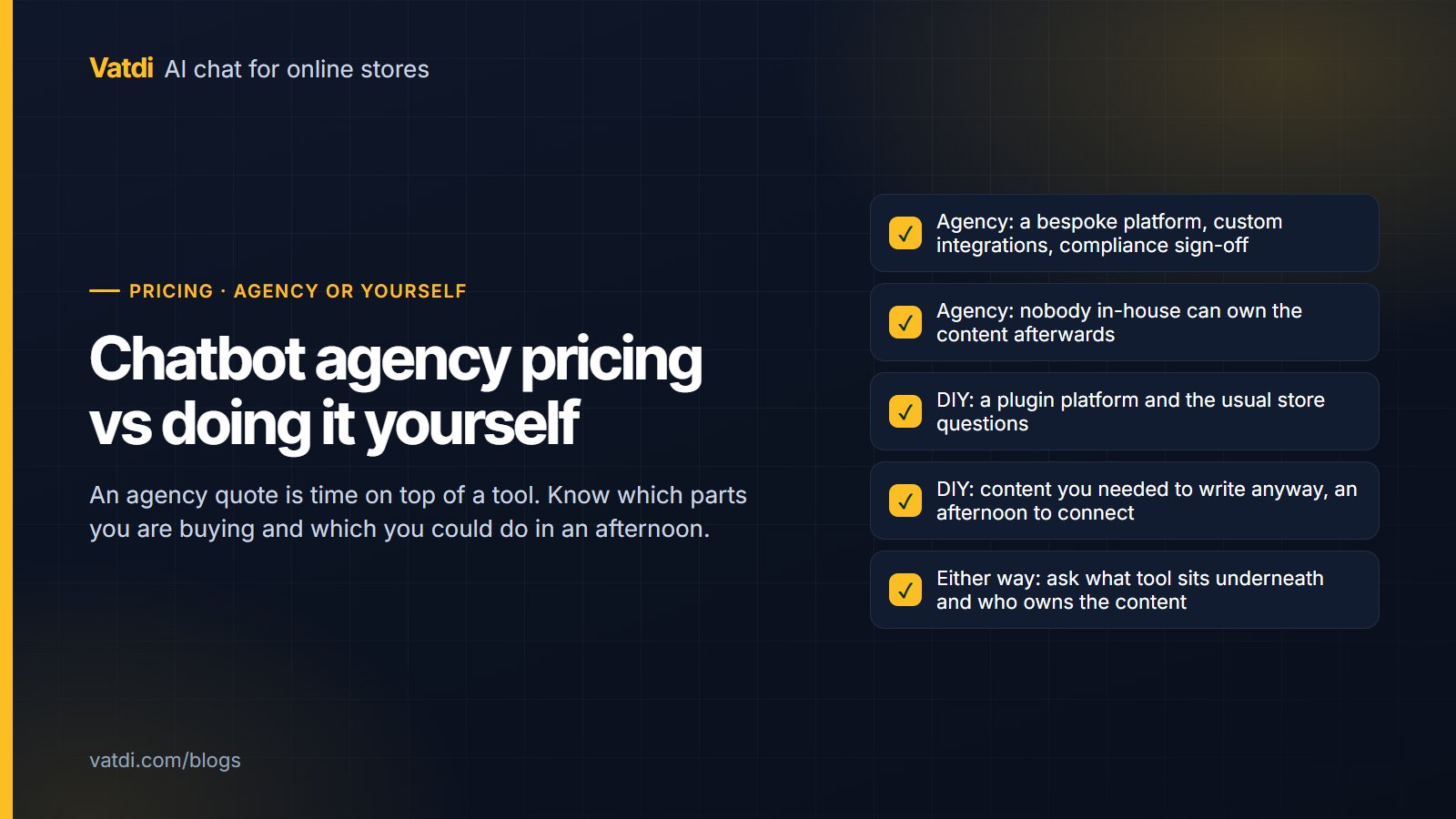
Buy the assistant and build only the integration that has no plugin. That keeps the recurring bill small, keeps the answering layer maintained by someone else, and puts your development time where it is genuinely required. Vatdi's own bespoke work sits under custom AI agent development for exactly this case, and the same logic applies to the agency decision set out in chatbot agency pricing vs doing it yourself. Plugin platforms are listed on the integrations page, which is the fastest way to find out whether an integration is needed at all.
Questions to answer before you build
- Who maintains it in eighteen months, and is that in their job description?
- What happens when it stops answering on a Saturday in December?
- How will you know the answers are getting worse, and what is your regression test?
- What is the model bill at ten times current volume, and who watches it?
- Who owns safety, including refusals, data exposure and abuse?
- What is the opportunity cost, measured in features not built for your actual product?
A team that can answer all six comfortably may well be right to build. A team that hesitates on any of them is describing a maintenance problem rather than a capability gap. Model providers document the moving parts involved, for example OpenAI's embeddings guide, which is a useful reality check on how much of this is infrastructure rather than intelligence.
The hybrid that usually disappoints
One pattern recurs and rarely works: buying a general model API and treating the store integration as a small internal project, on the assumption that only a thin layer is needed. It starts well, because the first fifty questions are policy questions and a simple retrieval pass answers them. It struggles at the second stage, when order lookup, verification, handover, transcripts and a dashboard turn out to be required after all, and the thin layer becomes a product with no owner. If you find yourself scoping that project, price the twelve rows in the table above against a flat subscription before starting, and be honest about which of them you are prepared to maintain in eighteen months rather than which you could build this quarter.
What you keep either way
Your content. The policy pages, the product attributes, the FAQ entries and the unanswered-question discipline transfer between tools and survive a rebuild. That is the asset worth investing in, and it is also the reason a build rarely produces better answers than a bought product on the same content: both are reading the same pages. The content format is in how to write a chatbot knowledge base, and the setup order in the implementation checklist.
Frequently asked questions
How hard is it to build a chatbot?
A prototype takes an afternoon; a product takes months and never stops needing maintenance. The work is ingestion, chunking, retrieval quality, a widget, handover, a dashboard, connectors, safety, cost control and someone on call. The model call itself is the smallest part of the system.
Would a custom build give better answers?
Not usually, because both a build and a product read the same content, and answer quality tracks the content rather than the code. A build can match a good product on quality after considerable work; it rarely exceeds it on the standard store questions that products are optimised for.
When does building make sense?
When the assistant is part of your product, when data genuinely cannot leave your environment, when the workflow is unusual enough that nothing models it, or when you already run similar systems. All of those also require a team that will still maintain it in two years.
What does a build cost to run?
Model and embedding usage, vector storage, hosting, monitoring, and the engineering time to keep ingestion working as sites and feeds change. The variable bill scales with success, which is worth forecasting at ten times current volume before committing rather than afterwards.
Can I build just the parts I need?
Often the best answer: buy the assistant and build only the integration that has no plugin. That keeps the answering layer maintained by someone else, keeps the recurring cost small, and puts your development time on the part that genuinely needs it.
What if we outgrow a bought product?
Check exportability before you buy rather than after. Your content should live on your own site wherever possible, and conversations should be exportable. With both in place, moving is an afternoon rather than a rebuild, which also means the decision is reversible.