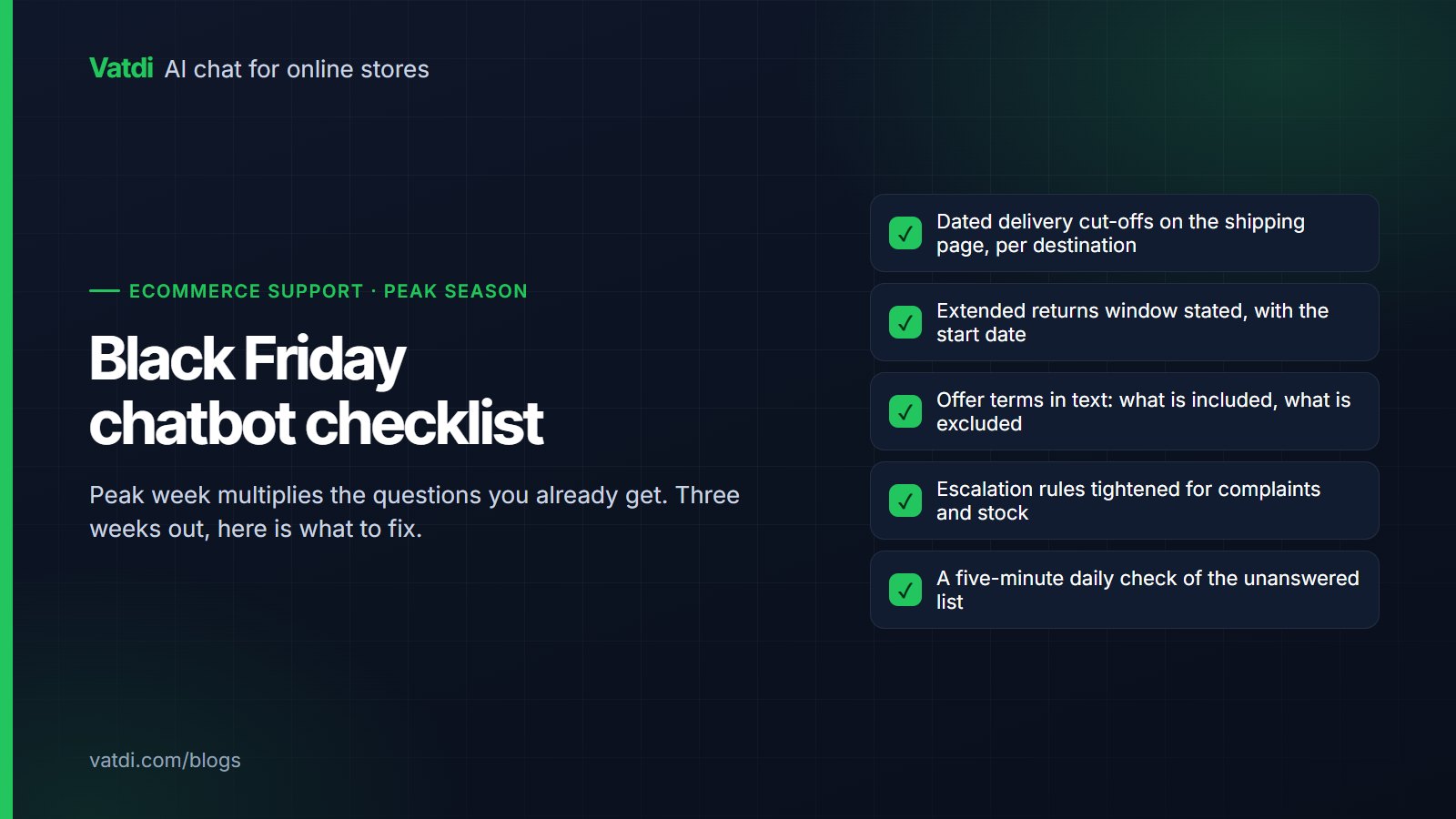
Peak week multiplies the questions you already receive rather than inventing new ones, which makes preparation unglamorous and effective. This Black Friday chatbot checklist covers what to update three weeks out, what volume changes, the rules to tighten before the weekend, and a five-minute daily check that keeps answers honest while everything is moving quickly.
Three weeks out: the content
| Page | What to add for peak | Why it matters now |
|---|---|---|
| Shipping | Dated cut-offs per destination and method, with the time zone | "Will it arrive in time" replaces "how long does it take" |
| Returns | Any extended window, its start date, and what it excludes | Gift buyers ask before purchase, not after |
| Offers | The terms in text: dates, exclusions, stacking, price matching | Prevents the assistant guessing at promotion rules |
| Stock | What happens when something sells out mid-order | The question peak week produces most |
| Payment | Any temporary methods or limits | Avoids a checkout question becoming a lost sale |
| Contact | Peak-week hours, including weekends | Agent hours that lie generate complaints |
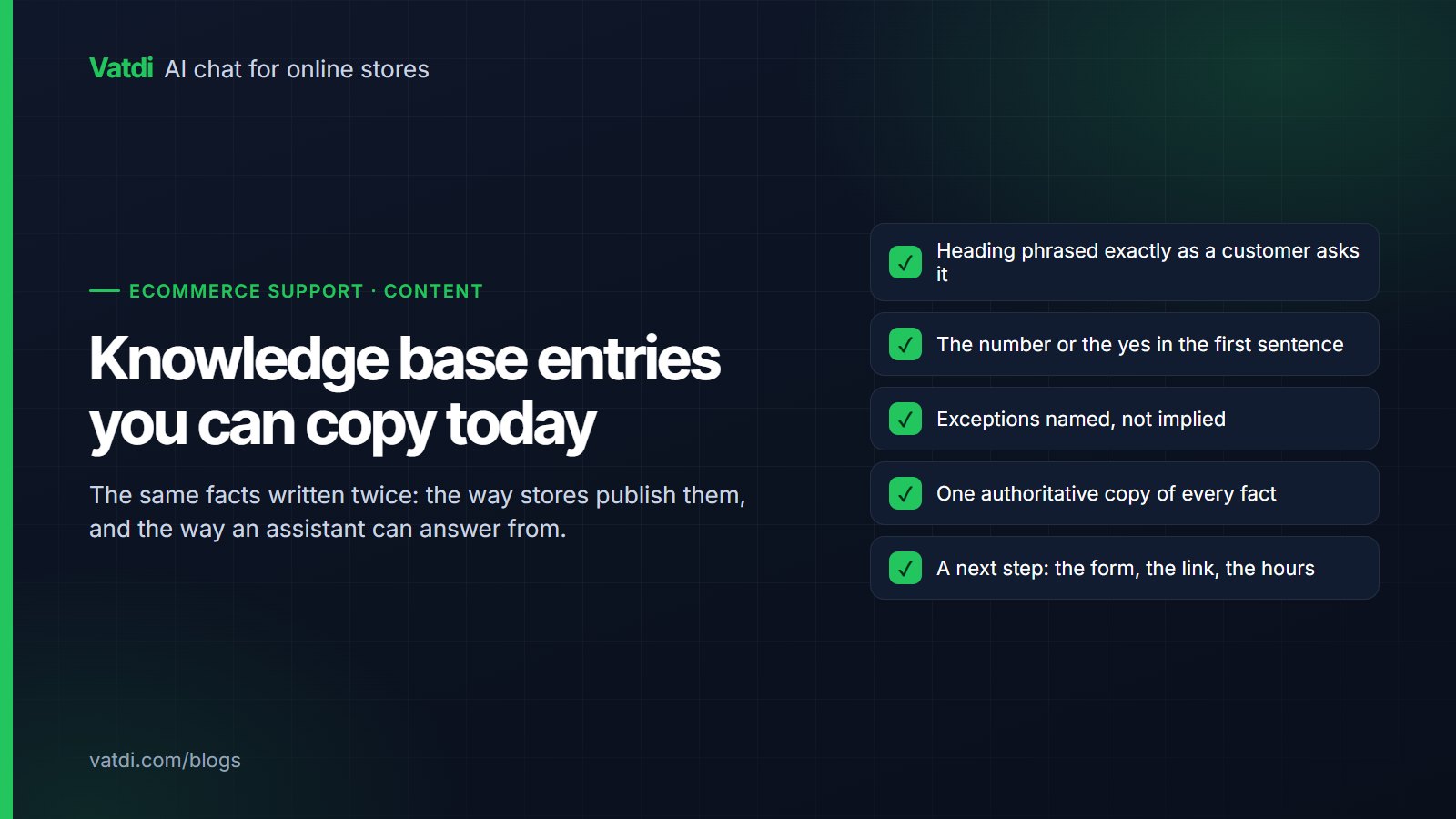
Write each as a heading phrased as the question with the answer in the first sentence, then delete the section in January rather than leaving last year's dates to confuse next November. The format is in chatbot knowledge base examples.
What volume actually changes
- Deadline questions dominate. "Will it arrive before the 24th" becomes the most common message, and a vague answer costs a sale.
- Gift-related returns questions arrive early. People check the policy before buying for someone else.
- Offer mechanics generate confusion. Stacking, exclusions and price matching produce more questions than the discount itself.
- Out-of-hours share rises. Sales run through evenings and weekends, which is when nobody is in the office.
- Patience falls. A shopper comparing three stores at 22:00 does not wait until Monday for an answer.
Our own figures across real store conversations, with the method stated, are in our ecommerce chatbot statistics; the out-of-hours pattern is pronounced even in ordinary months.
Two weeks out: the rules
Tighten the escalation rules so order problems reach a person faster than usual, and set peak-week agent hours honestly, including any weekend cover. If nobody is available on Sunday, say Monday rather than "shortly". The general rules are in chatbot human handover.
One week out: test like a customer
- Ask the deadline question for three destinations and check the dates are real.
- Ask about the offer in three wordings, including one that assumes stacking works.
- Ask about returning a gift bought this week.
- Ask about something sold out and confirm the reply does not promise a restock.
- Ask a question you cannot answer and confirm it declines and offers a person.
- Run an order lookup with a real order and a mismatched email.
Score each as correct, incomplete, wrong or declined well; the method is in how to test AI chatbot accuracy. Fix wrong answers before the weekend, because during peak week you will not have the attention.
Wording the deadline answer
This single answer does more work than anything else in peak week, so write it deliberately rather than leaving it to chance. It needs four elements: the last order date for that destination, the cut-off time with a time zone, the method it applies to, and an honest caveat about couriers. "Order by 3pm UK time on Thursday 18 December for standard delivery to UK addresses before Christmas. Couriers can run slower in peak weeks, so earlier is safer." That is specific enough to act on and careful enough not to become a promise you cannot keep. Avoid the two common failures: a vague "order early" that helps nobody, and a confident "guaranteed by the 24th" that turns one late parcel into a refund and a complaint. If you offer a genuinely guaranteed service, name it separately so the guarantee attaches to the thing you actually sell.
During the weekend: five minutes a day
Do not change settings mid-peak. Read the unanswered-question list once a day, fix only the content gaps that appear repeatedly, and skim the lowest-rated conversations for anything factually wrong. Everything else waits until December. The one exception is a cut-off date that turns out to be incorrect, which should be corrected immediately, because that error compounds with every hour it stays published. Resist the temptation to rewrite the assistant's instructions under pressure; a change made at midnight on the busiest weekend of the year is the change nobody will remember making.
After the weekend
- Remove the dated sections once the deadlines pass, so January shoppers do not read November's cut-offs.
- Keep the extended returns wording until the extension genuinely ends, then remove it.
- Read the whole unanswered list, which is now the richest it will be all year.
- Note which questions spiked, and make those permanent entries rather than seasonal ones.
- Write next year's checklist while you remember what went wrong.
Peak traffic also exposes the pre-purchase questions that quietly cost sales all year, which is the mechanism Baymard documents in its research on cart abandonment. The assistant's value in these weeks comes from answering those instantly, which is possible because it reads your pages rather than a script, as described in Lewis et al., 2020.
If you are starting from nothing
Stores sometimes decide in early November that they want chat for the sales weekend. That is late but not hopeless, provided the scope stays narrow. Install, connect the catalogue and order lookup, and write only three things: the dated cut-offs, the returns position including any extension, and the offer terms. Skip the full content project and let the assistant decline everything else with a clear route to a person. A narrow assistant that answers three questions perfectly and admits the rest is genuinely useful in peak week, while a half-finished broad one that guesses is worse than nothing. Do the wider content work in January, when the unanswered list from the sales period tells you exactly what to write.
Capacity and cost
Check your plan ceiling before the weekend rather than during it. Metered tools bill hardest in exactly this week, which is the practical argument for flat pricing; as of September 2026 Vatdi's Grow plan is $7.49 with unlimited conversations, Starter is $4.49 for 150, and the free plan covers 15, with every feature on every plan. Current numbers are on the pricing page, and the comparison of metering units is in chatbot pricing models explained.
Frequently asked questions
What should I prepare before Black Friday?
Dated delivery cut-offs per destination, the extended returns window with its start date, the offer terms in text, what happens when something sells out, peak-week contact hours, and tightened escalation rules. Three weeks out is comfortable; the week itself is too late to be writing content.
What do customers ask most during peak week?
Whether it will arrive in time, followed by returns for gifts and how the offer works. All three are answerable from content you can write in advance, which is why preparation beats staffing: the questions are predictable even when the volume is not.
Should I change settings during the weekend?
No, apart from correcting a factual error such as a wrong cut-off date. Changes made under pressure are rarely tested and hard to unpick afterwards. Read the unanswered list daily, fix repeated content gaps, and leave everything else until December.
How do I handle sold-out items in chat?
Say it is sold out, do not promise a restock date you cannot keep, and offer the nearest alternatives from your catalogue. If you genuinely restock, say what your policy is rather than guessing. A vague promise made in peak week becomes a complaint in December.
What about extended returns for gifts?
State the extension explicitly with its start and end dates, and say what it excludes. Gift buyers check the policy before purchasing, so a clear answer at that moment protects the sale. Remove the wording once the extension ends so it cannot mislead later.
Will my plan handle the volume?
Check the ceiling before the weekend. Flat plans with unlimited conversations remove the question entirely; metered plans bill most in your busiest week, so forecast from last year's peak rather than an average month. Find out what happens at the limit before you reach it.