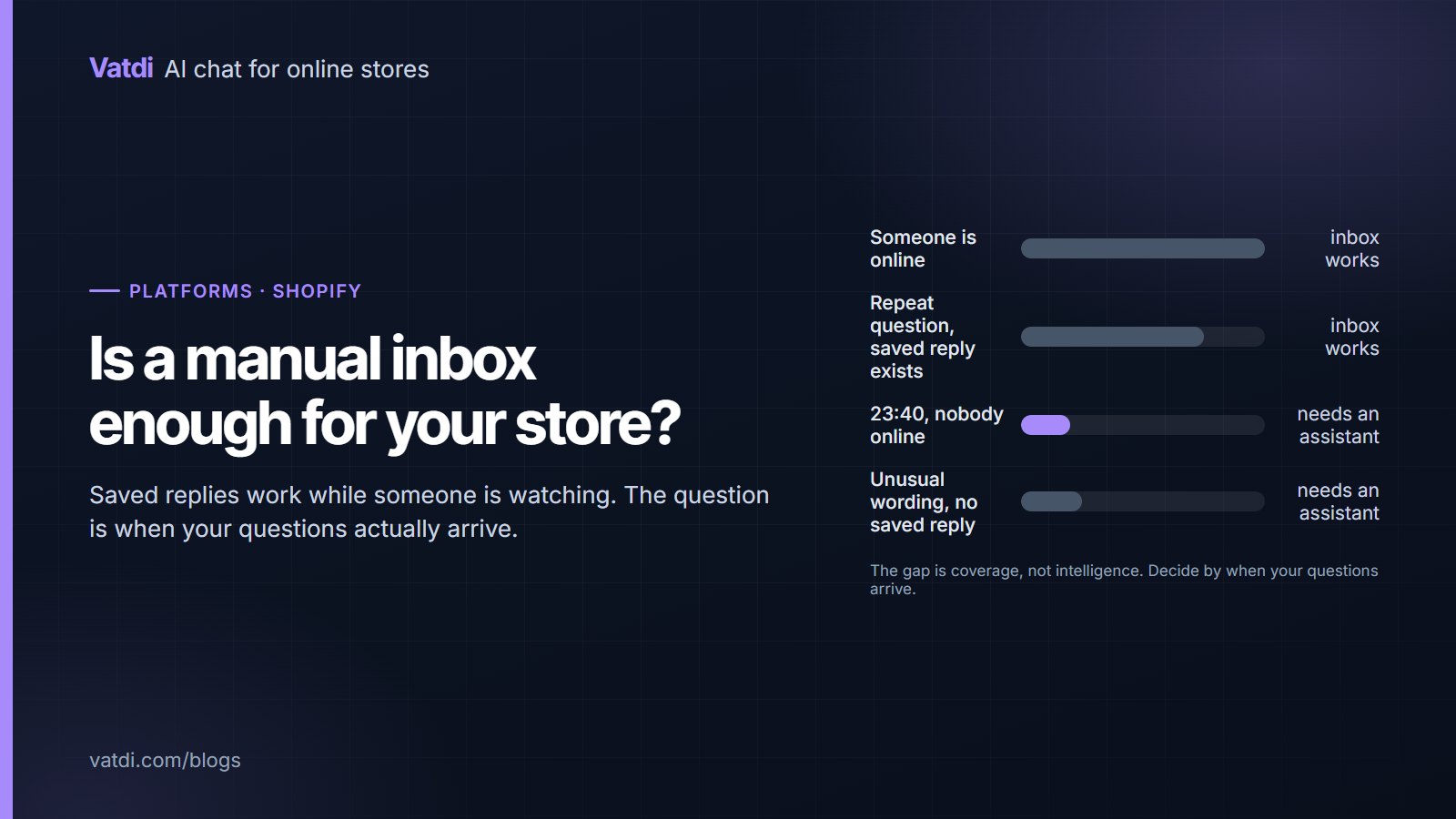
Is Shopify Inbox enough for your store? It is free, built in, and good at what it does: letting customers message you and letting you reply, with saved responses for the questions you answer constantly. The answer depends on two things, when your questions arrive and how repetitive they are. This is a coverage decision rather than a features argument, and a week of your own data settles it.
What a manual inbox does well
| Situation | Manual inbox with saved replies | Assistant answering from content |
|---|---|---|
| Someone is online | Excellent: a person, in context | Good, and escalates to that person |
| Common question, saved reply exists | Fast, if the agent picks the right one | Automatic, in the customer's wording |
| Question at 23:40 | Answered tomorrow | Answered now, if the content covers it |
| Unusual phrasing | Needs a person to interpret | Matches the meaning rather than keywords |
| Policy changed last week | Saved replies must be rewritten by hand | Follows the page as soon as it is updated |
| Another language | Depends who is on shift | Replies in the language used |
The pattern is clear enough: a manual inbox is excellent when someone is watching it, and silent when nobody is. Everything else in the comparison follows from that.
Four signs a store has outgrown it
- You answer the same five questions every day. Saved replies help, but you are still the one sending them, and each one interrupts something else.
- Messages arrive when you are asleep. Store chat skews heavily outside office hours; our own figures across real stores, with the method stated, are in our ecommerce chatbot statistics.
- Saved replies have drifted from the policy. A returns window changed on the page but not in the canned response, and nobody noticed for a month.
- Shoppers ask before buying, not after. Pre-purchase questions are time-sensitive in a way support tickets are not; an unanswered one is usually a lost sale rather than a delayed reply.
The real difference: where the answer comes from
A grounded assistant searches your catalogue and pages for each question and composes an answer, the approach described in Lewis et al., 2020. That is why a policy edit propagates automatically and why unusual wording still finds the right answer. The trade-off is that answer quality tracks content quality, which is the subject of how to write a chatbot knowledge base. Saved replies, by contrast, are exact and reliable but only exist for questions someone anticipated.
The hidden cost of saved replies
Canned responses look free because writing one takes two minutes. The cost arrives later, in maintenance. Each reply is a copy of a fact that also lives on a page, so every policy change means finding and editing both. Stores rarely do, which is how a shopper ends up being told fourteen days by chat and thirty days by the returns page, both from the same business on the same afternoon. The number of copies grows with the number of questions you handle well, so the better your saved-reply library, the more expensive it is to keep honest. An assistant reading the page has the opposite property: one edit, one source, and nothing to reconcile. That difference matters most in the months when you are busiest and least able to audit anything.
When a manual inbox is the right answer
There are stores where adding an assistant would be premature, and it is worth saying so. If your volume is a handful of messages a week, all of them genuinely unusual, then the automation has nothing repetitive to remove and a person answering properly is the whole product. If you sell something bespoke where every enquiry is a conversation about specifications and price, the same applies. And if your policy content genuinely does not exist yet, writing it is the first job either way; an assistant on top of nothing produces confident silence. The rule of thumb: automate the repetitive, keep the human for the rest, and do not automate before you have identified what the repetitive part is.
You do not have to choose
The common arrangement is both: the assistant answers what your content covers, and everything else reaches a person in the same conversation, with the transcript attached. That preserves what a manual inbox is good at, a human reply when it matters, and removes the part that does not scale, answering the same five questions at midnight. The escalation rules worth setting are in chatbot human handover, and Vatdi includes handover, agent hours and the dashboard on every plan.
Deciding in one afternoon
- Export a week of messages from your inbox.
- Tag each one as answerable from an existing page, answerable from the catalogue, needs a person, or nobody could answer it.
- Note the timestamps. How many arrived outside your working hours?
- Count the repeats. How many are the same five questions in different words?
- Decide from the counts. If most are answerable from content and many arrive out of hours, an assistant pays for itself immediately. If almost everything genuinely needs a person, your content is the project, not the tool.
This is more reliable than comparing feature lists, because it measures your store rather than an average one. Shopify's own documentation on store pages is a reminder that the policy content an assistant needs is already part of the storefront.
What it costs to add
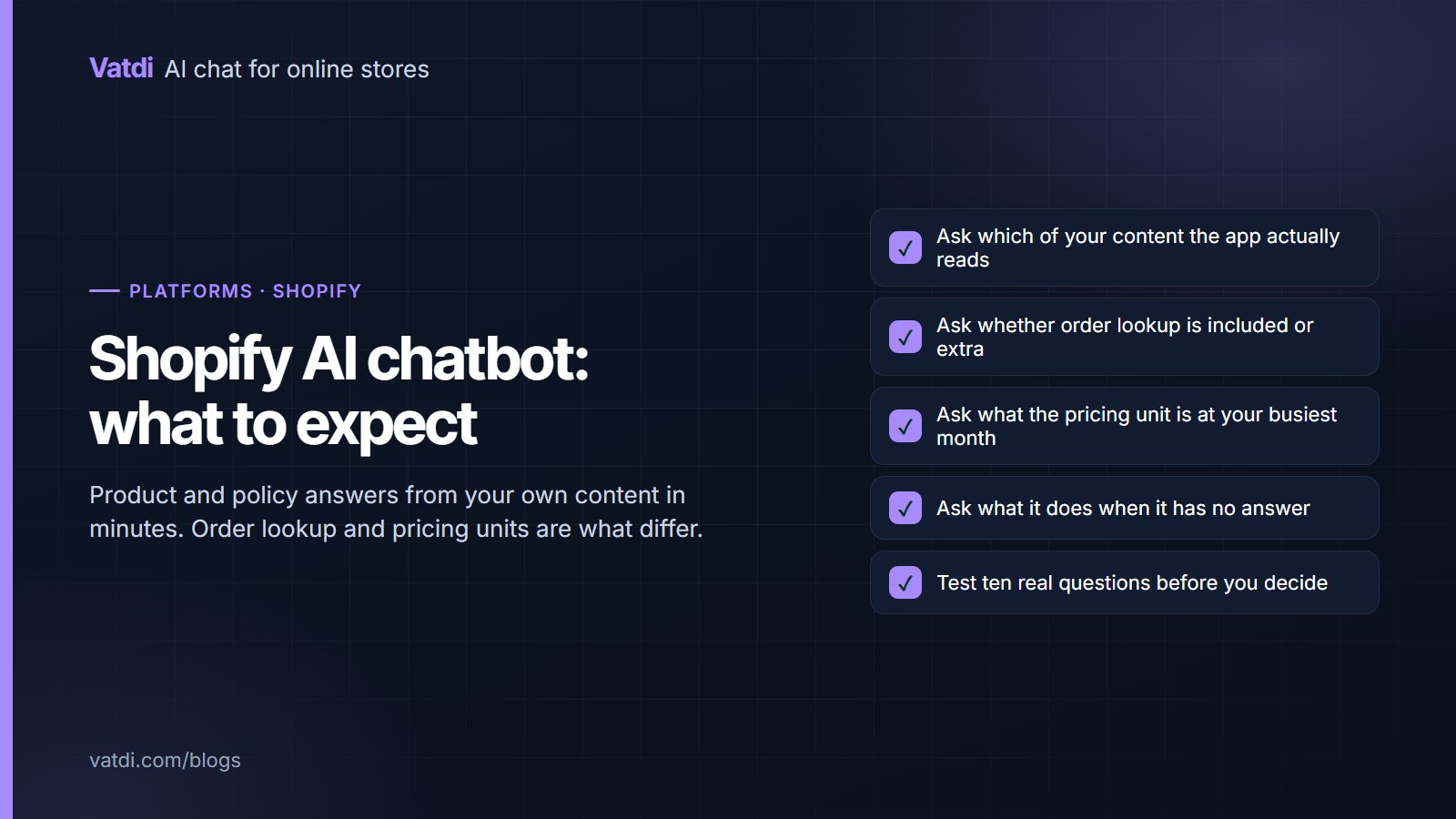
Adding an assistant alongside a manual inbox is not an expensive decision. As of September 2026 Vatdi is free for 15 conversations a month with every feature, $4.49 for 150 and $7.49 for unlimited, with badge removal the only paid extra; see pricing. The bigger cost is the afternoon spent rewriting five policy pages as questions, which improves the storefront whether or not you keep the assistant. What to expect from any chat app on this platform is in Shopify AI chatbot: what to expect, and the wider setup order is in the AI chatbot implementation guide.
Frequently asked questions
Is Shopify Inbox free?
Yes, it is included with Shopify, which is a genuine advantage for a store that mainly needs a way to be reachable. The cost that is easy to miss is your time: every saved reply has to be written, kept current, and chosen correctly by whoever is on shift when the message arrives.
What can Shopify Inbox not do?
Answer when nobody is available, interpret a question nobody anticipated, or follow a policy change automatically. Those are the three gaps an assistant that reads your content fills. Everything else it does well, particularly giving a real person the context to reply properly.
Do saved replies count as AI?
No. A saved reply is a fixed piece of text a person selects, which makes it exact but limited to questions someone wrote in advance. An assistant that answers from your catalogue and pages produces wording it composes for the question asked, including phrasings you never thought of.
Can I run both at once?
Yes, and most stores should. The assistant handles the repetitive and out-of-hours questions, and hands anything uncertain or sensitive to a person in the same conversation with the transcript attached. That keeps the human touch where it matters and removes the part that does not scale.
How do I know if my store needs more than an inbox?
Tag a week of messages by whether an existing page could have answered them, and note how many arrived outside your hours. Two counts decide it. Feature comparisons cannot, because they describe an average store rather than the questions your customers actually send.
Will customers mind talking to an assistant?
Not when it is honest about being one and answers accurately. What people dislike is a bot that pretends to be human, guesses, or blocks the route to a person. Say what it is, answer well, and offer the handover clearly, and the reaction is usually relief at a fast answer.