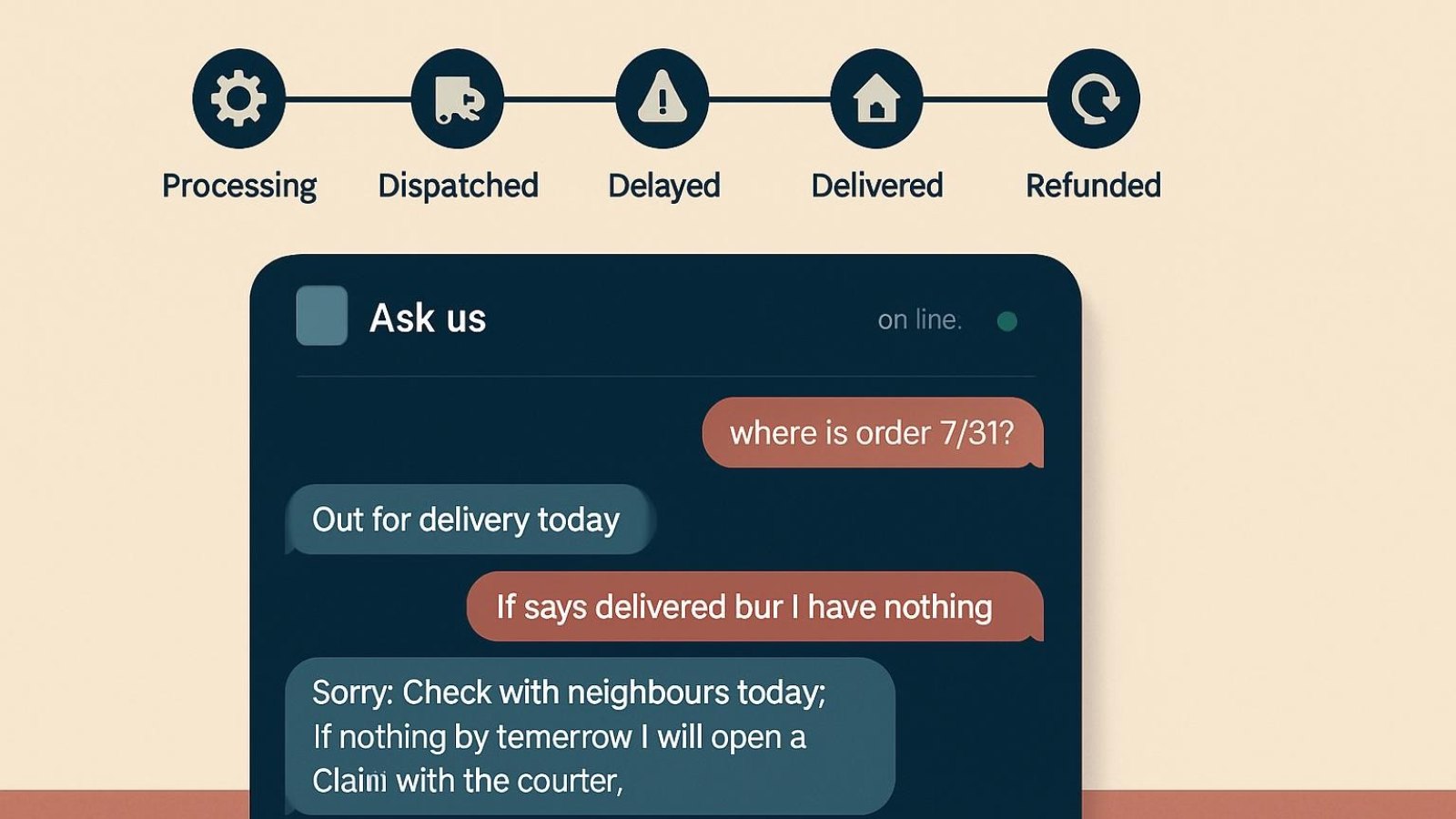
Order tracking chat is the most common conversation a store has, and the wording decides whether it ends in one exchange or three. These examples cover each status, the verification request, the decline when details do not match, and the hand-over when tracking has stalled. Adapt the phrasing to your voice; keep the structure, because the structure is what prevents follow-up messages.
Asking for what you need
Ask for both facts in one message rather than two, and say why. "I can check that. What is the order number and the email you used at checkout?" That single sentence does three jobs: it confirms the assistant can help, it collects both items at once, and it implies the security reason without a lecture. Avoid asking for the order number first and the email afterwards, which doubles the exchange and reads as an interrogation.
Wording for each status
| Status | What to say | Why this wording |
|---|---|---|
| Awaiting payment | "We have not received payment yet, so it has not been prepared. If you think you have paid, the team can check." | Neutral, and offers the route out |
| Processing | "Received and being prepared. Orders placed before 3pm UK time go out the same working day." | Gives the next milestone, not just the state |
| Dispatched | "Dispatched on Tuesday with Royal Mail. Here is the tracking link. Standard delivery is 2 to 3 working days from dispatch." | Carrier, date, link and expectation in one line |
| Tracking stalled | "Tracking last updated on Wednesday, which is slower than usual. If there is no movement by Friday I will pass this to the team." | Names the threshold so the customer knows when to worry |
| Delivered, not received | "Tracking says delivered yesterday at 14:12. That needs a person, so I am passing it on now with your order number." | No investigation, immediate escalation |
| Cancelled | "This order was cancelled on 3 November. If that is unexpected, I will pass it to the team to explain." | States the fact, never guesses the reason |
| Refunded | "A refund was processed on 5 November to the original payment method. Card refunds appear as a credit on your statement within 3 to 5 working days." | Pre-empts the "I cannot see it" follow-up |
When the details do not match
The verification design behind this is covered in WooCommerce chatbot order tracking, and it applies identically on other platforms. Test the mismatch case deliberately before launch; it is the one nobody remembers to try.
Phrases that create complaints
- "Your order has been delivered" when the platform status only means dispatched. Word it as dispatched and let tracking speak for delivery.
- "It will arrive tomorrow" when your content supports a range. Quote the range.
- "The courier has lost it" or any interpretation of scan history. Report, do not interpret.
- "Please allow 10 working days before contacting us" as a brush-off. Give a threshold and offer to act at it.
- "I cannot help with that" with nothing after it. Every decline needs a route.
The follow-up questions worth answering in the same breath
Three questions follow a tracking answer often enough to pre-empt: can I change the address, what if I am out when it arrives, and what if it does not fit when it comes. Answering the relevant one unprompted turns a two-message conversation into one. "Dispatched on Tuesday, here is the tracking link. If you will not be in, most carriers let you rearrange delivery from that page. You also have 30 days from delivery to return it if it is not right." That is a complete answer to a question the customer had not asked yet, and it is only possible because the shipping and returns pages state those facts, as set out in the shipping policy example and the returns policy example.
Small wording choices that change the reply
- Name the day, not the elapsed time. "Dispatched on Tuesday" is easier to act on than "dispatched two days ago", which ages badly if the conversation is read later.
- Give the carrier. Customers recognise their local carrier and often know its habits better than you do.
- Put the link last. A line ending in a tappable link reads better on a phone than one with the link buried mid-sentence.
- Avoid internal vocabulary. "Fulfilled", "picked" and "awaiting allocation" mean nothing to a shopper; translate them.
- Offer the next step, once. "Would you like me to pass this to the team?" beats repeating the status a second time.
These are small, and together they are the difference between a reply that settles the question and one that invites another message. If you write documentation for a living this will feel familiar: the guidance in Google's developer documentation style guide on plain, direct phrasing applies just as well to a chat reply as to a technical page.
When to hand over immediately
Four cases: delivered but missing, a parcel beyond your stated late threshold, any suggestion of damage, and anything where the customer is clearly upset. In each the assistant should collect the order number, say plainly that a person is taking it, give the hours, and stop trying to help. The rules and the wording are in chatbot human handover, and the broader shipping behaviour in a chatbot for shipping questions.
Why this conversation matters more than the others
Order status is the highest-volume question in store chat, mostly arriving outside working hours, and each instance is a small anxiety rather than a purchase decision. Handled in one exchange it costs nothing and reassures; handled badly it produces two more messages and a bad impression at the moment the customer has already paid. Our own figures across real store conversations, with the method stated, are in our ecommerce chatbot statistics. Every Vatdi plan includes order lookup and handover, with allowances on the pricing page as of September 2026, and the retrieval approach that answers the surrounding policy questions is described in Lewis et al., 2020.
Frequently asked questions
What should a chatbot ask before checking an order?
The order number and the email used at checkout, requested in a single message. Asking for them separately doubles the exchange, and asking for only one of them makes sequential order numbers guessable. One sentence collects both and implies the reason without lecturing the customer.
How should it word a dispatched order?
Name the carrier, the dispatch date, the tracking link and the expected range in one line. That answers the question and the two most likely follow-ups at once. Avoid saying delivered unless tracking says delivered, since most platform statuses mean dispatched rather than arrived.
What if tracking has not updated?
Say when it last updated, note that this is slower than usual, and give a threshold: if nothing changes by a named day, you will pass it to the team. A stated threshold stops the anxious message on day two without dismissing the concern.
What about a parcel marked delivered but missing?
Escalate immediately with the order number and transcript. Do not ask the customer to check with neighbours or wait another day first; those suggestions belong to a person who can also open a carrier case. This is the clearest example of a status that should never be handled automatically.
Should it explain courier scan messages?
No. Carriers use the same words differently, and a confident interpretation that turns out wrong costs more than saying nothing. Report the status and the link, then let the customer read the carrier's own page, which is the authoritative source for that journey.
How do I stop the same question coming back?
Answer the likely follow-up in the same message, and publish the underlying facts: the dispatch cut-off, the late-parcel threshold and the returns window. With those on the page, most tracking conversations end in one exchange, which is the practical measure of whether the wording is working.