Shipping policy chatbot answers come from one page, and most versions of that page omit the two facts customers most want: the daily dispatch cut-off and what happens when a parcel is late. Below is a complete worked example with nine question headings. Copy the structure, replace the numbers with yours, and the assistant starts quoting exact lines instead of paraphrasing a paragraph.
The nine questions a shipping page must answer
| Question | What the answer must contain |
|---|---|
| How much is delivery? | Cost per method and destination, plus any free threshold |
| How long does it take? | Working days per method, counted from dispatch or order |
| When does it go out? | The daily cut-off time with a time zone, and which days count |
| Where do you ship? | Countries or zones served, and those you do not serve |
| Who pays duties? | Whether prices include them and who the carrier collects from |
| Do I get tracking? | Whether tracking is provided, when the link arrives, which carrier |
| Can I change the address? | Whether it is possible after ordering, and how |
| What if it is late? | Your position, and when to contact you |
| What if it never arrives? | The process, and the window for reporting it |
The worked example
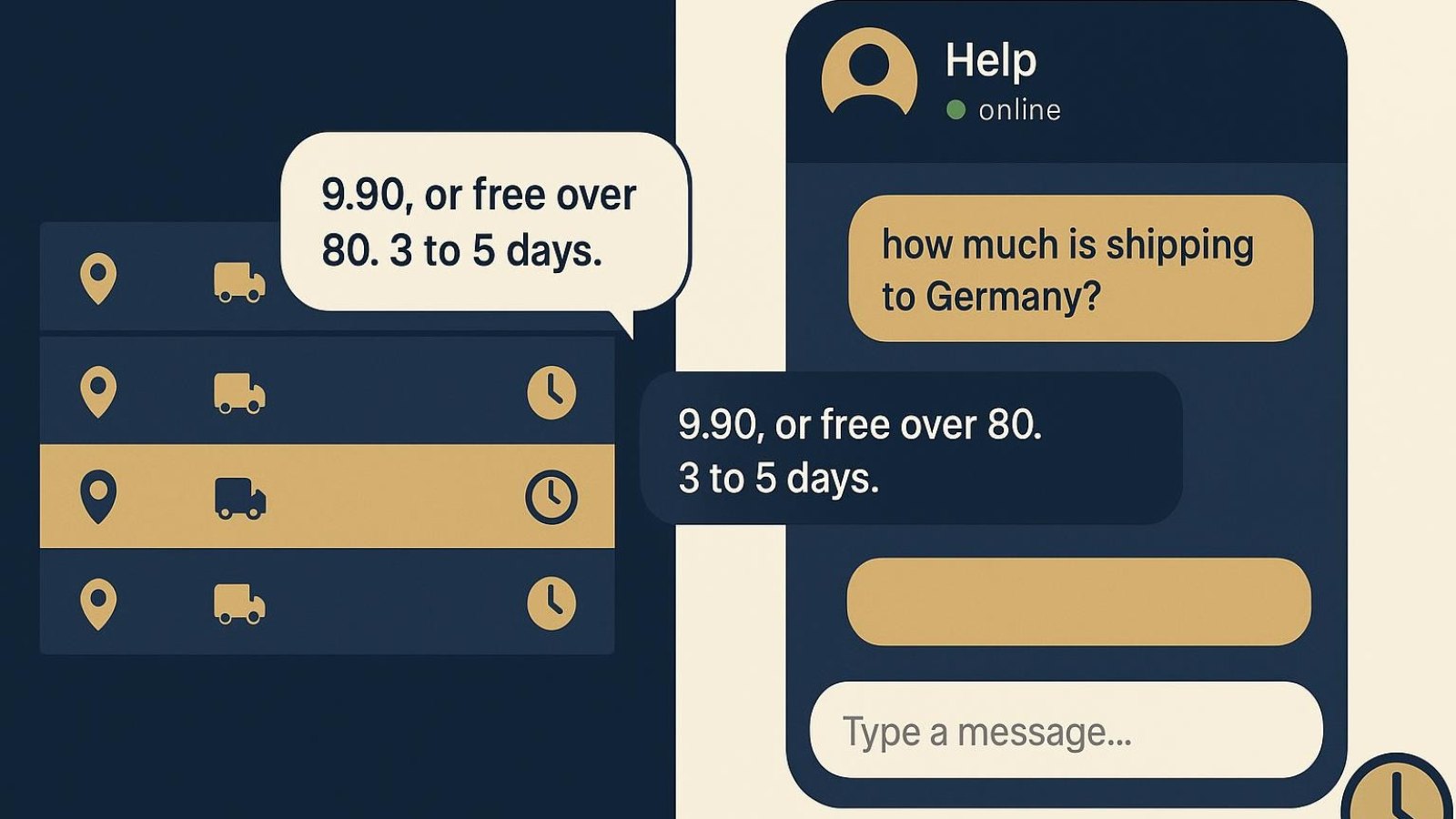
- "How much is delivery?" UK standard is £3.95 and free over £50. UK express is £6.95. EU standard is £9.95. Rest of world is £14.95. Delivery is calculated at checkout before you pay.
- "How long will it take?" UK standard is 2 to 3 working days from dispatch, UK express is next working day, EU is 3 to 5 working days and rest of world is 7 to 14. Working days exclude weekends and public holidays.
- "If I order now, when does it go out?" Orders placed before 3pm UK time on a working day are dispatched the same day. After that, the next working day. We do not dispatch on weekends or bank holidays.
- "Do you ship to my country?" We ship to the UK, the EU, Norway, Switzerland, the United States, Canada, Australia and New Zealand. We do not currently ship to Russia, Belarus or any destination our carrier suspends.
- "Will I pay customs or import charges?" Orders outside the UK may attract duties and import VAT. These are not included in our prices and the carrier collects them on delivery. We cannot estimate them, as they depend on your country.
- "Do I get tracking?" Yes, on every method. The tracking link is emailed when the parcel leaves us, usually within an hour of dispatch, and you can also ask for it in the chat window with your order number.
- "Can I change my delivery address?" Only before dispatch, and only by contacting the team. Once the parcel is with the carrier we cannot redirect it, though most carriers let you rearrange delivery using the tracking link.
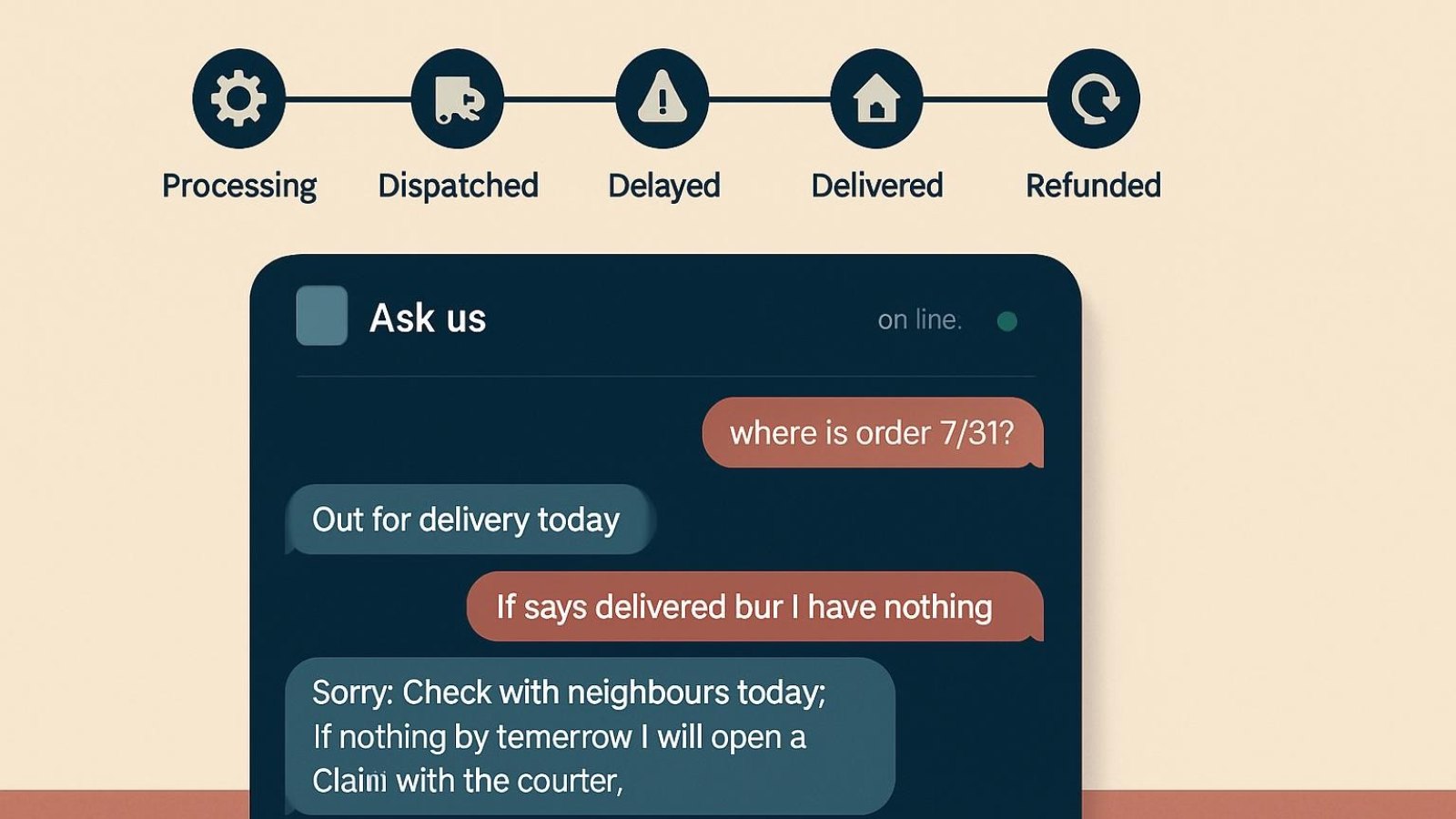
- "What if my parcel is late?" Carriers occasionally run behind, particularly in peak weeks. If tracking has not updated for three working days, contact us with your order number and we will chase it.
- "What if it never arrives?" Tell us within 21 days of the dispatch date. We will open a case with the carrier and either resend or refund. If tracking says delivered but nothing arrived, contact us the same day so we can act quickly.
Why the structure matters
An assistant quotes what it can read, and a heading matching the question produces a precise answer while a paragraph holding nine facts produces an approximate one. The general discipline is in how to write a chatbot knowledge base, and the same treatment applied to returns is in the returns policy example.
The two lines that remove the most email
The cut-off and the late-parcel position. The cut-off converts a vague "how long does it take" into an actionable answer, and it is the fact most often absent, because it lives in the warehouse rather than on the website. The late-parcel line pre-empts the most frequent follow-up in store chat: it tells the customer when to worry and what you will do, which stops the anxious message on day two and the angry one on day five. Both take one sentence. The wider behaviour around tracking is in a chatbot for shipping questions, and the escalation rules in chatbot human handover.
Where the assistant should stop
- Interpreting courier scans. Report the status and the tracking link; do not translate "in transit" into a prediction.
- Naming a delivery day your content does not support. Quote the range and the cut-off.
- Estimating duties. Say they may apply and who collects them.
- Redirecting a parcel. That is an action with a cost, so hand it to a person.
- Resolving a missing parcel. Collect the order number and escalate immediately.
Free-delivery thresholds and the questions they create
A free-delivery threshold is good for average order value and generates three predictable questions: what the threshold is, whether it applies before or after a discount, and whether it counts per order or per delivery address. Answer all three on the page. The second matters more than it sounds, because a shopper who reaches the threshold with a voucher applied and then finds delivery charged at checkout feels misled even if the terms were technically stated. The third matters for gifts and split deliveries. Two sentences cover both, and they prevent the checkout abandonment that follows an unexpected charge, which is among the documented reasons people leave a basket.
Keeping it current
Review the page whenever carrier prices change, whenever you add or drop a destination, and before every peak season, when a dated cut-off block should be added and then removed in January. Keep one authoritative copy of each figure: if the cost appears in the footer, the FAQ and the checkout, those three will eventually disagree and the assistant will quote whichever it finds first. The plan allowances that cover conversation volume during busy periods are on the pricing page, where every feature is included on every plan as of September 2026, and the peak-season version of this work is in holiday shipping cut-offs. The retrieval mechanism that makes a page edit change an answer immediately is described in Lewis et al., 2020, and the commercial case for clarity here is documented in Baymard's research on cart abandonment.
Frequently asked questions
What should a shipping page contain for a chatbot?
Nine facts, each under its own question heading: cost, delivery time, dispatch cut-off, destinations served, duties, tracking, address changes, late parcels and missing parcels. Written that way, each becomes a precise answer rather than a paragraph the assistant has to summarise.
Why can the assistant not read my rate table?
Because it is almost certainly an image. Try selecting a price with your cursor on the live page. If you cannot, add the same figures as text; keep the table graphic if it suits the design. Search engines and screen readers have the same limitation.
How important is the dispatch cut-off?
It is the single most useful line on the page, and the most commonly missing, because it lives in the warehouse rather than on the website. Without it, "2 to 3 working days" cannot be turned into a useful answer for someone ordering at four in the afternoon.
Should I publish a position on late parcels?
Yes, in one sentence: when to contact you and what you will do. It pre-empts the most frequent follow-up in store chat, sets a reasonable expectation during peak weeks, and lets the assistant answer the anxious message on day two without involving anyone.
What about international duties?
State that they may apply, that they are not included, and that the carrier collects them. Do not attempt estimates, which vary by country and change. An unexpected charge on delivery is a common reason parcels are refused, which costs you the shipping twice.
How often should the page change?
Whenever carrier prices change, when you add or drop a destination, and seasonally for peak cut-offs. Keep one copy of each number so the review is a single page, and remove dated blocks in January so last year's deadlines cannot be quoted in March.