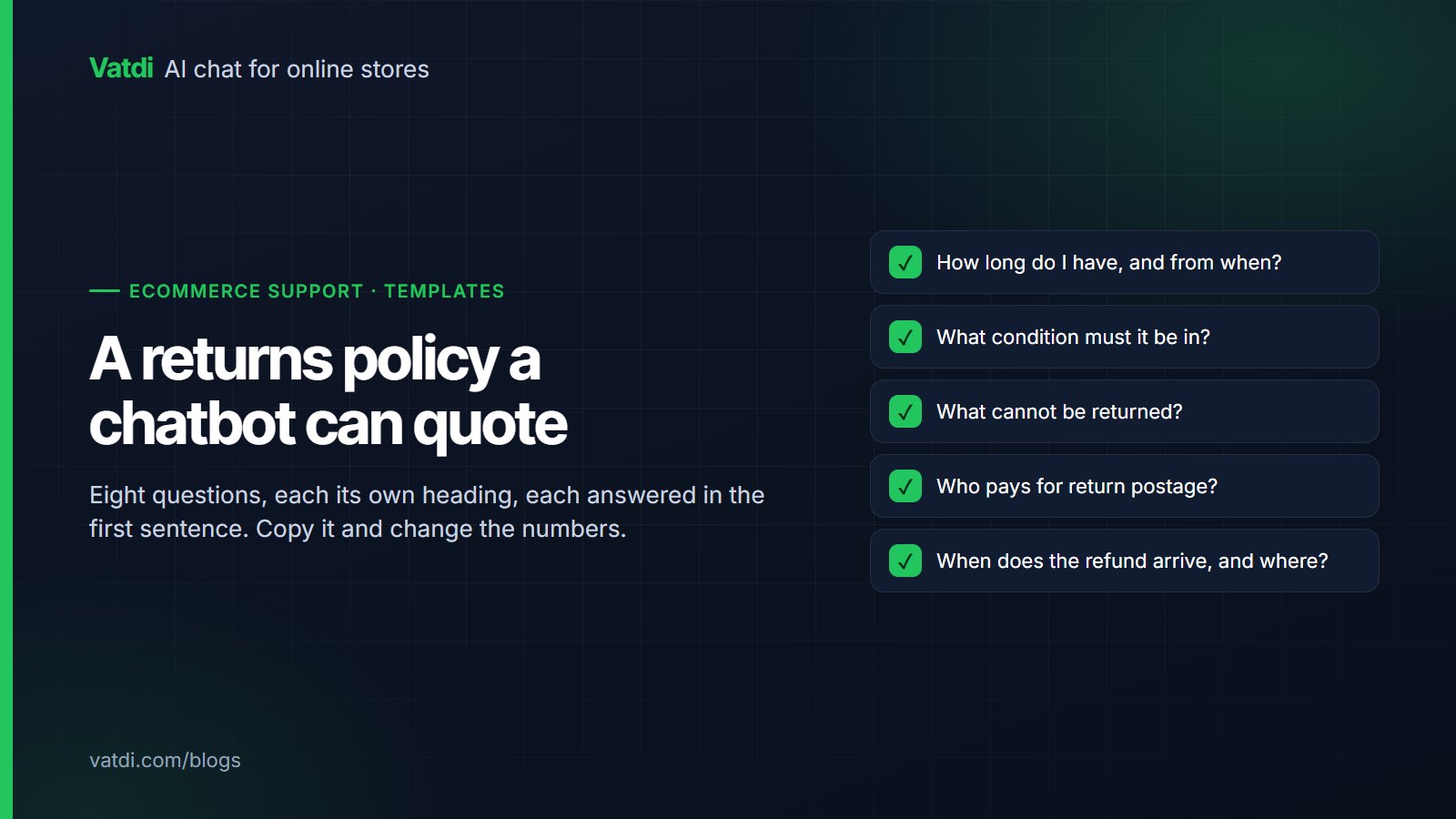
Most returns pages answer two questions and bury the other six, which is why an assistant reading them gives vague replies. Returns policy chatbot answers are only as good as the page behind them. Below is a complete worked example, written as questions with the fact in the opening sentence. Copy the structure, replace the numbers with yours, and the answers become exact.
The eight questions a returns page must answer
| Question | What the answer must contain |
|---|---|
| How long do I have? | The number of days and what it counts from |
| What condition? | Unworn, tags, original packaging, and how strict you are |
| What cannot be returned? | Every excluded category, named individually |
| Who pays postage? | Free label, deducted cost, or the customer, per destination |
| How do I start one? | The exact steps and where the form lives |
| When do I get the money? | Days after receipt, and to which payment method |
| What if it is faulty? | That faults are treated differently, and how |
| What about gifts? | Extended windows, receipts, and who gets the refund |
The worked example
Each heading below is written the way a customer asks it. The answer leads with the fact.
- "How long do I have to return something?" You have 30 days from the delivery date. The date on your tracking is the one we use, not the order date.
- "What condition does it need to be in?" Unworn and unwashed, with tags attached and in its original packaging. Try things on over clothing where you can, and keep the box until you are sure.
- "What cannot be returned?" Pierced jewellery, underwear and swimwear once the hygiene seal is removed, personalised items, and anything marked final sale on the product page. Faulty goods are always returnable, whatever the category.
- "Who pays for return postage?" UK returns are free using the label in your confirmation email. EU returns cost £6.95, deducted from the refund. Rest of world returns are at your own cost.
- "How do I start a return?" Open the returns form, enter your order number and email, print the label and drop the parcel at any post office. You do not need to contact us first.
- "When will I get my refund?" Within 3 to 5 working days of the parcel reaching us, to the card or account you paid with. Card refunds appear as a credit on your statement rather than as a new transaction, which is why some people miss them.
- "What if the item is faulty?" Faults are not ordinary returns. Contact the team with your order number and a photo and they will arrange a replacement or refund, including return postage, outside the 30-day window where your rights apply.
- "Can I return a gift?" Yes, within 30 days of delivery, and until 31 January for orders placed from 1 November. The refund goes to the original payment method, so tell us if you would prefer a credit note instead.
Why this structure works
A grounded assistant searches your content and composes a reply from the closest match, the approach described in Lewis et al., 2020. A heading that matches the question produces a precise answer; a paragraph containing eight facts produces an approximate one. The same discipline is set out in how to write a chatbot knowledge base, with more before-and-after examples in chatbot knowledge base examples.
The awkward cases worth adding
- Outside the window: state whether you consider late returns at all, and who decides.
- Part of an order: whether returning one item of a multi-buy affects the discount.
- Refund smaller than expected: name the deductions, so the assistant can explain the difference.
- Exchange rather than refund: whether you do them, and how.
- Refused or undelivered parcels: what happens and whether postage is deducted.
Each of these generates support email precisely because it is unwritten. Adding five sentences removes five recurring conversations.
Where the assistant should stop
The policy answers above are lookups. Anything requiring a judgement is not: a late return you might accept as goodwill, a dispute about condition, a refund that has not appeared, or a claim about statutory rights. Those go to a person, and the rules are in chatbot human handover, with the wider division in a chatbot for returns and refunds. Where consumer law applies, link the official guidance rather than paraphrasing it; for European customers the EU guidance on guarantees and returns is a reasonable orientation, and your own published policy plus your legal advice govern.
Where the page should live and who reads it
Publish it as an ordinary page on your storefront, linked from the footer, the product pages and the order confirmation email. That single page then serves four audiences at once: shoppers deciding whether to risk a purchase, customers who have already bought, search engines, and the assistant. Keeping it public rather than hiding the detail behind a support form matters more than it sounds, because a shopper who cannot find the returns terms often assumes the worst and leaves. The same clarity that makes the assistant precise is what makes the page persuasive before a sale, which is the argument behind our wider setup advice in the AI chatbot implementation guide and the plan allowances on the pricing page, where every feature is included on every plan as of September 2026.
A ten-minute rewrite
- Open your current returns page and list every fact it contains.
- Write a heading for each, phrased as a customer question.
- Put the fact in the first sentence under each heading.
- Add the four facts from the list above that are missing.
- Delete any duplicate copy of these numbers elsewhere on the site, replacing it with a link.
- Ask the assistant the eight questions and check each answer quotes the specific line.
One copy of each fact
Put the detail on this page and link to it from everywhere else. Stores that repeat the returns window in the footer, the FAQ, the terms and a product tab end up with four versions that eventually disagree, and the assistant will quote whichever it finds. If a customer can be told 14 days by chat and 30 days by the policy page, the problem is not the assistant. Keeping the numbers in one place also makes the annual review trivial: one page to check, one page to change.
Frequently asked questions
How should a returns policy be structured for a chatbot?
One heading per question, phrased the way customers ask, with the specific fact in the first sentence. Eight headings cover most stores: window, condition, exclusions, postage, process, refund timing, faults and gifts. The same structure helps human readers and search, so nothing is sacrificed.
Why does my assistant give vague returns answers?
Almost always because the page holds several facts in one paragraph, so the closest match is the paragraph rather than the answer. Split it into separate question headings and the replies sharpen immediately, without any change to settings or instructions.
Should exclusions be listed individually?
Yes, by name and on their own line. Exclusions are what generate angry follow-ups, because a shopper who reads "some items are excluded" assumes theirs is not one of them. Naming each category lets the assistant answer "can I return earrings?" precisely.
What about statutory rights?
State your published policy and link official guidance for your market rather than interpreting the law in your own words. Your obligations may exceed your policy, which is a matter for legal advice. An assistant improvising on consumer law creates risk a clear page avoids.
Can the assistant process a return?
It can explain the process and link the form. Changing an order, issuing a refund or making an exception are actions with a cost, and they belong with a person. The useful automation here is answering the eight questions instantly, not taking the decisions.
How often should I review the page?
Whenever the policy changes, plus once a season if you run extended windows for gifts. Keep the detail in one place so the review is a single page. If you publish a holiday extension, diary the date to remove it, since a stale extension is worse than none.