A multilingual ecommerce chatbot should detect the shopper's language from the first message, answer from your own catalogue and policies in that language, switch the widget's own labels to match, and know that "do you ship to Mexico" is a data question, not a translation question. This guide covers what to check before choosing one for a store that sells in several countries, and how to test it per market before launch.
What "multilingual" means in practice
Vendors use one word for three different designs, and the difference decides how much work lands on you.
| Approach | How it works | Work for the store | Where it breaks |
|---|---|---|---|
| One bot per language | You configure a separate bot, flows and content for each language | Everything multiplied by the number of languages | Content drifts between versions; a new market is a new project |
| Translation layer over one bot | Incoming message translated to a base language, answered, translated back | Low | Product names and policy terms get translated too; tone suffers; labels often stay in the base language |
| Language-aware retrieval and generation | The bot detects the language, retrieves from your content in whatever language it exists, and writes the answer in the shopper's language | Low; content stays where it is | Depends on detection quality and on a fallback for ambiguous short messages |
The third design is what a retrieval-based bot does naturally (see what a RAG chatbot is). Vatdi works this way: it detects the visitor's language across 95+ languages, answers from the store's synced catalogue, pages and uploads, and lets you set a fallback language for messages too short to detect. The feature page for multilingual AI chat lists the specifics.
The five questions to ask a vendor
- Is the language detected per message or set per bot? Detection per message handles a Spanish shopper on your English site without any setup. Per-bot configuration means you maintain one bot per market.
- What happens when the answer only exists in one language? Most stores write policies once. Ask the vendor to demonstrate a German question against an English-only returns page.
- Do the widget labels switch too? Placeholder text, buttons, the pre-chat form and the offline notice are the first things a shopper sees. Ask whether they follow the detected language and whether you can edit each translation.
- Are languages limited by plan? Some tools gate languages behind tiers. Vatdi includes all languages on every plan, including the free one; check the pricing page for the conversation limits, which are the only limits.
- How does handover behave outside the language and hours of your team? A shopper in Tokyo at 10 a.m. is writing at 2 a.m. for a European team. The widget should say so honestly and collect contact details rather than promise a person is coming.
Content language: what happens to an English-only policy
You do not need to translate your product catalogue or policies for a language-aware bot to answer in the shopper's language. The retrieval step finds the matching passage in whatever language it exists; the answer is then written in the shopper's language. Two things still matter. First, product names should stay as they are: a "Trailhead 40L" is a "Trailhead 40L" in every language, and a bot that translates it confuses the shopper and breaks the product card. Second, terms with legal weight, such as the returns window or warranty period, should be checked in each market's language once, because a mistranslated "14 days from delivery" is a dispute. Write the policy page one question per heading with the number in the first sentence; that structure survives translation better than prose. See how to set up a multilingual chatbot for the step-by-step.
Shipping, currency and destination are data questions
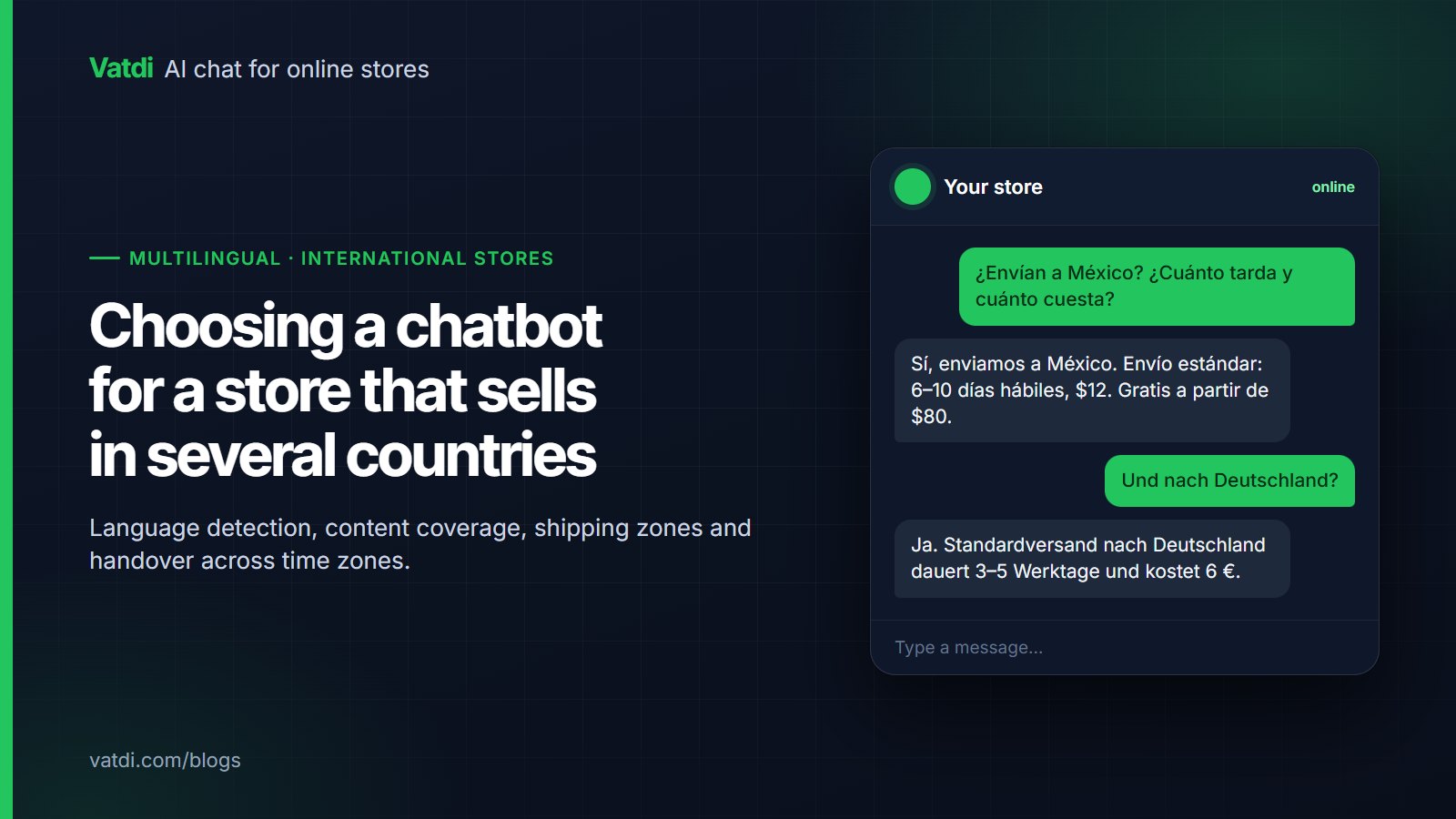
The most common international questions are not about language at all: do you ship to my country, how long does it take, what does it cost, will I pay import duties, which currency will I be charged in. A bot can only answer these from structured content. Put a shipping-zones table on one page (destination, service, days, price, free-shipping threshold), state the duties policy explicitly per region, and keep prices in the synced catalogue so the bot never quotes a stale figure. The example below is what a good answer looks like once the table exists; without it, the bot should say it does not know and hand over, which is the correct behaviour rather than a failure. More on this in AI chatbot for shipping queries.
It is worth the effort: the Baymard Institute's running average puts cart abandonment at about 70% (Baymard cart abandonment statistics), and unexpected shipping cost and unclear delivery are among the reasons shoppers give. A shopper who gets "6–10 business days, $12, free over $80" in their own language before checkout has one less reason to leave.
Widget labels and the offline notice
Answer language is half the experience. If the answer is in Spanish but the input placeholder says "Type your message", the pre-chat form asks for "Email" and the offline notice says "We're away", the widget still feels foreign. Check that every label follows the detected language, that you can edit each translation per store (an AI first draft you review is the practical middle ground), and that the language attribute on the widget is set correctly so screen readers pronounce it properly; the W3C explains why in its note on declaring language in HTML. Vatdi translates every widget label per store with an editable AI draft.
Handover across time zones
International stores get requests around the clock; the team does not work around the clock. Three settings make this honest. Enter real agent hours, so outside them the widget says no one is available and when someone will be. Turn on email and browser alerts so the first person in sees the overnight handovers. And decide which topics always escalate (refunds in progress, damaged goods, payment disputes) so the bot collects the details in the shopper's language and a person follows up in theirs. The count of missed handovers, reviewed weekly, tells you whether your hours match your markets. Details in what chatbot human handover is.
A test plan per market
Do not trust the feature list. Before launch, build a small test set per language you sell into and run it in the live widget on a phone. Ten questions per language is enough to find the failures that matter.
- Three product questions: fit or size, compatibility, stock of a specific variant. Pass when the product card shows and the product name is not translated.
- Three policy questions: returns window, who pays return shipping, payment methods. Pass when the answer quotes the number from your page.
- Two destination questions: do you ship to my country, how long and how much. Pass when the answer comes from your shipping-zones table.
- Two negative cases: a product you do not sell and an exact delivery date. Pass when the bot declines the first and gives a range for the second, both in the shopper's language.
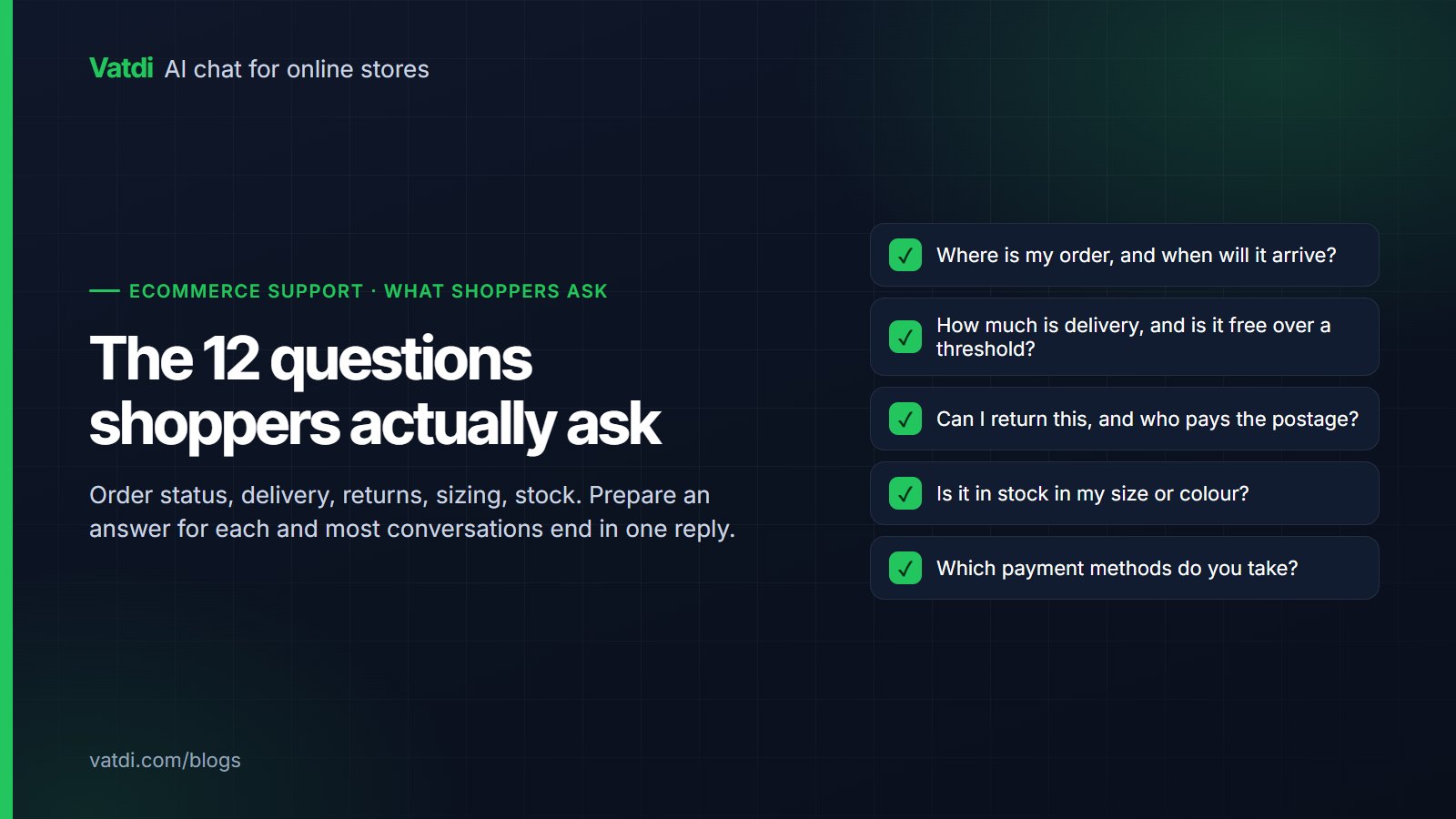
The twelve questions shoppers ask a store chatbot is a good source for the product and policy items; pick the ones your inbox actually receives.
Choosing between tools
Language handling is one axis; the others are the same as for any store chatbot: whether it answers from your catalogue, whether it can look up an order, how it hands over, and what the bill does as conversations grow. Our seven-tool comparison covers those with published prices as of September 2026, and the best multilingual chatbot page ranks tools on the language axis specifically. For a small or mid-sized store on WooCommerce, OpenCart, PrestaShop, Magento or a similar platform, Vatdi's combination of automatic detection, editable label translations, catalogue sync and a flat price is the practical default; if your customers reach you mostly through Messenger or WhatsApp, a multichannel inbox matters more than any of this, and Vatdi does not offer those channels.
Frequently asked questions
Do I need to translate my product catalogue for a multilingual chatbot?
No, not for a language-aware retrieval bot. It finds the matching product or policy passage in the language your content exists in and writes the answer in the shopper's language. Keep product names untranslated so the product card and the answer match, and spot-check terms with legal weight, such as the returns window, once per market language. Translating a shipping-zones table into each language is optional; the numbers carry across.
How does the chatbot know which language to answer in?
Good tools detect it from the shopper's message rather than from the browser setting, and re-detect on each message so a shopper who switches language gets a matching reply. Short or ambiguous messages such as "ok" or a product code cannot be detected reliably, which is why you set a fallback language. Vatdi detects across 95+ languages and uses the fallback you choose when detection is not possible.
Can a multilingual chatbot answer shipping and customs questions per country?
Only if the information exists in your content in a structured form. Put a shipping-zones table on one page with destination, service, delivery days, price and free-shipping threshold, and state your duties policy per region. The bot then answers per destination in the shopper's language. Without that page it should say it does not know and offer a person, which is correct behaviour rather than a failure.
What about the widget's own text, like buttons and the offline message?
Check this specifically during a trial; it is where many tools fall short. Every label the shopper sees, including the input placeholder, quick replies, the pre-chat form and the offline notice, should switch with the detected language, and you should be able to edit each translation. Vatdi translates every widget label per store with an AI draft you review, and the language attribute is set so assistive technology reads it correctly.
How do we handle handover when the team does not speak the shopper's language?
Let the bot collect the details in the shopper's language and set expectations honestly: real agent hours, an offline notice that says when someone will reply, and contact capture so the follow-up can happen by email. Agents can reply in their own language and rely on the customer's tools to translate, but the promise made by the widget should never exceed what the team can do.
Do languages cost extra on Vatdi?
No. All languages, automatic detection, the fallback setting and per-store label translations are included on every plan, including Free. As of September 2026 the plans differ only in the monthly conversation limit (15 on Free, 150 on Starter at $4.49 a month, unlimited on Grow at $7.49 a month) and in whether the "Powered by Vatdi" badge can be removed.