A weekly chatbot review is the difference between an assistant that improves and one that quietly goes stale, and it takes ten minutes. Four things to look at, three things to change, and a clear rule about what to leave alone. The failure mode it prevents is silent: nothing errors when an assistant goes out of date, so nobody notices until a customer is told the wrong thing.
The four things, in order
| Look at | What you are asking | Typical action |
|---|---|---|
| Unanswered questions | What did customers ask that we could not answer? | Write or fix the page behind the top three |
| Low-rated answered conversations | Was the answer wrong, or just unhelpful? | Fix the content or the wording on that page |
| Handover waits | Are escalations actually being served? | Adjust hours or the promise the assistant makes |
| One order lookup | Is the connection still working? | Investigate if it fails; nothing if it works |
That order matters. The unanswered list is where the value is, so read it first while you still have attention; the order lookup is a thirty-second health check that belongs last.
The unanswered-question list
This is the only report that arrives with its own instructions. Each line is a question a customer asked in their own words and your content could not answer. Read the whole list, then pick the three that appear most often and trace each to a cause: a missing page, a policy detail buried in the terms, an empty product attribute, or a fact that exists only inside an image. Fix those three and stop. Trying to clear the list in one sitting is how the habit dies in week three. Over a couple of months the list shortens to genuinely unusual questions, which is the practical definition of finished.
Reading low ratings properly
Read the conversations rather than the score. A low rating on a correct answer about a restrictive returns policy is information about the policy, not about the assistant. A low rating on a wrong answer is two pages contradicting each other, and the fix is to remove one copy. The metric set this fits into is in the six chatbot KPIs worth watching.
Handover waits, split by hours
Look at the in-hours figure and the out-of-hours figure separately, because blending them hides a long overnight tail behind a healthy median. Two questions follow. Are in-hours escalations being picked up quickly enough to match what the assistant promises? And does the out-of-hours message tell customers the truth about when they will hear back? If either answer is no, the fix is usually the promise rather than the staffing: saying "first thing Monday" is better than saying "shortly" and meaning Monday. The rules are in chatbot human handover.
The thirty-second health check
- Run one order lookup with a real order number and its email.
- Confirm the status wording still reads correctly to a customer.
- If it fails, check whether a plugin or platform update changed the order reference.
- Open the storefront on a phone and confirm the launcher is still visible.
- Stop. That is the whole check.
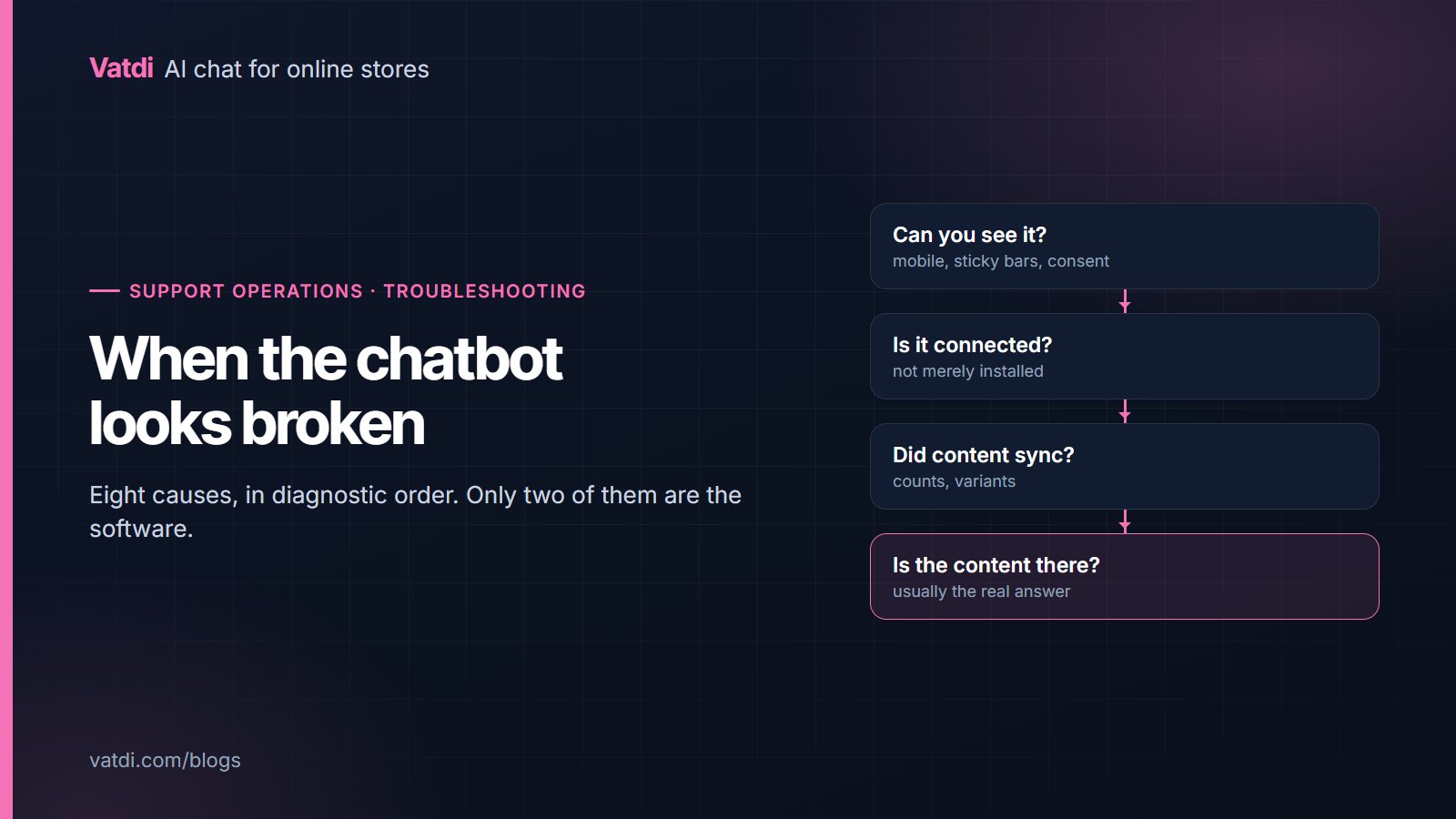
Both failures are silent: nothing errors when an integration breaks or a theme update hides the widget. The diagnostic order for either is in chatbot installation troubleshooting.
What to resist
- Editing the instructions. Almost every disappointing answer is a content gap; instruction edits introduce regressions you will not notice for weeks.
- Chasing the deflection number. It moves for seasonal reasons and it can be gamed by hiding the handover route.
- Adding sources. More content is usually worse; the fix is better pages, not more of them.
- Rewriting quick replies weekly. Change them quarterly, on evidence, as covered in chatbot quick replies.
- Making the review longer. A thirty-minute version is skipped after a fortnight; a ten-minute one survives.
Keeping a record
Write one line a week somewhere you will find it again: the date, the three things you fixed, and anything that surprised you. It takes thirty seconds and it earns its place twice. First, it shows whether the same gap keeps reappearing, which usually means the fix was applied to the wrong page or a second copy of the fact exists elsewhere. Second, it is the evidence that answers the question of whether the assistant is worth its subscription, and it answers it far better than any dashboard figure, because it lists concrete improvements to the storefront rather than a percentage. After three months the record also makes the seasonal pattern visible, which is useful when peak weeks arrive and the question mix changes.
Once a month, add two things
Count repeat contacts, the same person asking the same question within a few days across chat and email, which is what separates answered from resolved. And look at whether conversations mentioning a product are followed by orders from the same visitor, as a signal rather than attribution. Both take a few minutes and neither needs new software. The honest treatment of the underlying metric is in chatbot deflection rate, and the value case that sits on top of it in chatbot ROI for a small store.
Who should do it
Whoever can edit the content, because the review produces edits rather than observations. Splitting the job, one person reading conversations and another making changes, introduces a delay that usually turns three fixes a week into three a month. In a small store that means the owner or whoever writes the product pages. Put it in the calendar on a fixed day, because an unscheduled ten minutes is the first thing a busy week removes, and the value of this loop comes entirely from its regularity rather than from any single session.
Why the loop works
A grounded assistant answers from your published content, so a page edit changes the answer immediately, the mechanism described in Lewis et al., 2020. That means the weekly loop compounds: each fix removes a recurring failure permanently rather than patching one conversation. It also improves the storefront for visitors who never open the chat window, which is the argument Google makes about helpful content. Every Vatdi plan includes the dashboard, ratings and the unanswered-question list; allowances are on the pricing page as of September 2026.
Frequently asked questions
What should I check in a weekly chatbot review?
The unanswered-question list, the lowest-rated answered conversations, handover waits split by inside and outside hours, and one order lookup as a health check. Ten minutes covers all four for a small store, and the unanswered list is where nearly all the value sits.
How many things should I fix each week?
Three. Clearing the whole list in one sitting is how the habit dies, and the top three by frequency capture most of the benefit anyway. Over a couple of months the list shortens to genuinely unusual questions, at which point the content is finished for practical purposes and the review becomes a two-minute glance.
Should I change settings during the review?
Rarely. Almost every disappointing answer is a content gap rather than a configuration problem, and instruction edits introduce regressions that surface weeks later. If you do change something, change one thing and re-run your question set afterwards, keeping the previous version so you can revert rather than patch.
What does a low rating actually tell me?
Read the conversation to find out. It may be a wrong answer caused by two pages disagreeing, an incomplete answer because an exception was never written down, or a correct answer the customer did not like. Only the first two need action.
Why check order lookup every week?
Because it fails silently. A plugin update, a change to order numbering or a platform upgrade can break it without producing an error, and the first sign is customers being told their order cannot be found. Thirty seconds a week catches it early, which matters most in the weeks when you are busiest and least able to investigate.
Is ten minutes really enough?
For a small store, yes, and a review that fits in ten minutes is one that actually happens. Add the two monthly checks, repeat contacts and whether product conversations precede orders, and that is the entire ongoing commitment for a store of this size, which is considerably less than most owners expect when they start.