Chatbot deflection rate is the share of conversations that end without a person, and it is the easiest support metric to fool yourself with. A customer who gave up in frustration counts exactly the same as a customer who got their answer. Measured honestly it is still worth tracking, because the direction tells you whether your content is keeping up. This guide covers the definitions, the honest measurement, and what to change when it moves.
Three definitions, three different numbers
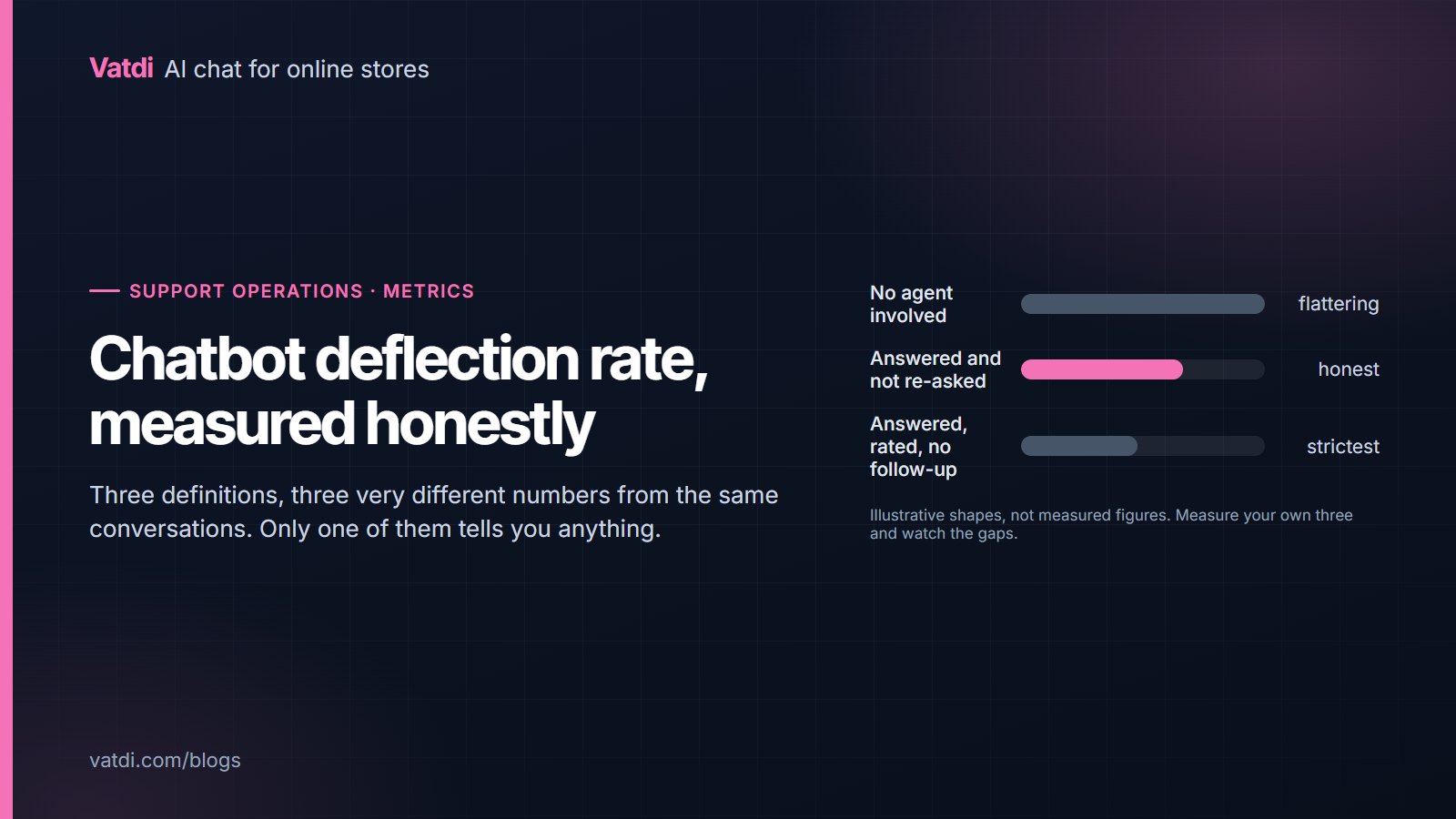
Vendors and teams use "deflection" to mean at least three things, and the same week of conversations produces very different rates depending on which one you pick. Agree on one before anyone reports a number.
| Definition | What it counts | What it hides |
|---|---|---|
| Containment | Conversations where no agent was ever involved | Abandonment. Someone who closed the window in disgust is "contained" |
| Answered and not re-asked | Conversations the assistant answered where the same person did not come back with the same question or email you | Silent dissatisfaction that never re-contacts |
| Answered, rated and no follow-up | As above, with a positive rating attached | Most people never rate, so the base is small |
The middle one is the number worth reporting. Containment flatters, the strictest version has too small a sample to steer by, and the middle version at least punishes the failure modes you care about. Report one definition consistently, and say which one in the report header.
How to measure the honest version
- Pick a period and a base. One calendar month of conversations, excluding your own testing.
- Remove conversations that reached an agent. Handover requests and assignments both count.
- Remove abandoned conversations where the visitor left before the assistant replied at all. They were never deflected; they were lost.
- Remove repeat contacts. Same visitor, same question, within a few days, whether by chat or email. This is the step most teams skip, and it is the one that makes the number honest.
- Divide by the base and record the definition alongside the figure.
In Vatdi the dashboard gives you the pieces: conversations in the period, which ones requested or received a human, and ratings. The repeat-contact step needs a glance at your inbox, which is worth the ten minutes once a month.
Why published benchmarks mislead
Any deflection benchmark you read is somebody else's store, with their catalogue, their policies, their question mix and their definition. A store selling one configurable product has different traffic from a store selling ten thousand SKUs. The only comparison that means anything is your own store against itself last month. We publish figures from our own conversation data in our ecommerce chatbot statistics, with the method stated, precisely so they are read as one data set rather than an industry law. Treat vendor claims the same way: ask which definition, which stores, and over what period.
Where the idea comes from, and its limits
Deflection arrived from helpdesk reporting, where the thing being deflected was a ticket with a cost attached. Store chat is different: many conversations would never have become a ticket at all, because the shopper would simply have left. That is why deflection in ecommerce is better read as a content-coverage signal than a cost saving. Two outside references help keep it honest. Baymard's long-running checkout research on cart abandonment documents how unanswered delivery and returns questions push shoppers out of a purchase, which is the loss a store should care about more than a deflected ticket. And the retrieval method that lets an assistant answer from your own pages, rather than a scripted tree, is described in Lewis et al., 2020; it explains why adding a page usually moves this number, and why prompt tinkering usually does not.
What moves the number
- Missing content. Most failures are a question with no page behind it. The unanswered-questions list is your work queue; the format that fixes it is in how to write a chatbot knowledge base.
- Stale policies. A changed returns window that nobody updated produces answers that are wrong, then a handover, then a complaint.
- Catalogue gaps. Empty attributes mean the assistant cannot answer "is it waterproof?". Filling attributes on the top fifty products moves more conversations than any prompt change.
- Order lookup not connected. Order status is the most common question in store chat, and without the plugin connection every one of them becomes a handover.
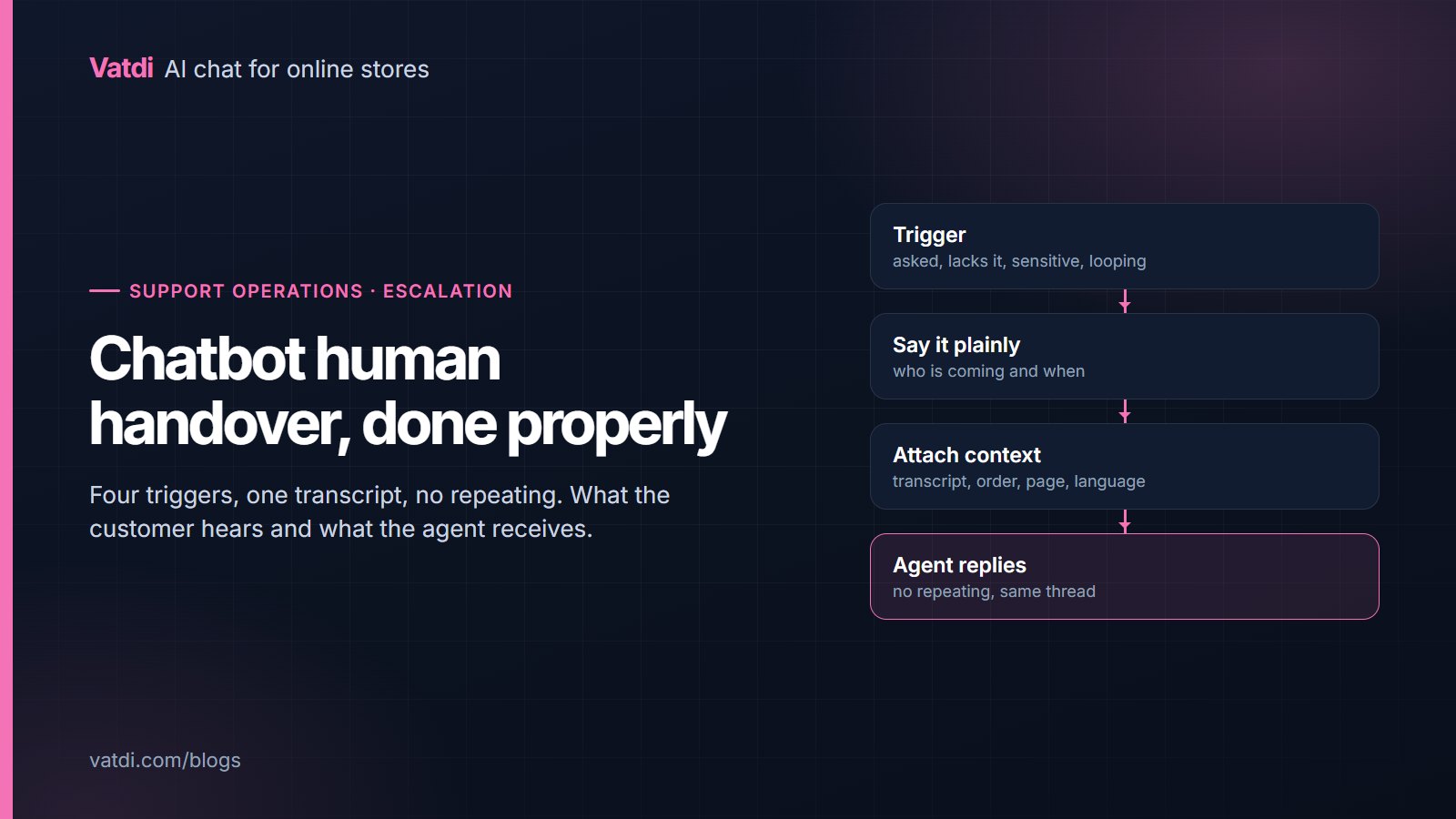
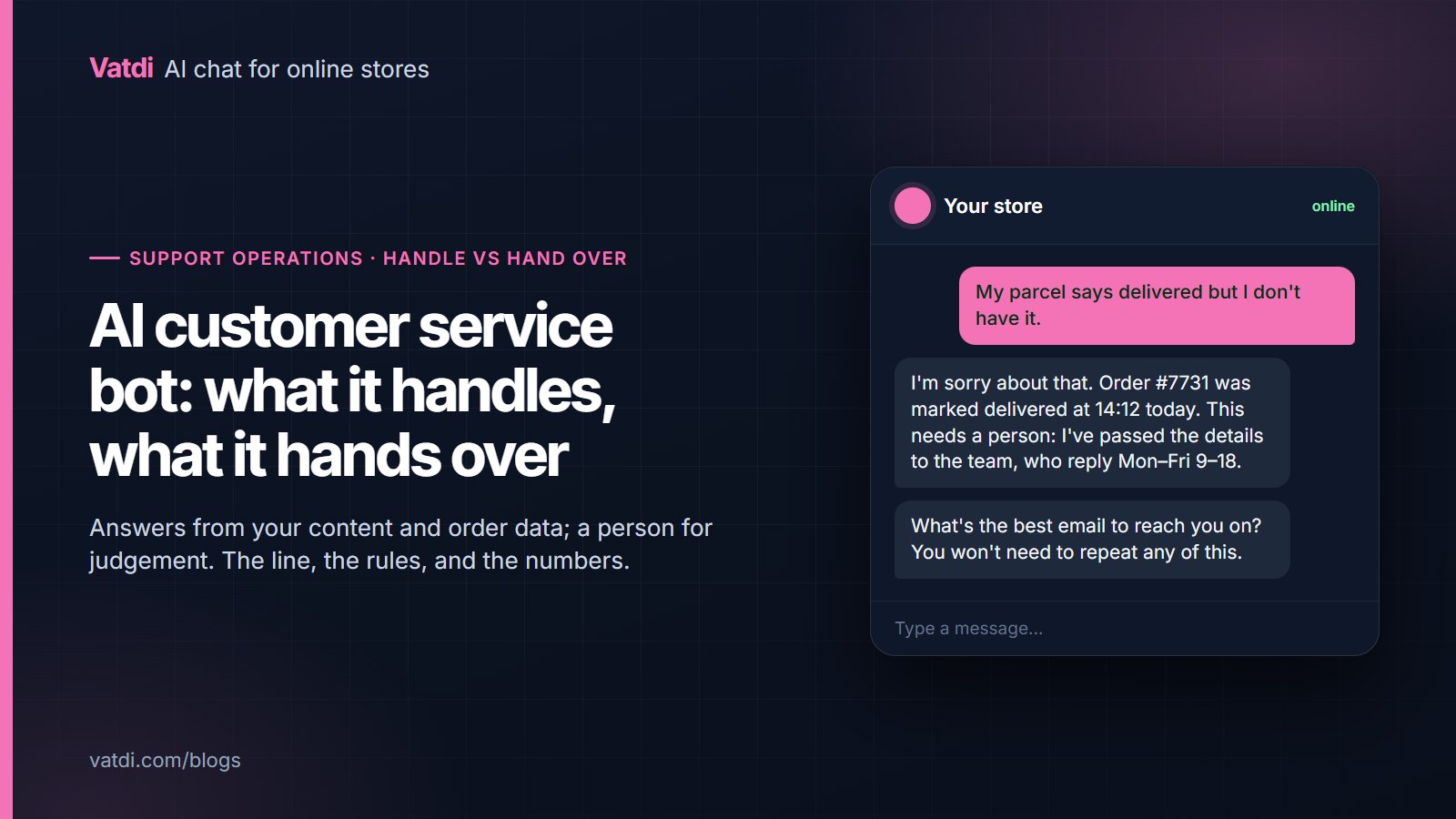
- Handover rules set too wide. Escalating every message containing "refund" sends policy questions to a person; the rules worth setting are in chatbot human handover.
- Seasonality. A delivery-deadline month raises the share of questions the assistant can answer; a returns month raises the share that need a person. Compare like with like.
What not to do with it
Do not set a deflection target for the team, because the easy way to hit it is to hide the handover button. Do not chase the number upward past the point where customers get worse service; a complaint that reaches a person quickly is a good outcome with a bad effect on deflection. And do not report it alone. Paired with ratings on answered conversations and with time to first agent reply, it tells a true story; on its own it is a vanity metric. For the broader context of whether assistant or live chat fits your team at all, see chatbot vs live chat.
A monthly review that takes ten minutes
- Note the honest deflection figure and last month's, in the same definition.
- Read the unanswered-question list and pick the three that appear most.
- Fix the page or attribute behind each; publish.
- Skim the lowest-rated answered conversations and check whether the content or the wording was at fault.
- Check that order lookup still works with one live order number.
That loop, run monthly, does more than any settings change. The full setup sequence around it is in the AI chatbot implementation guide, and the plan allowances that govern how many conversations you can run are on the pricing page, where every feature including the dashboard and handover is on every plan as of September 2026.
Frequently asked questions
What is a good chatbot deflection rate?
There is no honest universal answer, because the figure depends on your question mix, your catalogue and which of the three definitions you use. The useful question is whether your own rate is rising or falling against the same definition and a similar season. A store whose rate improves month over month while ratings hold steady is doing the right things, whatever the absolute number.
How is deflection different from resolution?
Deflection counts conversations that did not reach a person; resolution counts conversations where the customer's problem was actually solved. They diverge whenever someone gives up, gets a wrong answer and leaves, or emails you instead. That gap is why the honest measurement subtracts abandoned conversations and repeat contacts before dividing.
Does a high deflection rate mean customers are happy?
Not by itself. Containment counts the frustrated customer who closed the window exactly like the satisfied one who got an answer. Read deflection next to ratings on answered conversations and the volume of email arriving on the same topics. If deflection rises while email on the same questions also rises, the number is lying to you.
How do I count repeat contacts?
Look for the same visitor or email address asking the same question within a few days, across chat and email. Most small stores can do this by eye in ten minutes a month. It is the step that separates a number you can act on from one that only flatters, so it is worth the time even when it is manual.
Should I set a deflection target for my team?
No. Targets on this metric reward hiding the route to a person, which damages service and eventually sales. Set targets on content instead: questions answered, pages fixed, attributes filled. Deflection then moves as a consequence, and when it does not you learn something real about what customers are asking.
Where do I see these numbers in Vatdi?
The dashboard shows conversations in a period, which ones requested or received a person, and the ratings customers left, on every plan. The repeat-contact subtraction is the one step that needs a look at your own inbox. Nothing about analytics is gated behind a higher tier; the plans differ in conversation allowance, content caps and the badge.