The same chatbot mistakes appear on store after store, and almost none of them are technical. They are decisions: to gate the conversation, to hide the route to a person, to let the assistant guess rather than decline. Each one costs conversations or trust, and each has a fix that takes under an hour. Here are the ten worth checking on your own store this week.
The ten, and what each costs
| Mistake | What it costs | The fix |
|---|---|---|
| 1. Email gate before any answer | The visitor leaves with nothing; you get neither lead nor sale | Answer first, ask once, only when there is a reason |
| 2. Hiding the route to a person | Frustration, then a public complaint | Offer a person whenever asked, immediately |
| 3. Guessing instead of declining | A wrong promise becomes a refund | Use a grounded assistant and test the negative cases |
| 4. Promising delivery dates | One late parcel, one angry review | Quote the range and the cut-off |
| 5. Crawling the whole site | Vague answers, old promotions resurfacing | Choose the pages that answer; leave archives out |
| 6. Agent hours that lie | Broken expectations at the worst moment | Publish real hours and honour them |
| 7. Escalating every mention of "refund" | Your inbox fills with policy questions | Escalate complaints, not policy lookups |
| 8. Auto-opening over a product image | Interrupted shoppers, fewer conversations | Closed by default, visible, not intrusive |
| 9. Never reading the conversations | The same failure repeats for months | Ten minutes weekly on the unanswered list |
| 10. Two versions of the same fact | Confident contradictions nobody can trace | One authoritative copy, linked from everywhere |
The three that cost the most
The gate is covered in chatbot lead capture, the dead end in chatbot human handover, and the guess in chatbot guardrails for online stores. Fix those three and the rest are tidying.
The quiet ones that erode quality
- Crawling everything. Blog archives and tag pages compete with the returns page during retrieval, so answers get vaguer as your site grows. Choose sources deliberately, as argued in what to feed a store chatbot.
- Duplicate facts. The returns window in the footer, the FAQ and the terms will eventually diverge, and the assistant quotes whichever it finds.
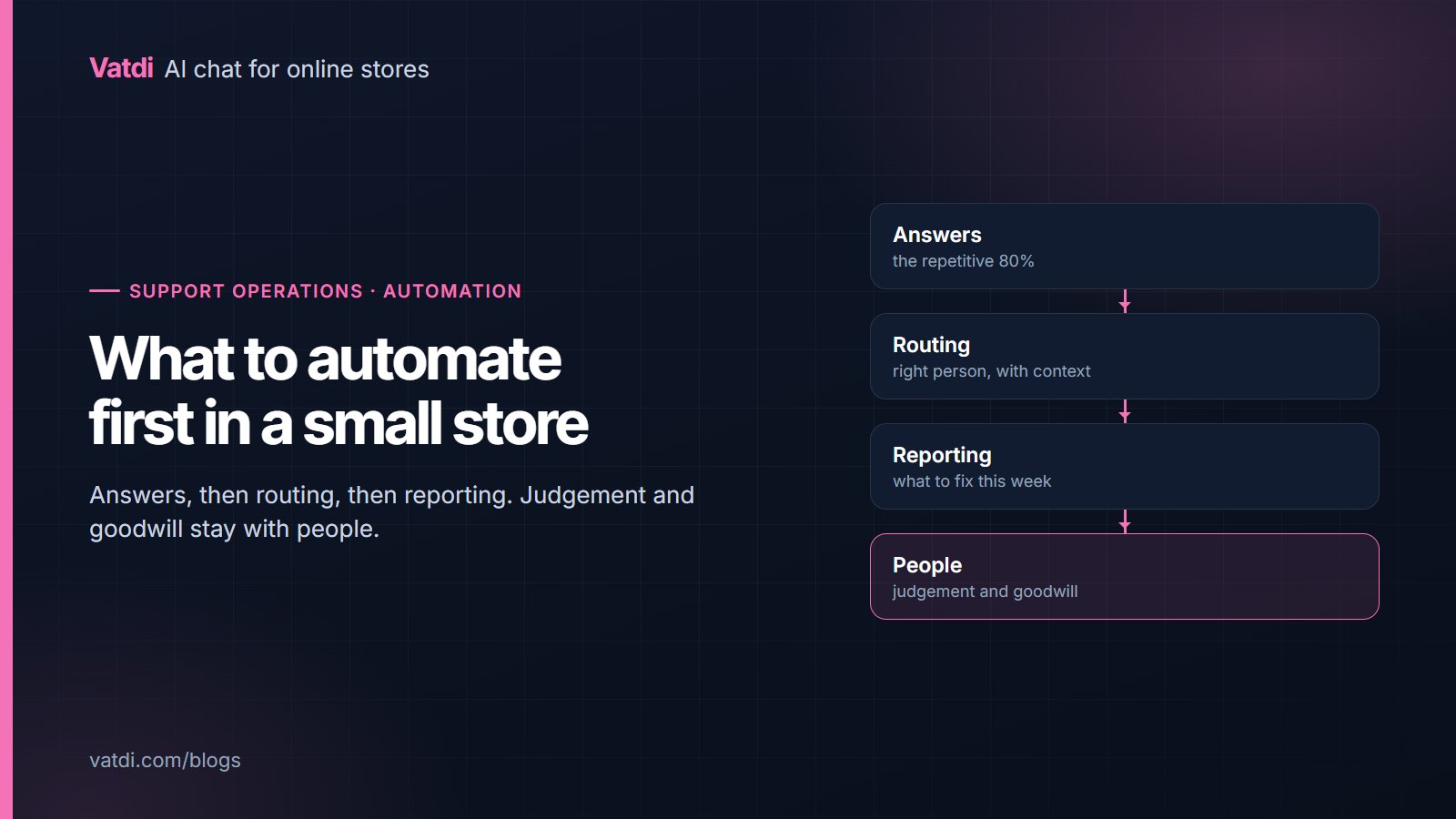
- Never reading conversations. The unanswered-question list names your next three content fixes; ignoring it means the same failure recurs weekly.
- Image-only content. Size charts and rate tables as graphics are invisible to the assistant, to search and to screen readers.
- Setting and forgetting. An assistant accurate in March drifts as policies change, quietly, with no error to alert you.
Two mistakes in how stores judge the results
The first is measuring the wrong thing. A high containment rate looks like success and counts the frustrated customer who closed the window exactly like the satisfied one, which is why the honest measurement subtracts abandonment and repeat contacts. The second is judging the assistant on its fluency rather than on what it says when your content is silent. Modern systems write well regardless of whether they have the facts, so a smooth demo tells you very little. Ask the questions you cannot answer and watch what happens; that single test predicts how the assistant will behave on the day a customer asks something nobody anticipated, which is the day that actually matters.
Mistakes of tone
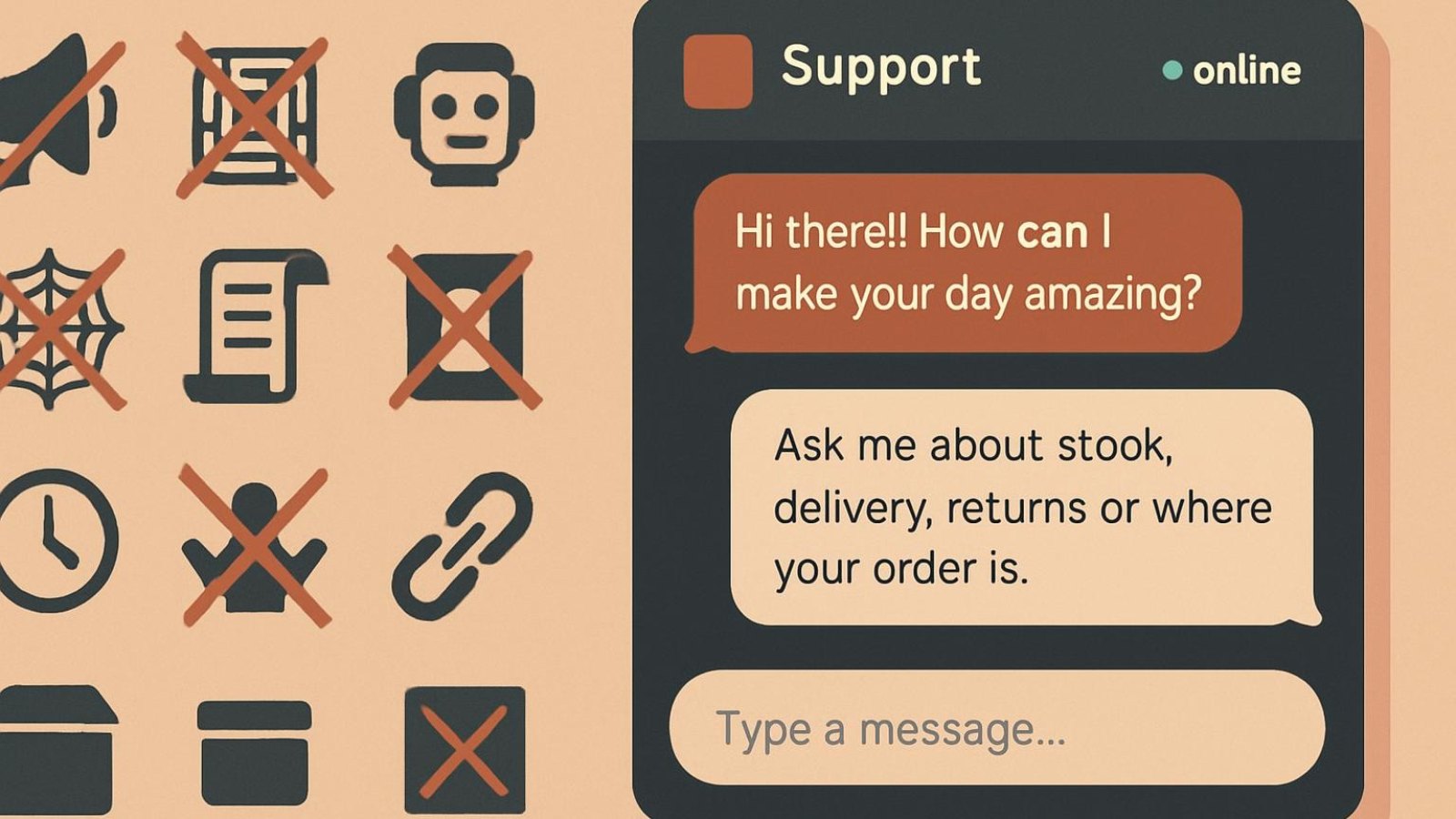
Three wordings do more damage than they appear to. Excessive cheerfulness in reply to a complaint reads as indifference, so match the register to the situation. Long preambles before the fact waste the one thing a chat reader wants, which is the answer. And apologising on behalf of a person who has not seen the message yet sets up a resolution the assistant cannot deliver. A neutral, specific reply that ends with a clear next step is better than a warm one that does not. The register that works in store chat is the one a competent colleague would use: direct, unhurried, and free of performance. The wording patterns that work are collected in ecommerce chatbot examples.
The mistake behind most of the others
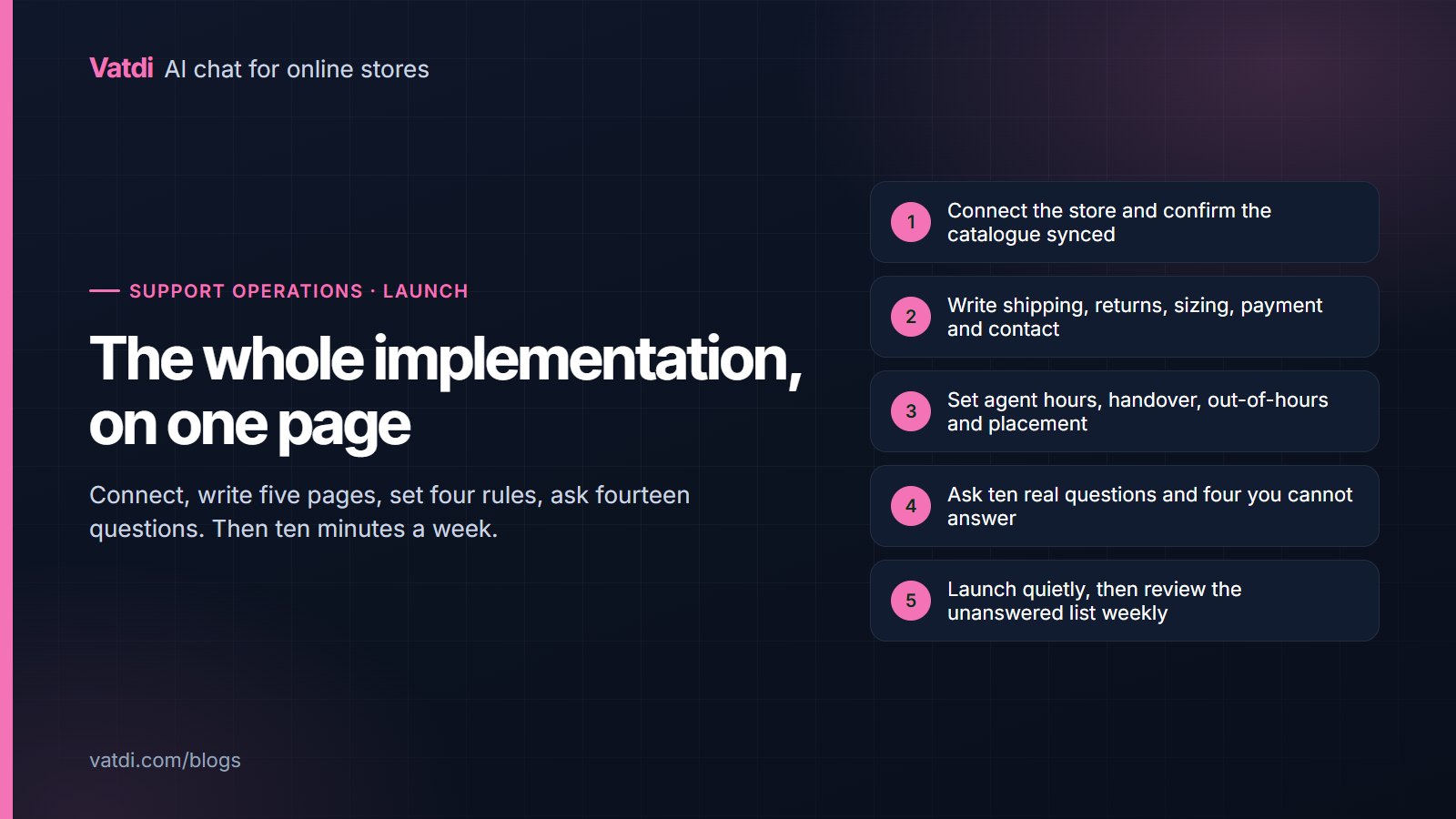
Treating the assistant as a configuration exercise rather than a content one. Nearly every complaint about answer quality traces back to a page that does not say what it needs to say: a cut-off time held only in the warehouse, an exclusion buried three screens down, an empty product attribute. Instructions and settings cannot compensate for that, and time spent tuning them is usually time not spent writing the sentence that would have fixed it. The order of work that avoids this is in the AI chatbot implementation guide, and the underlying reason is the retrieval design described in Lewis et al., 2020.
The mistake of launching too loudly
Announcing an assistant on day one puts the largest audience in front of the version with the most gaps. The first week of real questions is where you learn what your content is missing, and that learning is cheaper with ten visitors than with a thousand. Launch quietly, read every conversation, fix what the unanswered list names, and promote it a fortnight later if you want to. The same logic applies to placing it on every page immediately: start with product and policy pages, where the questions actually arise, and widen once the answers are good. Nobody is watching closely enough in week one for a quiet launch to cost you anything.
A thirty-minute audit
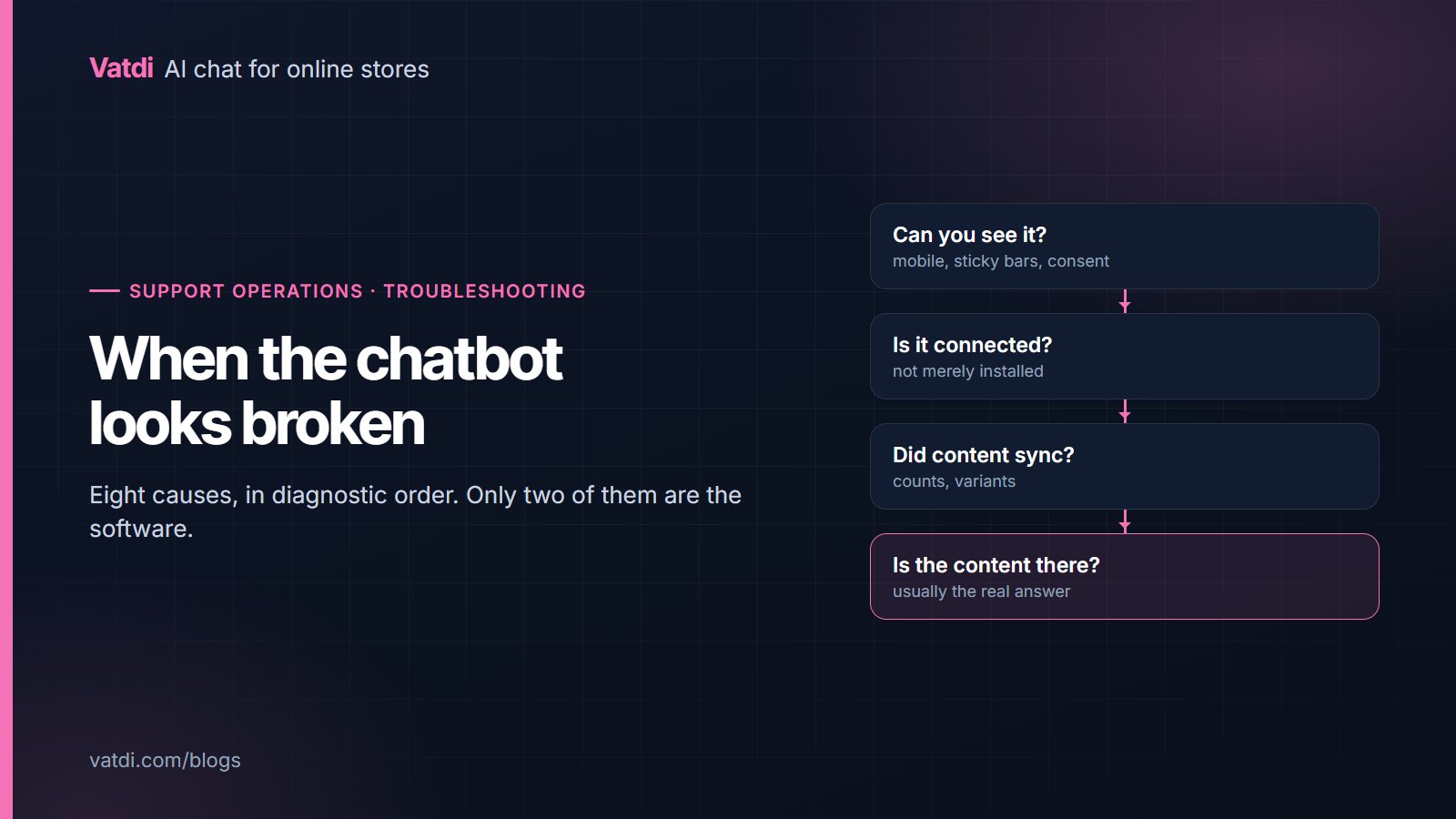
- Open your own widget as a customer on a phone. Can you see it? Does it interrupt?
- Ask a question you cannot answer. Does it decline honestly and offer a person?
- Type "human". Does it hand over immediately?
- Ask about delivery timing. Does it quote a range or invent a day?
- Check whether the returns window appears in more than one place on your site.
- Read last week's unanswered questions and fix the top three.
Six checks, most failures fixable the same day. Do them as a customer on a phone rather than as an admin on a desktop, because that is the view every visitor gets. Vatdi includes handover, agent hours, the dashboard and the unanswered list on every plan, with allowances on the pricing page as of September 2026. Baymard's research on cart abandonment is a reminder of what the first three mistakes actually cost, since the questions being blocked are the ones shoppers ask before deciding.
Frequently asked questions
What is the biggest chatbot mistake?
Asking for an email address before answering anything. The visitor came for a fact, hit a form, and left, which costs both the sale and the lead the form was supposed to capture. Answer first, then ask once if there is a genuine reason to follow up.
Why do people say they hate chatbots?
Mostly because of dead ends: no route to a person, repeated unhelpful replies, and confident wrong answers. None of those are inherent to the technology. An assistant that answers accurately, admits what it does not know and hands over on request gets a very different reaction.
Should the bot always offer a human?
It should hand over whenever asked, without attempting to deflect, and offer proactively when it lacks an answer or the topic is a complaint. Proactively offering on every routine question is unnecessary and slows people down, so the rule is on request plus the specific triggers.
Why are the answers vague?
Usually because the assistant is reading too much. Blog archives, tag pages and old promotions compete with the pages that actually answer. Narrow the sources to the content that answers questions, then rewrite those pages with a heading per question.
How often should I check my own chatbot?
Ten minutes a week on the unanswered-question list and the lowest-rated conversations, plus a thirty-minute audit every quarter. That is enough for a small store. The failure mode to avoid is never looking, because nothing errors when an assistant quietly goes out of date.
Can these mistakes be fixed without switching tools?
Almost always, because they are decisions and content rather than software limits. The exceptions are a tool that cannot decline honestly or cannot hand over to a person. If yours guesses when your content is silent, that is worth changing; everything else on the list is yours to fix.