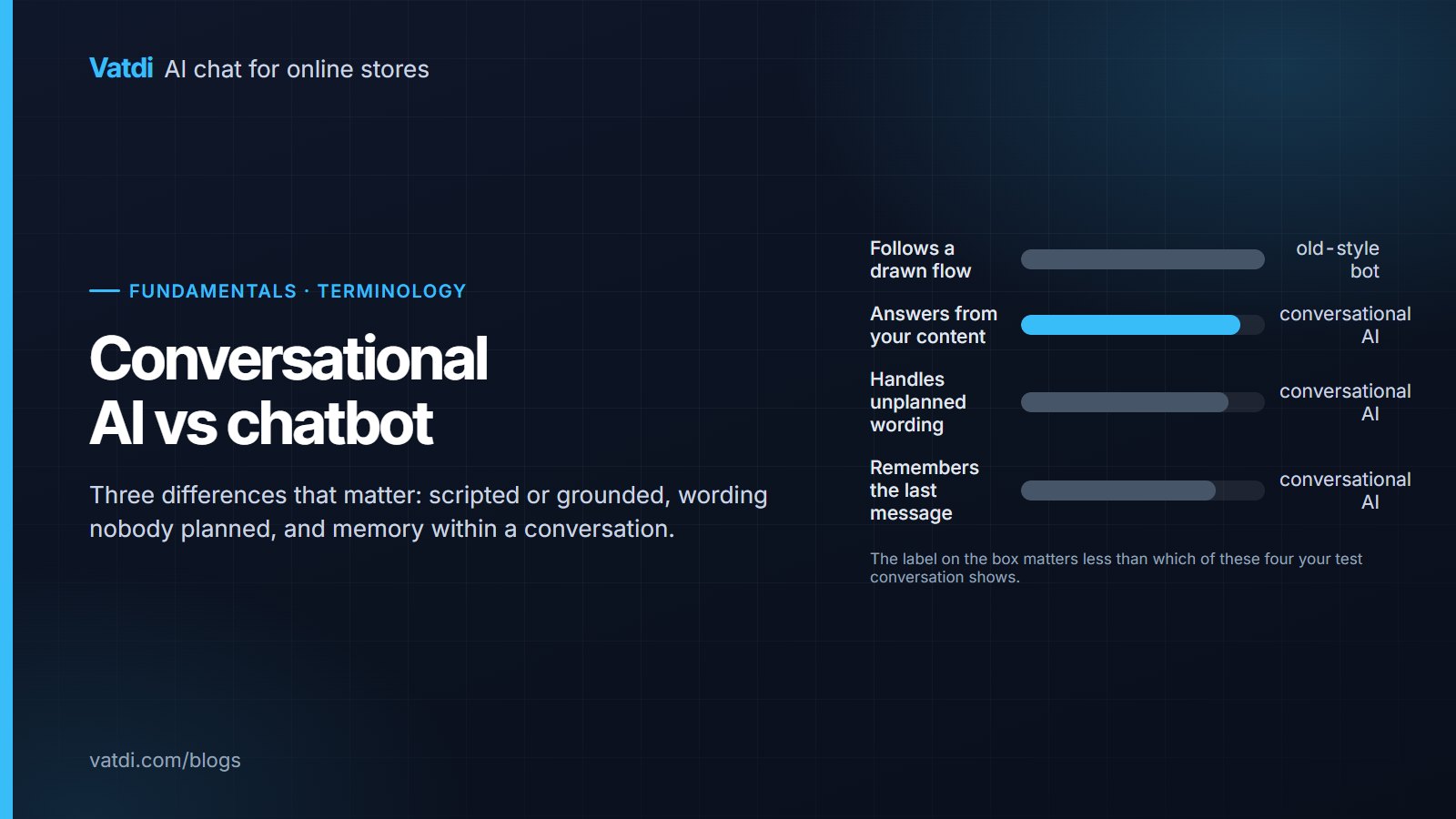
Conversational AI vs chatbot is largely a vocabulary argument, and vendors use both words for the same product. Three real differences sit underneath the labels: whether the software follows a script or reads your content, whether it copes with wording nobody anticipated, and whether it holds context across a conversation. Those three are testable in ten minutes, which is more useful than any definition.
Where the terms came from
| Term | Original meaning | How it is used now |
|---|---|---|
| Chatbot | A scripted program answering fixed inputs, often with buttons | Any chat window with automation behind it |
| Conversational AI | Systems using language understanding rather than keyword matching | A marketing upgrade on "chatbot", sometimes justified |
| Virtual assistant | A broader assistant covering several tasks | Mostly enterprise vocabulary for the same thing |
| AI agent | Software permitted to take actions in other systems | Often read-only lookups; covered in a separate guide |
None of these words tell you what a product does. A "conversational AI platform" can be a flow builder with a natural-language veneer, and a product modestly calling itself a chatbot can be fully grounded in your catalogue. The distinction that matters is behavioural, so test behaviour. The related question of action-taking is covered in chatbot vs AI agent.
Difference one: scripted or grounded
A scripted bot answers what someone drew. Every path exists because a person built it, which makes the answers exact and the coverage narrow: a question outside the flow produces a menu or a dead end. A grounded assistant searches your pages, products and policies for each question and composes an answer from what it finds, the approach described in Lewis et al., 2020. That changes who does the work. With a script, someone maintains the flows; with a grounded assistant, someone maintains the content, which customers also read. The trade-off is covered at length in no-code chatbot builder vs an AI trained on your own data.
Difference two: wording nobody planned
Shoppers write in fragments, with typos, in several languages, and often without naming the thing they mean. Handling that reliably is the main practical benefit of language understanding, and it is why the same knowledge base can serve several markets, as covered in multilingual chatbot setup.
Difference three: context within a conversation
A conversation is not a series of independent questions. "Is the medium in stock?" followed by "and in black?" only makes sense if the second message inherits the first. Scripted systems usually lose that, which is why they ask people to start again. Test it deliberately: ask a question, then a follow-up that omits the subject, then a third that changes one variable. Anything that answers all three has real conversational handling; anything that responds to the second with a generic menu does not, whatever the website calls it.
Four questions that reveal which you have
- Ask something your content covers, in unusual wording. A grounded assistant finds it; a script does not.
- Ask a follow-up with the subject left out. Tests context.
- Ask something you genuinely cannot answer. The right reply is an honest decline plus a route to a person, not a plausible invention.
- Change a policy page, then ask about it again. A grounded assistant follows the edit; a script keeps its old answer until someone rebuilds the flow.
The fourth is the most revealing and the least often tested. The full scoring method is in how to test AI chatbot accuracy.
What does not actually differ
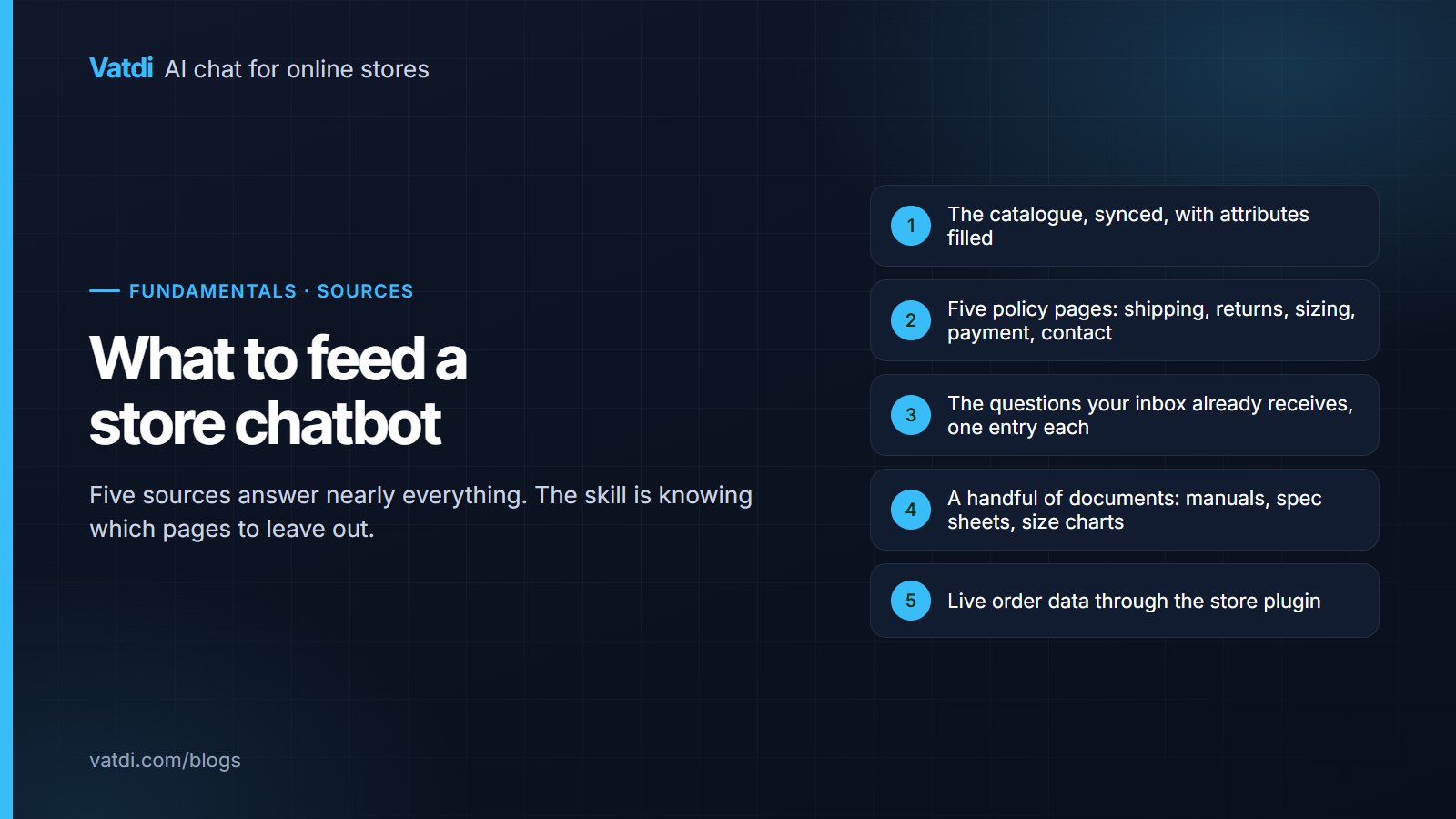
Several things sold as differentiators are common to both. Both can have a launcher, quick replies and a handover button. Both can be free or expensive. Both can be multilingual in the marketing copy and monolingual in practice. And both depend entirely on your content: a grounded assistant with a thin knowledge base declines constantly, while a scripted bot with excellent flows answers its narrow set very well. The technology sets the ceiling; your content decides where you land under it, which is the argument of what to feed a store chatbot.
What each approach costs you in maintenance
- Scripted: every new question is a build task, and every policy change means editing both the page and the flow that repeats it.
- Scripted, at scale: the flows become their own system, with owners, review cycles and a testing burden nobody planned for.
- Grounded: the maintenance is the content, which customers read too, so the work has a second audience.
- Grounded, badly done: contradictory pages produce inconsistent answers, so the discipline is one authoritative copy of each fact.
- Either: somebody still has to read the conversations weekly and act on what failed.
Neither approach is maintenance-free. The question is whether the upkeep produces something only the bot benefits from, or something your customers and your search traffic benefit from as well.
Which matters for a store
For an online store the ranking is clear. Grounding matters most, because store questions are policy and product questions that already have written answers. Wording tolerance comes second, because real shoppers write badly and in a hurry. Context comes third, useful but less decisive than the first two. Action-taking, the thing most often sold as the frontier, matters least for a small store, since the high-volume tasks are reads rather than changes. If a vendor's demo shows an impressive multi-step automation but cannot answer your returns question from your own page, they have solved the wrong problem.
A note on language quality
Fluency is not accuracy. Modern systems produce natural sentences regardless of whether they have the facts, which is exactly why the honest decline matters more than the smooth phrasing. Judge a product on what it says when your content is silent, not on how nicely it says the easy things. That is also why guardrails belong in the evaluation, as set out in chatbot guardrails for online stores, and why Google's framing of helpful content applies as much to the pages an assistant reads as to search.
Practical conclusion
Ignore the label, run the four questions, and choose on the results. Then spend your remaining effort on the content, because that is what moves answers in either architecture. As of September 2026 Vatdi is free for 15 conversations a month with every feature included, $4.49 for 150 and $7.49 for unlimited, with badge removal the only paid extra; see pricing. The order of setup work, whichever tool you choose, is in the AI chatbot implementation guide.
Frequently asked questions
What is the difference between conversational AI and a chatbot?
In current usage, very little: both words are applied to the same products. The differences worth checking are behavioural: whether answers come from your content or a drawn flow, whether unplanned wording works, and whether a follow-up question inherits context. Test those three rather than reading definitions.
Is conversational AI better?
Better at coverage and at handling how people actually write, which matters for a store. It is not automatically more accurate: accuracy comes from the content it reads. A grounded assistant on thin content declines a lot, and a scripted bot with well-built flows answers its narrow set precisely.
Do I need natural language understanding for a small store?
It helps more than it sounds, because shoppers write in fragments and typos and in several languages. The alternative is anticipating every phrasing yourself, which is a maintenance job that never finishes. For twenty recurring questions asked a hundred ways, grounding plus language understanding is the cheaper route.
How can I tell what a vendor is selling?
Change one of your own policy pages and ask about it in the demo. A grounded assistant reflects the edit; a flow-based product keeps its old answer until someone rebuilds the path. That single test separates the categories faster than any feature list or sales call.
Does fluent language mean accurate answers?
No, and conflating the two is the most expensive mistake in evaluation. Modern systems write well whether or not they have the facts. Judge a product on what it does when your content is silent: an honest "I don't have that" with a route to a person is the behaviour you want.
Which term should I use on my own site?
Whichever your customers use, which is usually "chat" or "chatbot". Describing it plainly, such as "ask a question about delivery, returns or your order", beats either piece of industry vocabulary, and it sets expectations that the assistant can actually meet.