Chatbot vs AI agent is mostly a marketing distinction, but one real difference sits underneath it: whether the software only answers questions or also takes actions in your systems. Everything else, the intelligence, the phrasing, the ability to understand a messy question, is now common to both. For a store owner the useful question is not which word a vendor uses but what the product is allowed to change.
What each term actually means
| Term | Common meaning in 2026 | What it does for a store |
|---|---|---|
| Rule-based chatbot | A scripted decision tree with buttons | Answers only what someone drew in the flow |
| AI chatbot (retrieval-based) | Searches your content and writes an answer | Answers questions from the catalogue, policies and order data |
| AI agent | The same, plus permission to take actions through tools | Could change an order, issue a refund, update a record |
| Agentic workflow | Multiple steps chained without a person in between | Useful in back-office automation; rarely needed in store chat |
The boundary is fuzzy on purpose. Looking up an order is technically an action, but a read-only one, and most vendors calling their product an agent mean exactly that. The line worth drawing is between reading and changing.
Reading versus changing
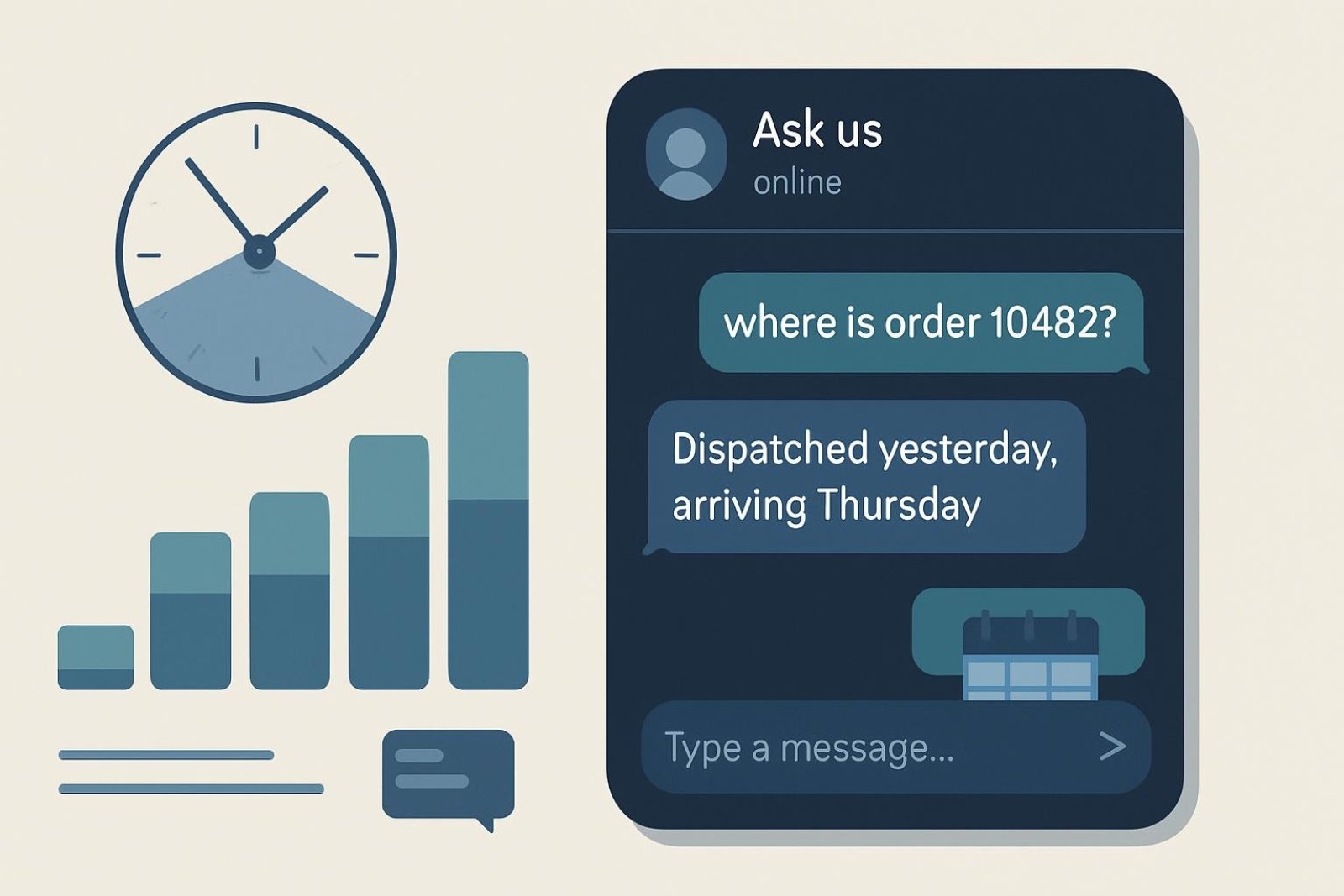
Read-only capability is where nearly all the value sits for a small store. Order status is the single most requested task in store chat, and it is a read. Stock, sizing, delivery windows and policy questions are reads. Vatdi does these through the store plugin on WooCommerce, OpenCart, PrestaShop, Magento, Shopware, Joomla and Drupal, and the same answers come from your own content rather than a script.
When action-taking genuinely helps
- High volume of one repetitive change. If hundreds of customers a month need the same trivial edit, automating it may pay for the risk.
- A change that is easy to reverse. Adding a note to an order is safer to automate than issuing a refund.
- A system with a proper audit trail, so you can see what was changed, by whom and why.
- A team that will actually review the log. Automation without oversight is how small errors become a month of small errors.
Even then, the common design is the assistant preparing the action and a person approving it. That keeps the speed and removes most of the risk, which is the same principle as the escalation rules in chatbot human handover.
When it does not
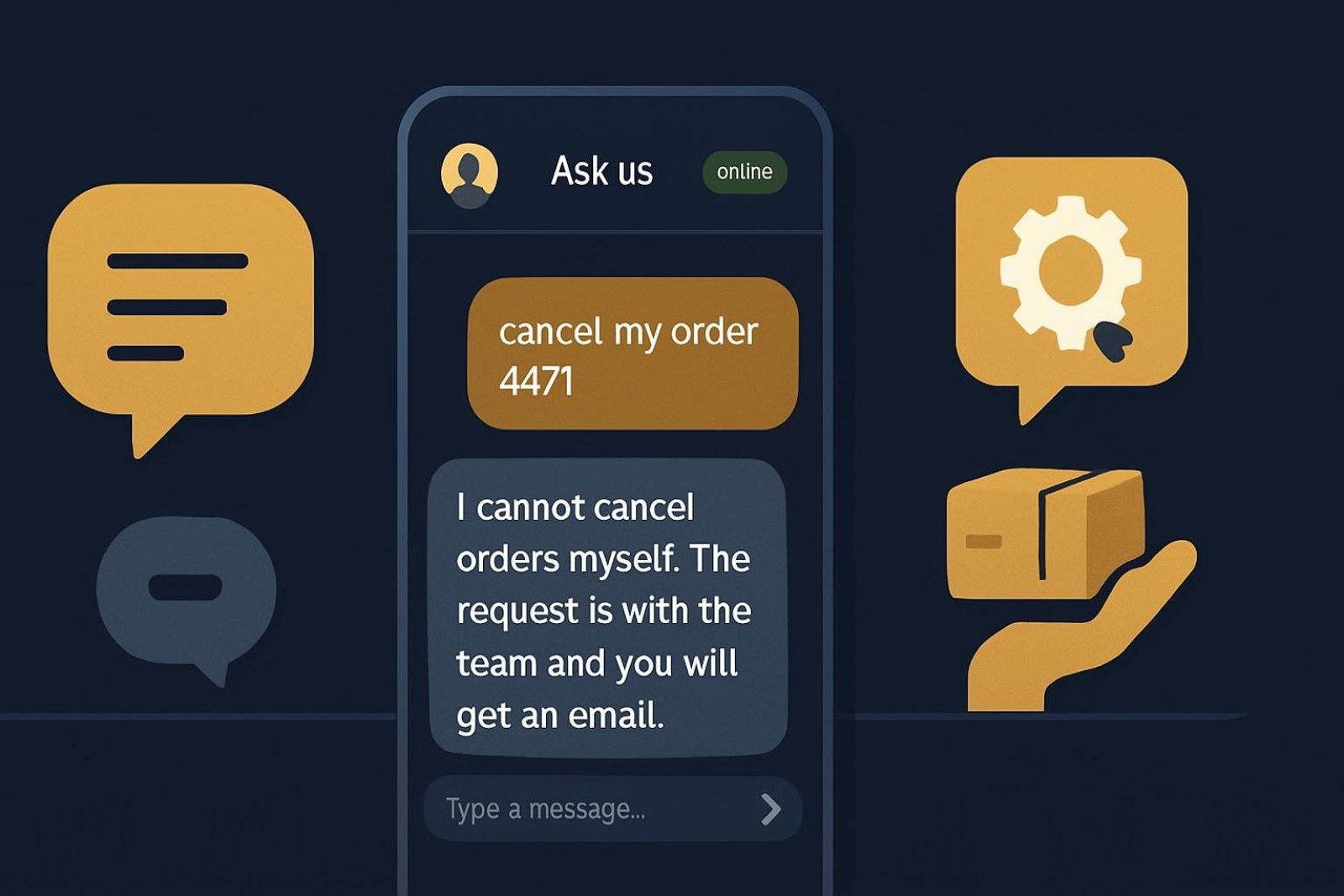
For most small stores, action-taking adds integration work, failure modes and auditing duty in exchange for automating things that happen a few times a week. A refund issued in error costs real money and customer trust; a cancelled order that should not have been cancelled costs both plus a difficult conversation. The honest position is that grounded answering solves the bulk of store chat, and that the extra machinery is worth it only when the volume justifies it. That is why our own product answers and looks things up rather than changing them, and hands anything that needs a decision to a person.
A worked example: the address change
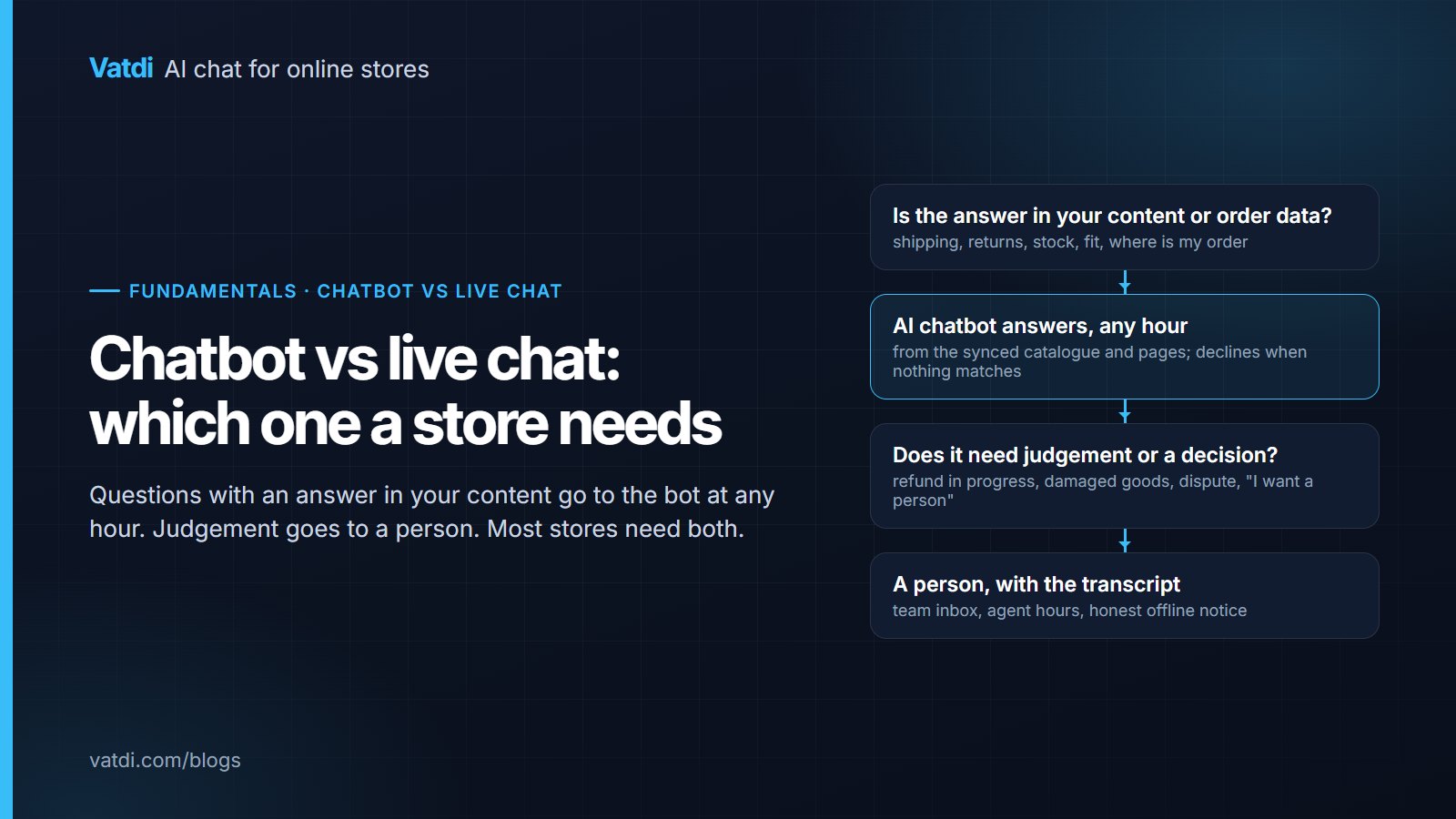
A customer messages an hour after ordering to say the delivery address is wrong. Three designs handle it differently. A scripted bot offers a menu that does not contain this case and ends in a contact form. A grounded assistant looks up the order, confirms it has not shipped, explains your policy on address changes and hands the conversation to a person with the order reference attached, so the edit takes seconds. An action-taking agent edits the address itself. The third is faster when it works, and expensive when the order has already been picked, the customer gave a partial address, or two people ask about the same order. Which design suits you depends on how often this happens: a handful of times a month and the assisted version is plainly better, because a person spends thirty seconds and nothing can go wrong silently.
Cutting through vendor wording
- "What can it change, specifically?" Ask for the list of write actions. If the answer is "it can do anything with our API", ask which ones are enabled by default.
- "Does a person approve before the action runs?" And can that be turned on per action type?
- "Where is the log?" An action without an audit record is an action you cannot investigate.
- "What happens when it is unsure?" The safe behaviour is to stop and ask, not to take its best guess and act.
- "How is this priced?" Action-taking products often bill per resolution or per action, which behaves very differently from a flat plan; the models are compared in chatbot pricing models explained.
Why both sit on the same foundation
Whatever the label, the quality of the answers comes from the same place: the content the software can search and how well it is written. An agent with permission to act and a thin knowledge base will act on bad information, which is worse than a plain assistant with good content. The retrieval approach underneath both is described in Lewis et al., 2020, and the practical work it implies is in how to write a chatbot knowledge base. Industry guidance on tool-using systems, such as OpenAI's function calling documentation, makes the same point in engineering terms: the model decides which tool to call, so the constraint on what it may call is your safety mechanism, not its judgement.
What to do with all this
Decide by task, not by label. List the five things your customers most often want, mark each as a read or a change, and count how often the changes occur. If the reads dominate, which is the usual case, a grounded assistant with order lookup covers your needs and costs a flat plan; Vatdi's allowances are on the pricing page, where every feature is on every plan as of September 2026. If one change dominates, look at automating that single action with approval, rather than buying a platform that promises autonomy in general. The setup path either way starts the same, and is in the AI chatbot implementation guide.
Frequently asked questions
What is the difference between a chatbot and an AI agent?
A chatbot answers questions; an AI agent also takes actions in other systems. In practice most products sold as agents for stores do read-only actions such as order lookup, which a good AI chatbot already does. The distinction that matters is whether the software can change something, because that is what needs approval, logging and a way to undo it.
Do I need an AI agent for my store?
Usually not. The questions customers ask most, stock, sizing, delivery, order status and returns, are answered by reading your catalogue, policies and order data. Action-taking earns its extra complexity only when one repetitive change happens at high volume and you have the appetite to review an audit log.
Is order lookup an agent feature?
It is an action, but a read-only one, and many vendors use it to justify the word agent. Treat it as table stakes for store chat rather than a premium capability. What separates products is whether the lookup is live, how it verifies the customer, and whether it works on your platform without custom development.
Are AI agents more accurate?
No. Accuracy comes from the content the software can search and how clearly it is written, not from permission to act. An agent with a thin knowledge base makes confident mistakes and then acts on them, which is worse than an assistant that answers from good content and declines what it does not know.
What should I ask a vendor selling an agent?
Which write actions exist, which are on by default, whether a person approves each one, where the log lives, what it does when uncertain, and how the pricing unit works. Per-action or per-resolution pricing behaves very differently from a flat plan once volume rises, so ask for the bill at your busiest month.
Does Vatdi take actions on orders?
It reads order data through the store plugin to answer status questions, and it does not change orders, issue refunds or edit addresses. Anything requiring a decision is handed to a person with the transcript and the order reference attached, which keeps the speed for customers and the control with you.