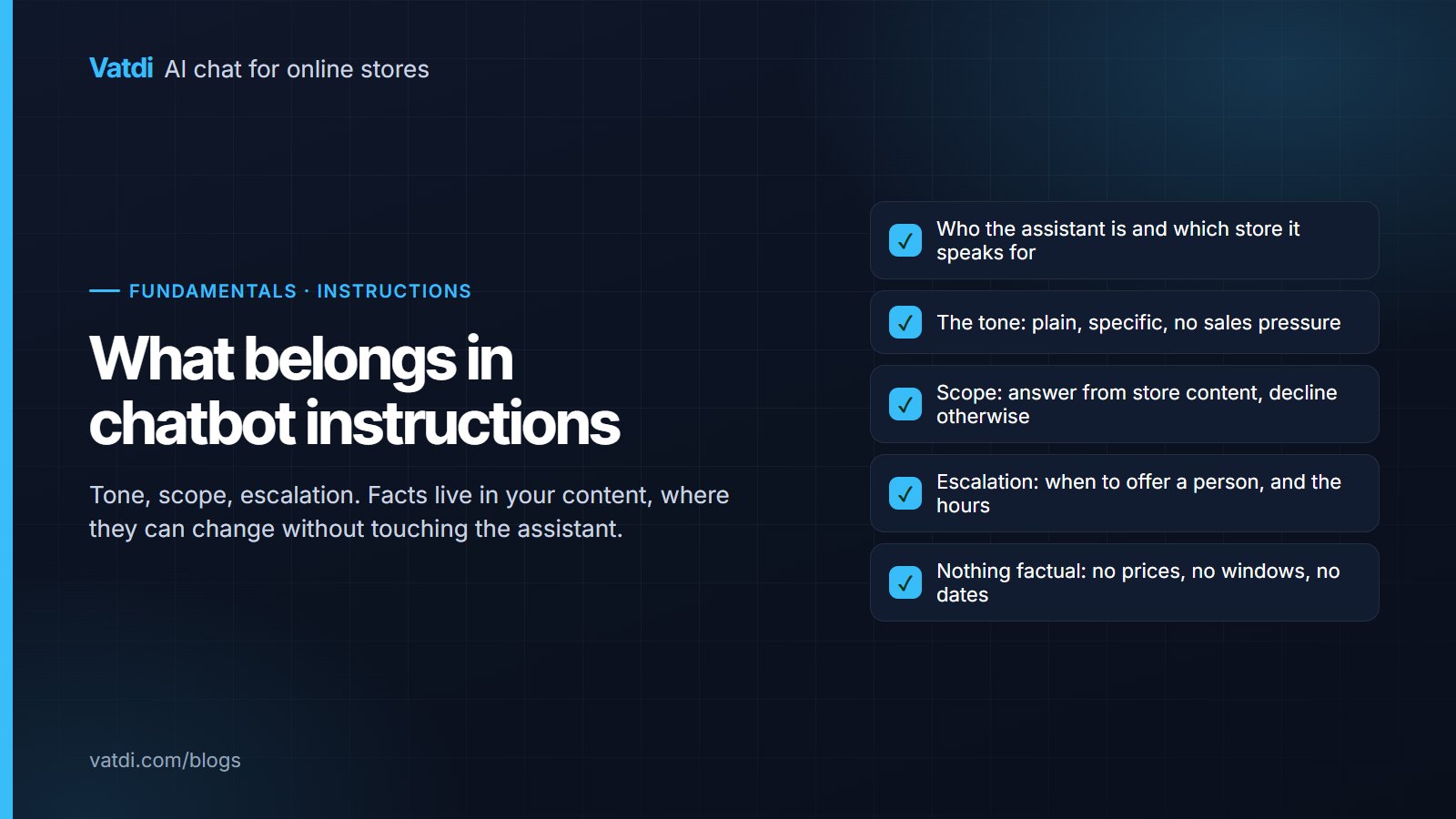
AI chatbot instructions should be short. They set who the assistant is, how it speaks, what it may answer and when it should fetch a person. Facts do not belong there: a returns window written into the instructions is a fact you will forget to update, in a place your team does not look. Everything factual belongs in your content, where it is visible, editable and shared with customers.
What goes where
| Belongs in instructions | Belongs in content |
|---|---|
| Who the assistant is and which store it represents | Shipping costs, delivery times and cut-offs |
| Tone: plain, specific, no pressure | Returns window, conditions and exclusions |
| Scope: answer from store content, decline otherwise | Sizing measurements and fit notes |
| When to offer a person, and the hours | Payment methods and any restrictions |
| Language behaviour: reply in the customer's language | Product attributes and specifications |
| What never to do: invent stock, offer unapproved discounts | Opening hours, addresses and contact routes |
The test is simple. If the answer could change next month, it is content. If it describes behaviour rather than fact, it is an instruction.
A template to adapt
Something close to this is enough for most stores. Replace the bracketed parts and delete anything that does not apply:
- Identity: "You are the assistant for [store], which sells [what] to customers in [where]. You are an assistant, not a human, and you say so if asked."
- Source of truth: "Answer only from the store's own content: products, policies and order data. If the information is not there, say you do not have it rather than guessing."
- Tone: "Be brief and specific. Lead with the fact the customer asked for. No sales pressure, no flattery, no exclamation marks."
- Escalation: "Offer a person when the customer asks, when you lack the answer, for complaints or damaged goods, or when the same question has failed twice. Agent hours are [hours]. Outside them, offer to take an email."
- Limits: "Never invent stock, prices or delivery dates. Never offer a discount that is not in the store's published offers. Do not give medical, legal or financial advice."
- Language: "Reply in the language the customer wrote in."
That is the whole thing. Instructions three times this length usually perform worse, because the specific guidance competes with the content for attention.
Additions that quietly make answers worse
- "Be as helpful as possible." Helpfulness is already the default; what this phrase actually does is discourage the honest refusal you want on questions your content cannot answer.
- "Always recommend a product." A customer chasing a parcel does not want a suggestion, and the instruction applies everywhere, including there.
- Long persona descriptions. A name and a sentence is plenty. Paragraphs of backstory occupy space that your content should have.
- Hard-coded facts. Prices, windows and hours in the instructions drift out of date invisibly, and produce confident contradictions of your own pages.
- Lists of forbidden words. Brittle, language-specific, and usually a sign that the real problem is content.
Telling an instructions problem from a content problem
Most complaints about answers are content problems wearing an instructions costume. The diagnostic takes a minute: read your published pages as if you were the assistant. If a careful person reading only those pages would give the same unsatisfactory answer, the content is at fault and no instruction will fix it. If your pages clearly contain the right answer but the reply still strays, then look at settings first, escalation rules and knowledge sources, and instructions last. The retrieval design underneath this is described in Lewis et al., 2020, and the content format that removes most problems is in how to write a chatbot knowledge base.
Tone, in practice
Three tone instructions cover almost everything a store needs. Lead with the fact, because a customer asking about delivery wants the days, not a paragraph of appreciation. Keep it short, because chat is read on a phone. And avoid enthusiasm the situation does not warrant, since a cheerful reply to a complaint reads as indifference. If your brand genuinely has a distinctive voice, add one sentence describing it and one example, not a style guide. The wording patterns that work in real store conversations are collected in ecommerce chatbot examples.
Why shorter instructions behave better
Everything the assistant considers for a given question shares one budget: your instructions, the content retrieved for that question, and the conversation so far. A long instruction block takes room that would otherwise hold more of your returns page, which is the material that actually answers the customer. Model providers describe this budget explicitly, for example in OpenAI's text generation guide, and the practical consequence for a store is easy to state: every paragraph of persona is a paragraph of policy that did not fit. There is also a competing-goals effect. Instructions that ask for brevity, enthusiasm, product suggestions and caution at once give the assistant no way to satisfy all four, so it picks, and which one it picks varies by question. Fewer, clearer rules produce more consistent answers than a long list of preferences.
Changing instructions safely
Treat the instructions as code: change one thing at a time, and re-run your question set afterwards. An edit that improves one answer often weakens another, particularly around refusals, and the only way to see that is a fixed set of questions asked before and after. The method is in how to test AI chatbot accuracy, and the rules worth keeping stable are in chatbot guardrails for online stores. Keep a copy of the previous version so you can revert rather than patch.
Where to write them
In Vatdi the assistant's instructions sit in the dashboard alongside agent hours, handover rules and the widget wording, on every plan; the allowances that differ between plans are on the pricing page. Write the instructions once during setup, spend the remaining time on content, and revisit them only when a specific behaviour needs changing. The order of work is in the AI chatbot implementation guide.
Frequently asked questions
What should be in an AI chatbot's instructions?
Identity, source of truth, tone, escalation rules, hard limits and language behaviour. Six short paragraphs is plenty. Everything factual, including prices, windows, hours and specifications, belongs in your content instead, where it can be updated by anyone and seen by customers.
How long should the instructions be?
A few hundred words at most. Longer versions tend to perform worse, because every extra sentence competes with your store's content for the model's attention. If you find yourself writing a third page, that is a sign the content is missing something the instructions are trying to compensate for.
Should I put my returns policy in the prompt?
No. Put it on the returns page, written as questions with the answer first. The assistant reads it there, customers can read it too, and updating it is a normal content edit rather than a change to the assistant's configuration that nobody remembers to review.
Can I give the assistant a name and personality?
A name and a sentence of character is fine and can suit the brand. Long backstories are counterproductive: they consume attention, rarely show up in the answers customers actually get, and make the assistant sound performative when someone is chasing a late parcel.
Why did my answers get worse after I edited the instructions?
Usually because an addition weakened a refusal or introduced a competing goal, such as always suggesting a product. Change one thing at a time and re-run a fixed question set, keeping the previous version so you can revert. That discipline catches regressions that a casual test conversation misses.
Do instructions differ by platform?
Not much. The same six elements apply whether the store runs on WooCommerce, OpenCart, PrestaShop, Magento, Shopware, Joomla, Drupal or a plain site. What differs by platform is the data the assistant can reach, such as live order lookup, which is a connection matter rather than an instruction.