An AI chatbot for Wix does not need a plugin, because Wix provides a site-wide custom code area and an embedded assistant is one script. The install is a five-minute job. What decides whether it is useful is the same thing as everywhere else: the pages it reads and how those pages are written.
Where the snippet goes
| Setting | Choose | Why |
|---|---|---|
| Location | Settings, then Custom Code | The site-wide area, not a single page's embed element |
| Pages | All pages | Visitors ask questions wherever they happen to be |
| Placement | Body, end | Loads after the page content, so nothing is blocked |
| Load once | Yes | Avoids a second instance on internal navigation |
| Embed element | Avoid for this | A page-level HTML element is scoped to that page only |
The common mistake is using a page-level HTML embed element, which puts the assistant on one page and nowhere else. Use the site-wide custom code area so the launcher follows the visitor.
What it can answer
- Anything on your pages: services, prices where published, opening hours, locations, policies, booking process, frequently asked questions.
- Documents you upload, such as a menu, a price list or a specification sheet.
- Entries written in the dashboard for questions with no natural page.
- Contact routing: who to email, when a person is available, and taking an address out of hours.
What an embed cannot do is read live store data. If you sell through Wix Stores, the assistant answers product questions from the published product pages rather than from a live catalogue feed, and it cannot look up order status the way a plugin platform can. Be explicit about that in your content so the assistant declines cleanly rather than guessing; the platforms where live lookup is available are on the integrations page.
Structuring a Wix site so answers are specific
- One question per heading, in the words visitors use.
- The fact in the first sentence: the price, the hours, the area covered.
- Numbers as text, not baked into an image or a decorative element.
- Exceptions named, because those generate the follow-up emails.
- One authoritative copy of each fact, so the footer and the contact page cannot disagree.
The full format is in how to write a chatbot knowledge base, with worked rewrites in chatbot knowledge base examples.
The Wix-specific checks
Three things are worth verifying before you tell anyone the assistant exists. First, open the site on a phone and confirm the launcher is not sitting under a sticky booking bar or a mobile action button, which Wix templates commonly include. Second, check it is reachable while your cookie banner is displayed, since a consent layer can cover the corner on first visit. Third, look at a page built with a heavy animation or a full-screen section and confirm the launcher still appears; some designs stack elements in ways that hide it at certain breakpoints. All three are five-minute checks and all three explain most cases of an assistant that nobody uses.
Who this suits
Wix sites are mostly small businesses selling services or a modest range of products, and the question pattern reflects that. A salon gets asked about prices, availability and parking. A restaurant gets asked about opening hours, allergens and whether it takes bookings. A consultancy gets asked what it costs and how quickly work can start. In each case three or four pages answer nearly everything, which makes the setup unusually quick: there is no catalogue to describe and no order data to connect. The trap is that these businesses often hold their key facts in places an assistant cannot read, such as a price graphic, a PDF menu or an opening-hours strip rendered as part of a header design. Moving those into text is the whole project, and it takes about an hour. Do that once and the same content serves the assistant, search engines and anyone using a screen reader.
Bookings and availability
Most Wix businesses run some form of booking, and visitors will ask about it. The assistant should explain the process, the hours, the notice period and the cancellation policy from your pages, then send people to the booking page for the actual slot. What it should not do is guess at availability, because a wrong answer there wastes a customer journey. Write a short page covering how booking works, how far ahead you take reservations, what happens if someone is late, and whether deposits apply. Those four facts absorb a surprising share of enquiries, and having them in text means the assistant answers at ten at night when the phone is off.
Text that only exists as an image
This is the most common content problem on design-led platforms. A price list rendered as a graphic, a menu saved as a picture, opening hours inside a stylised banner: all of them are invisible to an assistant and to screen readers, and mostly invisible to search as well. The fix is the same in every case: put the numbers in a text element on the page, keep the graphic if it suits the design, and let both exist. Google makes the same argument about helpful content from the search side, and it applies equally to anything trying to answer a question from your site.
Testing and cost
Ask the ten questions you receive most by email or phone, plus four you genuinely cannot answer, and score each as correct, incomplete, wrong or declined well; the method is in how to test AI chatbot accuracy. As of September 2026 Vatdi is free for 15 conversations a month with every feature included, $4.49 for 150 and $7.49 for unlimited, with badge removal the only paid extra; see pricing. The retrieval approach that lets an assistant answer from published pages rather than a script is described in Lewis et al., 2020, and the wider setup order is in the AI chatbot implementation guide. The equivalent guidance for hand-built sites is in AI chatbot for HTML website pages.
Frequently asked questions
How do I add a chatbot to a Wix site?
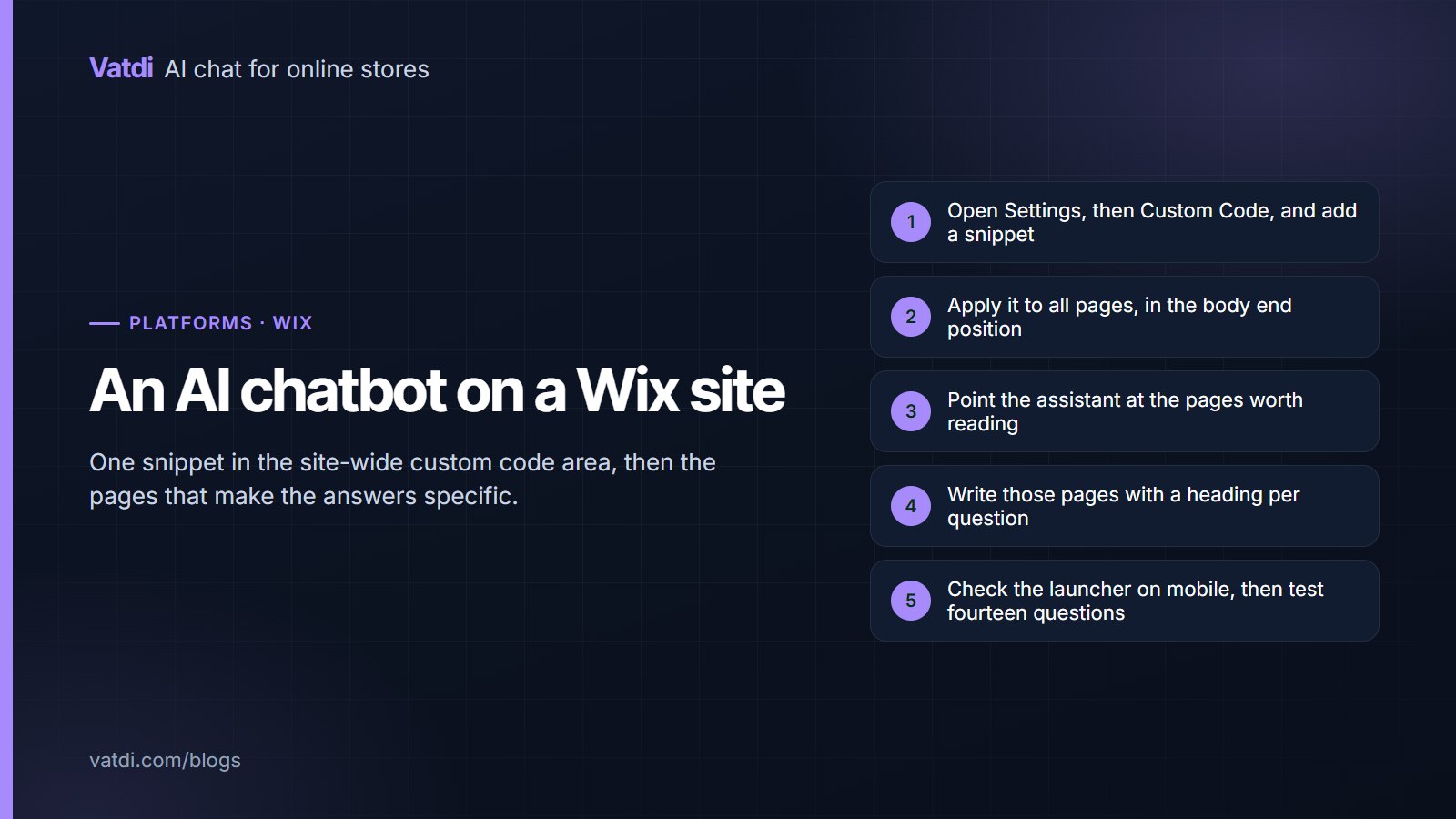
Open Settings, then Custom Code, add the embed snippet, apply it to all pages and place it at the end of the body. That puts the launcher on every page. Avoid using a page-level HTML embed element, which scopes the assistant to a single page and leaves the rest of the site without it.
Can it answer questions about my Wix Stores products?
It answers from your published product pages rather than a live catalogue feed, so descriptions and specifications work while live stock and order status do not. Say so in your content, so the assistant declines those cleanly and points people at their account or your contact route instead of guessing.
Will it slow my site down?
The script loads asynchronously at the end of the body, so it should not block rendering. If your site already carries several third-party embeds, the cumulative weight matters more than any single one. Check a page on mobile after adding it, which is where any effect shows up first.
Why can it not find my prices?
Almost always because the prices exist only inside an image or a design element rather than as text. Add a text element with the figures, keep the graphic if you like it, and the assistant can quote the numbers. The same change helps search and screen readers.
Does it work with Wix Bookings?
It can explain how booking works, what you offer and when you are available, from the pages describing those things. It does not read live availability or make bookings, so point people at the booking page for that. Setting the expectation in your content prevents a confident wrong answer.
What if the chat button is hidden on mobile?
Check for a sticky booking bar, a mobile action button or a cookie banner occupying the same corner, which Wix templates frequently include. Adjusting the launcher position resolves it. This is worth fixing before launch, since an invisible assistant looks like an unused one.