Vendors use two dozen terms to describe about six ideas. This AI chatbot glossary translates each into what it means for a store: what you pay for, what actually changes an answer, and which words are marketing rather than mechanism. Read it once and a pricing page or a sales call becomes much easier to interrogate.
How answers are produced
| Term | Plain meaning | Why it matters to you |
|---|---|---|
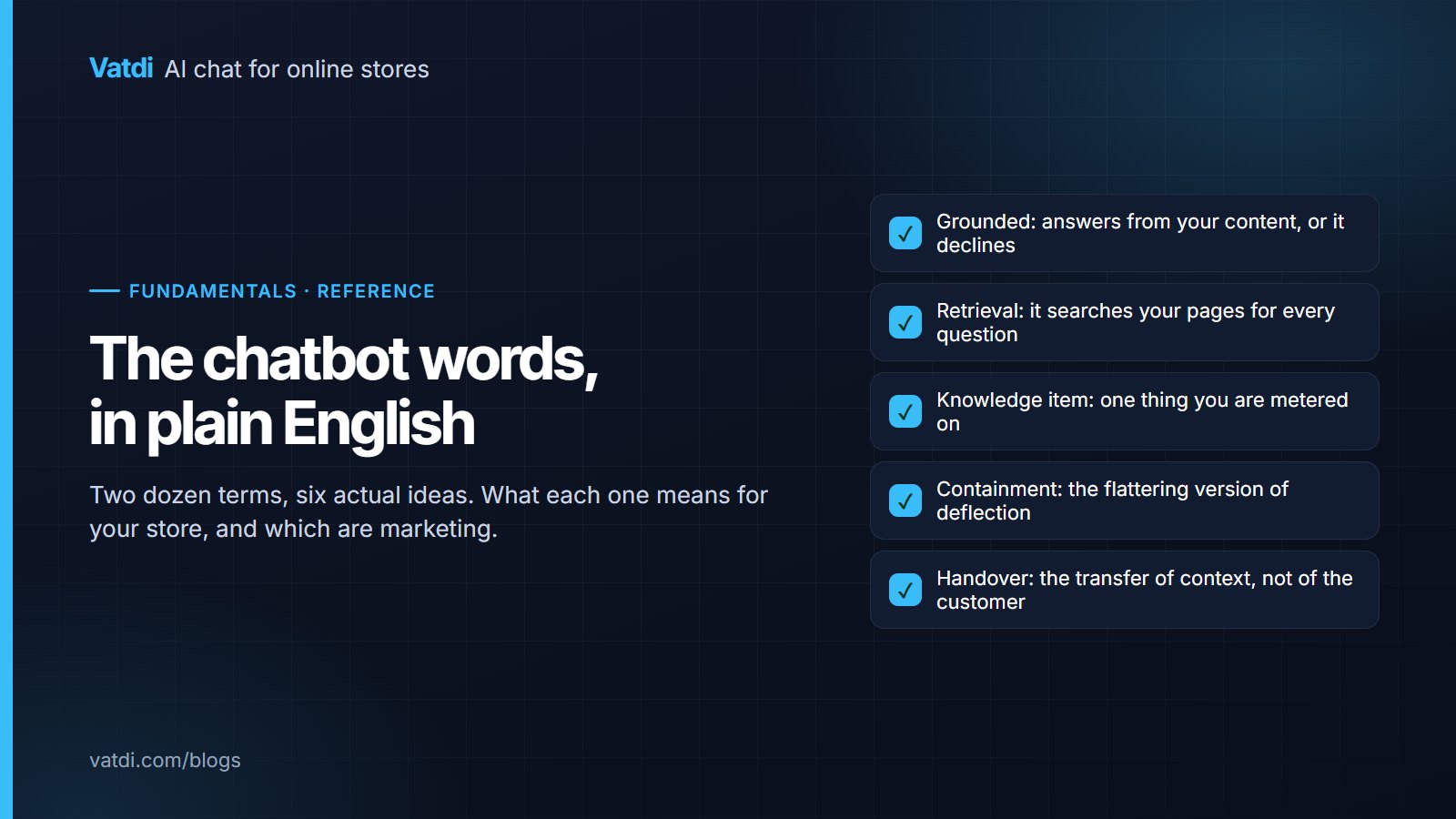
| Grounded | Answers come from your content, or it says it does not know | The single most important property; ungrounded tools invent |
| Retrieval (RAG) | It searches your pages for each question, then writes an answer | Editing a page changes the answer immediately |
| Embedding | A searchable numeric representation of a chunk of text | Why vendors meter your content; it costs them to store |
| Chunk | A page split into passages for searching | Why a clear heading per question improves precision |
| Hallucination | A confident answer with no source behind it | The failure that costs refunds; test for it deliberately |
| Intent | A category a flow builder sorts questions into | A flow-era concept; grounded tools do not need it |
| Flow | A drawn decision tree with buttons | Exact but narrow; every new question is a build task |
| Context window | How much text the model considers at once | Why long instructions crowd out your actual content |
The underlying retrieval method is described in Lewis et al., 2020, and embeddings in OpenAI's embeddings guide. Neither is necessary reading, but both explain why content work moves answers and prompt tinkering usually does not.
What you are metered on
- Knowledge item: one entry in the knowledge base, which may be a crawled page, an uploaded document, an FAQ entry or a snippet. The most common content unit.
- Synced product: a catalogue item kept current through a plugin, usually counted separately from knowledge items.
- Conversation: one exchange with one visitor, however many messages it contains. Check where a vendor draws the boundary.
- Resolution: a conversation the vendor counts as solved. The bill rises when the assistant works well.
- Seat: a person with dashboard access. Costs grow with your team rather than your traffic.
- Credit: an abstract unit consumed by indexing or answering. Ask for the conversion table before signing.
- Contact: a person in your database, whether or not they ever chat. Costs grow with your list.
Which unit a vendor picks changes your bill far more than the headline price; the comparison is in chatbot pricing models explained, and the content side in chatbot training data pricing.
How performance is described
- Containment: conversations with no agent involved, abandonment included. Flattering.
- Deflection: usually the same, unless the honest subtractions are applied; see chatbot deflection rate.
- Resolution: the customer's problem was actually solved. Harder to measure, worth more.
- CSAT: satisfaction ratings, usually from a small self-selecting sample of strong feelings.
- First response time: immediate for an assistant; the number that matters is the agent reply after a handover.
How it behaves
Handover is the transfer of a conversation to a person, and the quality of it is whether the transcript, order reference and language travel too; the practice is in chatbot human handover. Guardrails are the rules constraining what it may say or do, covered in chatbot guardrails for online stores. Agent hours are when a person is genuinely available, which the assistant should quote honestly. Quick replies are suggested opening questions. Proactive message means the widget opening itself, which usually costs more goodwill than it earns on a product page.
Words about your content
Crawl means the tool fetches your published pages itself, which is convenient and easy to over-use: crawling everything pulls in archives and tag pages that make answers vaguer. Ingest or index means processing content into a searchable form, which is what "training" usually means in practice. Source is any one place an answer can come from: a page, a document, an entry, a product. Freshness describes how quickly an edit reaches the assistant, which for synced catalogues and re-read pages is usually immediate. Coverage is the share of real questions your content can answer, and it is the thing the unanswered-question list measures without using the word. Coverage, not model choice, is what separates a useful assistant from a disappointing one.
Words that describe a category rather than a capability
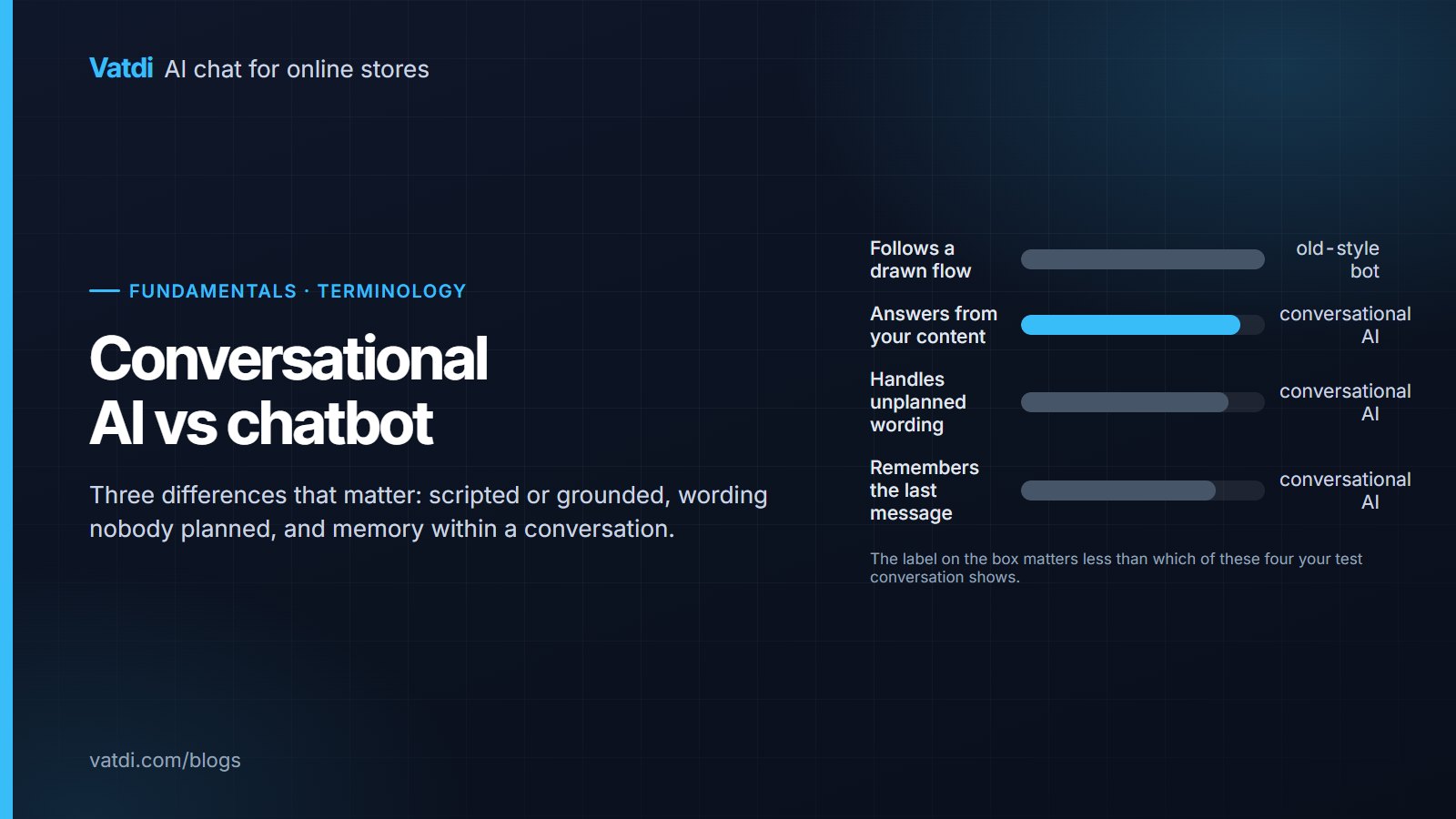
- Conversational AI: mostly a marketing upgrade on "chatbot"; test behaviour instead, as in conversational AI vs chatbot.
- AI agent: software allowed to take actions. Ask which write actions exist and who approves them; see chatbot vs AI agent.
- Virtual assistant: enterprise vocabulary for the same product.
- Omnichannel: several channels in one inbox. Confirm which channels are actually included rather than roadmapped.
- Trained on your data: usually means indexed, not fine-tuned. Ask which, because indexing updates instantly and training does not.
Where the words come from, and why they confuse
Three vocabularies have merged, which is the root of the confusion. The oldest comes from contact centres, and brought containment, deflection, first response time and escalation, all of which assume a ticket with a cost attached. The second comes from the flow-builder era of the late 2010s, and brought intents, entities, fallbacks and dialogue trees, concepts that describe a system somebody drew by hand. The third comes from language models and brought grounding, retrieval, embeddings, context windows and hallucination. A vendor page often uses all three at once, which makes products sound more different than they are. When you read a term, ask which vocabulary it belongs to: if it is contact-centre language it is probably about measurement, if it is flow-builder language the product may be older than it looks, and if it is model language it is describing how answers are produced.
Three questions this vocabulary lets you ask
First: is it grounded, and what does it do when my content is silent? Second: what is the metering unit, and what is my bill in the busiest month? Third: does a page edit change the answer, or does someone have to rebuild a flow? Those three separate most products faster than a feature list, and none of them require technical knowledge, only the words above. The practical test procedure is in how to test AI chatbot accuracy, and current Vatdi allowances, where every feature is on every plan as of September 2026, are on the pricing page.
Frequently asked questions
What does "trained on your data" actually mean?
Usually that your content has been indexed for searching rather than used to retrain a model. That distinction matters: indexed content updates as soon as you edit a page, while a genuinely trained model needs retraining. Ask which one a vendor means, since both use the same phrase.
What is a knowledge item?
One entry in the knowledge base: a crawled page, an uploaded document, an FAQ entry or a text snippet. It is the unit most vendors count content in, and it is usually separate from synced products. Knowing your item count tells you which plan tier you need.
Is RAG the same as AI?
Retrieval-augmented generation is one way of using a language model: search your content first, then write an answer from what was found. It is the approach that makes a store assistant answer from your pages rather than from general knowledge, which is why it declines when your content is silent.
What is the difference between containment and resolution?
Containment counts conversations where no agent was involved, including people who gave up. Resolution counts problems actually solved. They diverge whenever someone abandons a conversation or emails you instead, which is why a high containment figure alone tells you very little.
Does context window matter for a store?
Indirectly. Everything the assistant considers for a question shares one budget: your instructions, the retrieved content and the conversation so far. A long instruction block takes space your returns page would otherwise occupy, which is the practical argument for keeping instructions short.
Which term should I use with customers?
None of them. Describe what it does: ask a question about delivery, returns or your order. Industry vocabulary sets expectations that vary by reader, whereas a plain description tells people exactly what they can get from the window in front of them.