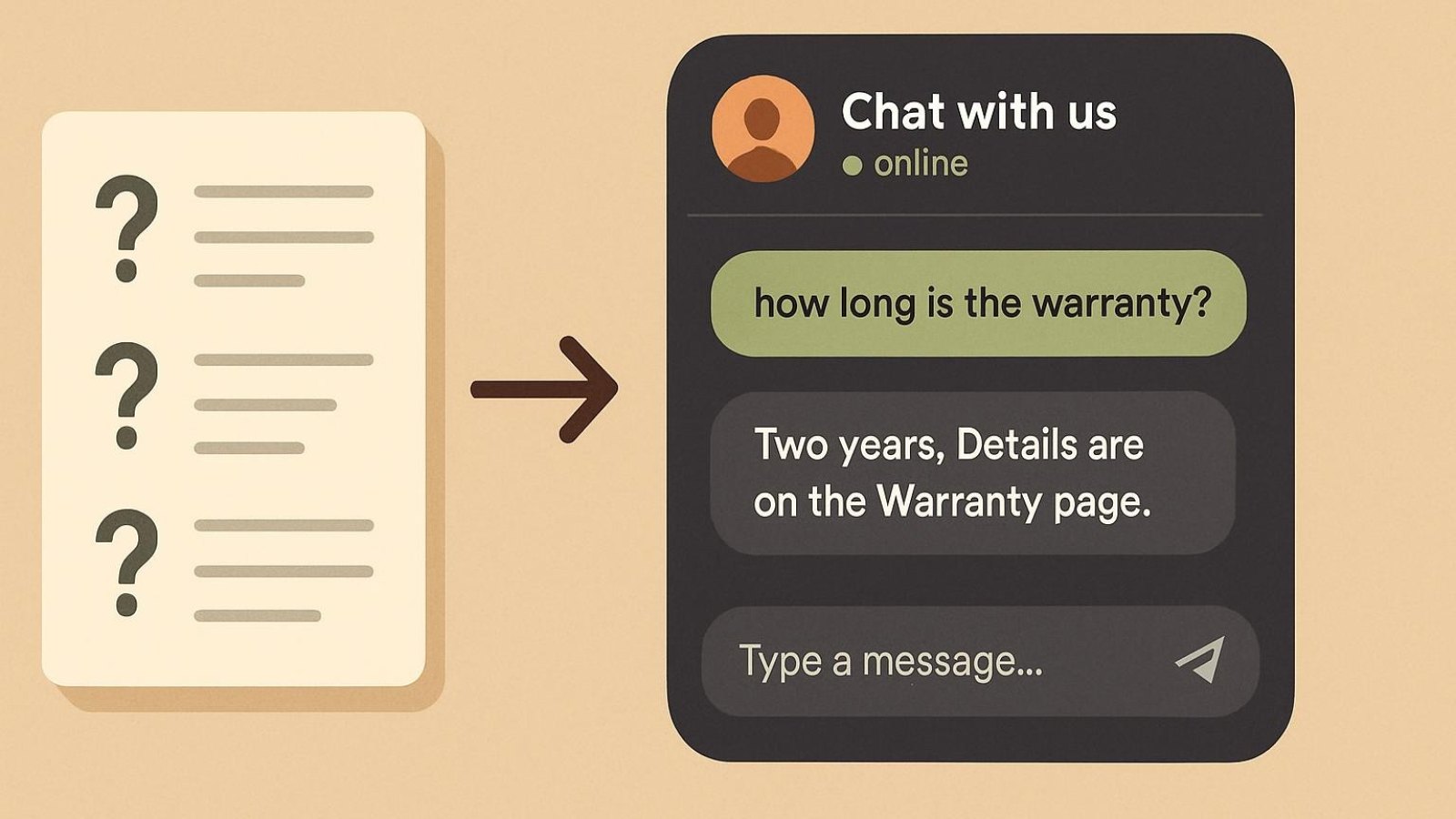
AI chatbot vs FAQ page is a false choice for most stores, because a grounded assistant answers from the FAQ. Delete the page and you have not simplified anything; you have removed the source the assistant was quoting. The useful question is not which to keep but how to write one set of content that serves both, plus the search traffic that arrives at the page directly.
What each does well
| Visitor behaviour | Better served by | Why |
|---|---|---|
| Scanning several policies before buying | FAQ page | Reading four answers at once beats four exchanges |
| One specific question, mid-decision | Assistant | Faster than finding the right section |
| Arriving from a search engine | FAQ page | Chat is not indexed; the page is |
| Unusual wording or another language | Assistant | Matches meaning rather than headings |
| A question combining two facts | Assistant | Composes an answer the page never wrote |
| Wanting to verify what they were told | FAQ page | A published page is checkable; a chat reply is not |
That last row matters more than it looks. A shopper told something in chat often wants to see it in writing, and a public page is what makes the answer credible.
Why a better FAQ makes a better assistant
A retrieval-based assistant searches your content for each question and composes an answer from what it finds, the approach described in Lewis et al., 2020. Everything the assistant knows about your returns window came from a page. That means the edits that improve your FAQ improve the chat answers immediately and automatically: a heading phrased as a question, the number in the first sentence, exclusions named individually. The format is in how to write a chatbot knowledge base, and the same work pays off in search, which is the argument Google makes about helpful content.
The FAQ format that works for both
- One question per heading, in the customer's words rather than your internal vocabulary.
- The answer in the first sentence, with the number, the date or the yes.
- Exceptions named, since those produce the follow-up emails either way.
- Grouped by topic, so a scanner can find the delivery section quickly.
- Linked from the footer and the confirmation email, so people can reach it without chat.
- One authoritative copy of each fact, so the page and the assistant cannot disagree.
When a store genuinely needs only one
Two cases exist. A very small site with three or four facts and almost no traffic can skip the assistant: the FAQ page answers everything and nobody is asking at midnight. And a store whose questions are overwhelmingly about specific orders rather than policy gets less from an FAQ, though it still needs one for the pre-purchase visitor. Outside those, the combination wins, because the two cover different behaviour rather than the same behaviour twice. Whether live chat belongs alongside both is a separate decision, weighed in chatbot vs live chat.
The FAQ mistakes that also damage chat
- Grouping several questions under one heading. Readers skim past them and the assistant quotes an approximate paragraph.
- Answers that restate the question before getting to the fact, which wastes the first line for both audiences.
- Vague phrasing such as "within a reasonable period", which cannot be turned into an answer by anything.
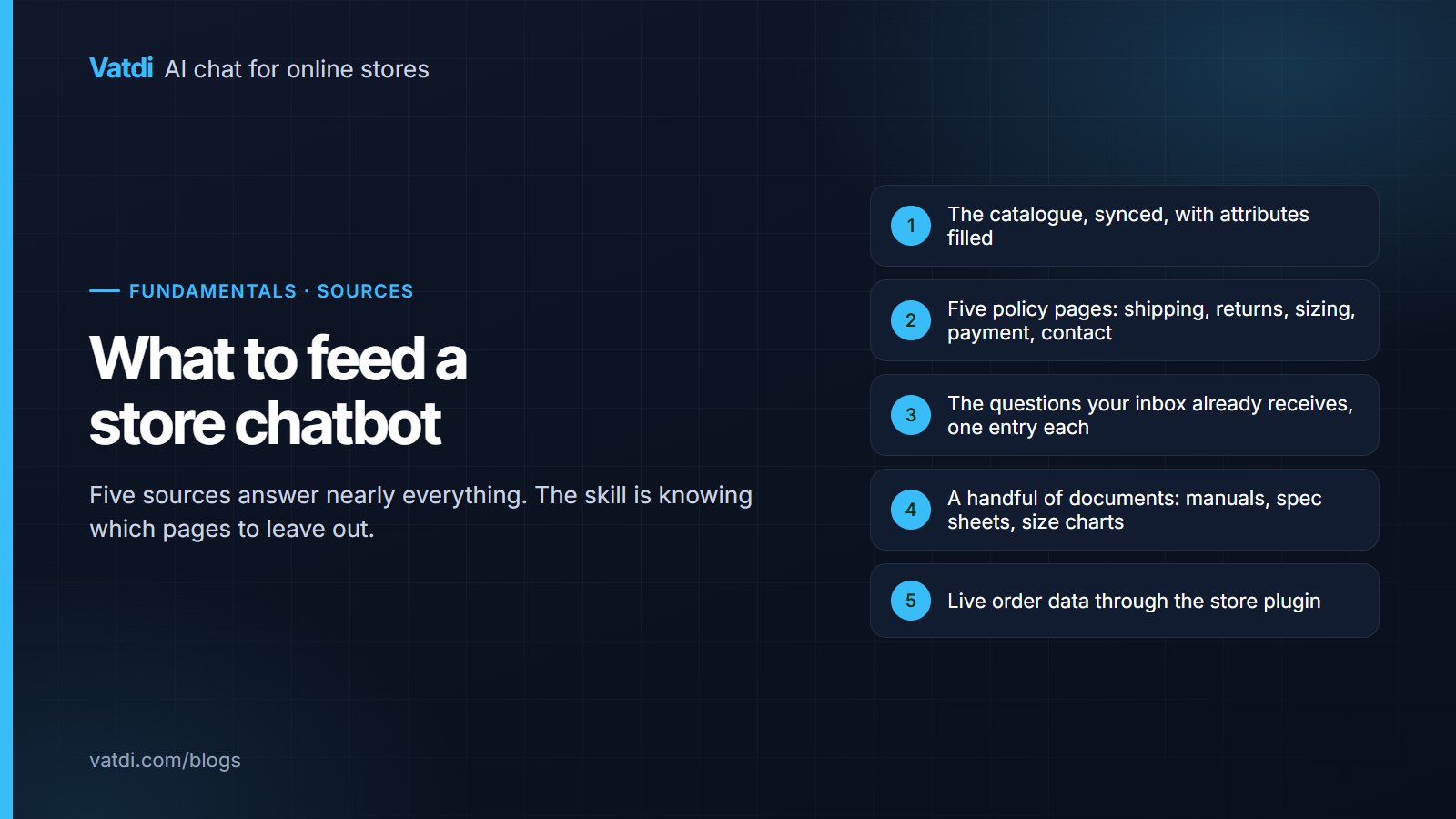
- Facts only in images, including size charts and rate tables, invisible to the assistant and to search.
- Duplicated copies in the terms, the footer and a product tab, which eventually disagree.
- Never updating it, so both the page and the chat answer go quietly stale.
Worked before-and-after rewrites are in chatbot knowledge base examples, with full policy templates in the returns policy example and the shipping policy example.
Where the FAQ page should sit
Three placements do most of the work: a footer link on every page, a link in the order confirmation email, and a link from the product pages where the relevant policy applies. Stores often bury the page in an "information" menu that nobody opens, then conclude that customers do not read FAQs. They do read them, when they can find them at the moment the question arises, which is usually on a product page before buying and in the confirmation email afterwards. If your analytics show almost no traffic to the page, check its links before rewriting the content, because an unread good page and an unwritten one look identical in a report.
Schema and how answers appear in search
A well-structured FAQ page can also earn richer presentation in search results, and the markup for that is straightforward. What matters more than the markup is the structure underneath it: one question per heading with a direct answer is what makes a page eligible in the first place, and it is the same structure the assistant needs. Treat the schema as a by-product rather than the goal, since a page written for markup without being written for readers tends to read like a form. The wider point is that one editorial decision, phrasing headings as questions, serves readers, the assistant and search simultaneously, which is why it is worth the afternoon even for a store with modest traffic.
Letting the assistant improve the FAQ
The unanswered-question list is a better editorial brief than any keyword tool, because it is your own customers asking in their own words. Read it weekly, and where a question recurs, add it to the FAQ page as a heading rather than only as a hidden knowledge entry. That way the next person who searches for it finds the page, and the assistant answers it too. Over a couple of months the list shortens to genuinely unusual questions, which is the point at which the FAQ is finished for practical purposes. The metric set around this is in the six chatbot KPIs worth watching.
What it costs to run both
An FAQ page costs the afternoon it takes to write properly, and it is work you would do anyway. The assistant costs a plan fee: as of September 2026 Vatdi is free for 15 conversations a month with every feature included, $4.49 for 150 and $7.49 for unlimited, with badge removal the only paid extra; see pricing. There is no ongoing duplication of effort, because both read the same source. The launch order is in the implementation checklist.
Frequently asked questions
Do I still need an FAQ page if I have a chatbot?
Yes, for three reasons: the assistant answers from it, search engines index it, and customers often want to verify in writing what they were told in chat. Removing the page makes the assistant worse and loses traffic, without simplifying anything you maintain.
Which is better for customers?
Neither, because they serve different behaviour. Someone comparing stores scans a page; someone mid-decision with one question asks. Someone arriving from a search engine lands on the page; someone at midnight with unusual wording asks the assistant. The combination covers all four.
Will a chatbot reduce traffic to my FAQ?
Possibly a little, and it does not matter. The page still earns search traffic and still serves scanners, while the assistant handles questions that would otherwise have become email. Judge the pair on total questions answered rather than on page views for one of them.
How should I structure the FAQ for a chatbot?
One question per heading in the customer's words, the specific fact in the first sentence, exceptions named individually, and one authoritative copy of each figure. That structure improves scanning and search at the same time, so nothing is sacrificed for the assistant's benefit.
What if my FAQ and the chatbot disagree?
Then the same fact exists in two places on your site and they have drifted. Search for the number, keep one copy, and link to it from the others. The assistant quotes whatever it finds, so a contradiction is always a content problem rather than a software one.
Should FAQ answers be long?
Short enough that the fact is the first sentence and long enough to name the exception. Two to five sentences suits most questions. Length is rarely the problem with store policies; ordering is, because the detail customers want sits below a heading that does not match their question.