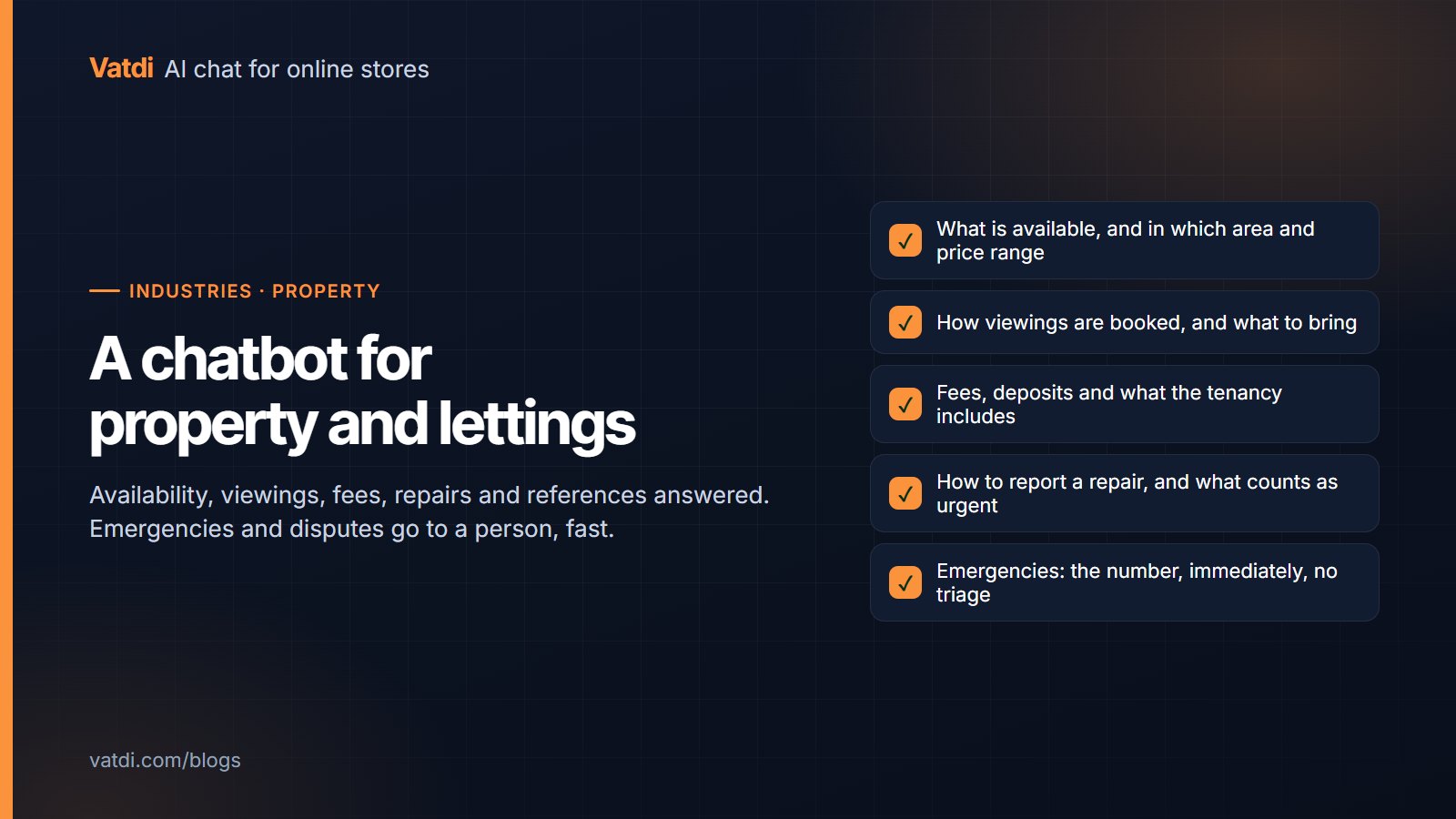
A property management chatbot earns its place on the questions that arrive constantly and rarely need judgement: what is available, how viewings work, what the fees are, how to report a repair and what references are required. Emergencies, disputes and anything about a specific tenancy go to a person immediately. The split is unusually clean in property, which is what makes it a good fit.
What it should answer
| Question type | Typical wording | Where the answer lives |
|---|---|---|
| Availability | "Any two-beds in the centre under £1,200?" | Your listings, if published as readable pages |
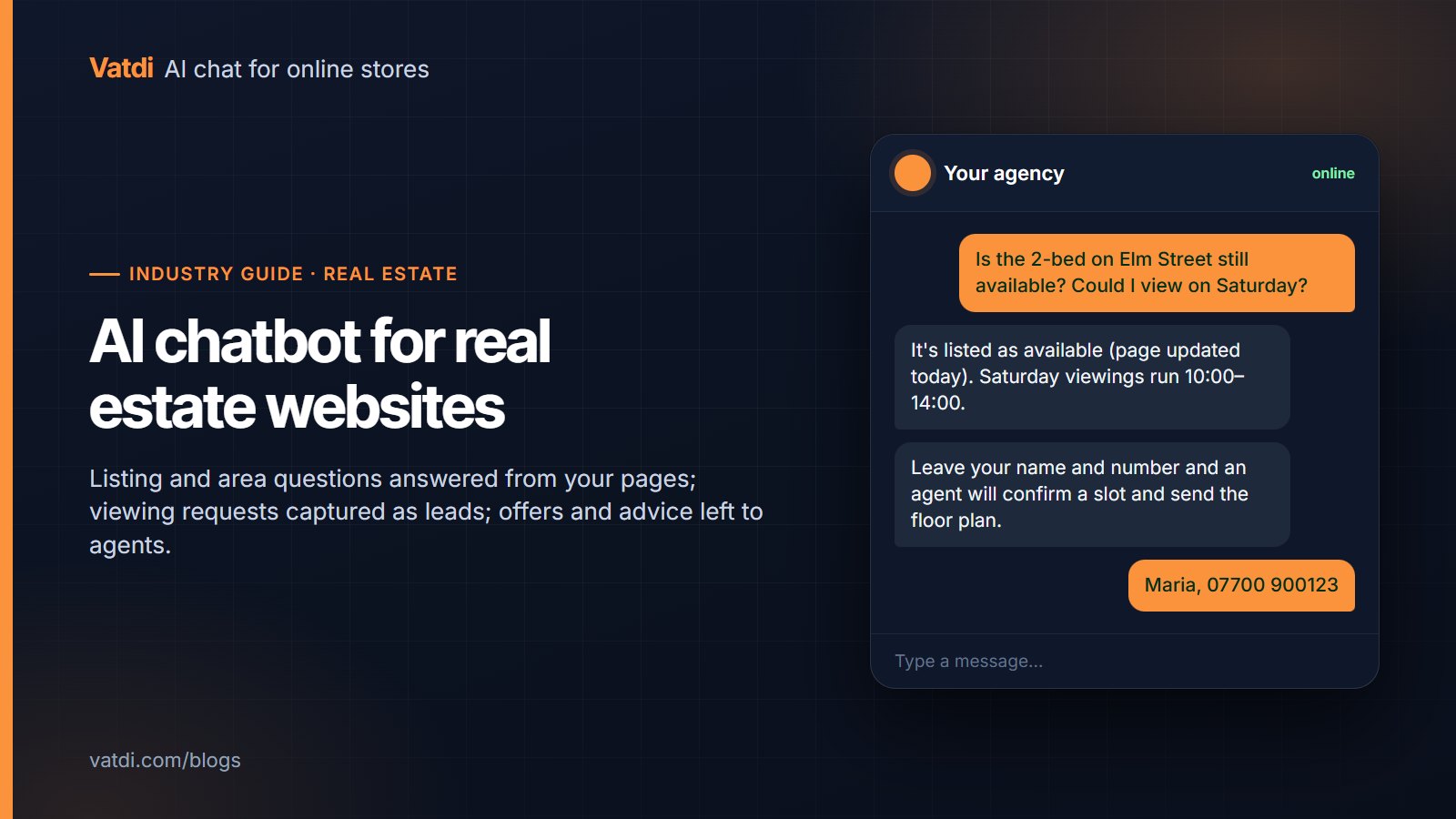
| Viewings | "How do I book a viewing? Can I come Saturday?" | A viewings page with the process and hours |
| Fees and deposits | "What do I pay up front?" | A fees page listing every charge with amounts |
| References | "What do you need from me?" | An application page with the documents and criteria |
| Repairs | "The boiler is making a noise, who do I tell?" | A repairs page with the route and what counts as urgent |
| Tenancy basics | "Can I keep a cat?" "When is rent due?" | A tenancy FAQ covering your standard terms |
The pattern is the same as retail: the answers already exist somewhere, usually in a PDF or in a colleague's head, and the work is publishing them as pages with a heading per question.
Emergencies come first
Write the emergency list explicitly and make the response a phone number rather than a conversation. An assistant that tries to diagnose a gas smell is a liability; one that says "call this number now" in the first line is useful. Everything else follows the normal escalation logic in chatbot human handover.
What to avoid saying
- Anything about a specific tenancy that is not verified. Tenancy details are personal data and belong behind a person or a portal login.
- Legal interpretation. Deposit disputes, eviction and notice periods are governed by law that varies by jurisdiction; quote your published policy and route the rest.
- Promises about availability. "That flat is still free" is only safe if your listings are current; otherwise link the listing.
- Anything that could read as a rental decision. Suitability, affordability and acceptance criteria must be stated as published policy, applied by people, and never improvised.
- Repair timelines you cannot keep. Give the process and the target you publish, not a guess at when a contractor will attend.
The general rules that keep an assistant inside its competence are in chatbot guardrails, and they apply with more force in a regulated sector.
The content to publish
- A fees page listing every charge with an amount and when it is payable.
- A viewings page with how to book, hours, what to bring and cancellation.
- An application page naming the references, documents and timescales.
- A repairs page with the reporting route, the emergency number and what counts as urgent.
- A tenancy FAQ covering pets, rent dates, notice, subletting and parking, as your standard terms allow.
- Area pages if you cover several, so "do you manage anything in Didsbury?" has an answer.
Each with a heading per question and the answer in the first sentence; the pattern is in chatbot knowledge base examples, and what to include overall is in what to feed a store chatbot.
Keeping listings answerable
Availability is the question most likely to produce a wrong answer, because listings change daily and are often published in a format nothing can read. Three habits fix it. Publish each property as a page with the essentials in text: bedrooms, area, monthly rent, availability date and whether it is let. Mark let properties as let on the page rather than deleting them silently, so the assistant can say "that one has gone, here are two similar" instead of inventing something. And if your listings come from a portal feed, check what actually lands on your own site, since feeds frequently render as images or as JavaScript widgets that leave nothing readable behind. Where listings genuinely cannot be published in a readable form, instruct the assistant to describe what you cover and link the search page rather than naming properties it cannot verify.
Lead capture, done properly
Property enquiries are genuinely leads, which makes the temptation to gate the conversation strong and still wrong. Answer the question first, then ask for contact details when there is a reason: booking a viewing, joining a waiting list for an area, or a request nobody can answer until the morning. Asking once, with a reason, gets a better response rate than a form in front of the chat, and it does not cost you the enquiries that end up as tenancies. The four moments worth asking are in chatbot lead capture.
Out of hours is the point
Tenants report problems in the evening and prospective renters browse at night, which is when a letting office is closed. An assistant that answers the routine questions at 22:00 and takes a repair report with the address attached removes most of the morning backlog. Our own figures across real store conversations show how heavily chat skews outside office hours, with the method stated, in our ecommerce chatbot statistics; the pattern in property is at least as pronounced. For the underlying approach that lets an assistant answer from your pages rather than a script, see Lewis et al., 2020. Sector regulators publish tenant-facing guidance worth linking rather than paraphrasing, for example the UK government's private renting guide.
Setting it up
Publish the six pages, set the emergency rule, set agent hours honestly, and test with ten real enquiries plus four you cannot answer, scoring each as in how to test AI chatbot accuracy. A plain website needs only the embed snippet, as covered in AI chatbot for HTML website pages. Vatdi includes handover, agent hours and the dashboard on every plan; allowances are on the pricing page.
Frequently asked questions
What can a property chatbot answer?
Availability in an area and price range, how viewings are booked, fees and deposits, what references you require, how to report a repair, and standard tenancy terms such as pets and rent dates. All of it comes from pages you publish, which means the answers are consistent and can be checked by anyone.
Should it handle repair reports?
It should take routine reports with the address and description and hand them to a person, and it should send emergencies straight to a phone number without attempting triage. Gas, flooding, fire, security and loss of heating in winter belong in the emergency list, answered with the number in the first line.
Can it access tenant accounts?
Not without verification, and personal tenancy details should stay behind a person or a portal login. An assistant answering "how much rent is outstanding" to whoever opens the chat is a data protection problem, so keep it to published policy and route account questions to your team.
Will it give legal advice by mistake?
Not if you instruct it to state published policy and route anything about notice, deposits or disputes to a person. Link the official guidance for your jurisdiction rather than paraphrasing it. This is one of the clearest cases where declining is the correct and safe behaviour.
Does it help with lettings enquiries?
Yes, particularly in the evening when the office is closed and people are browsing. Answer the question first, then ask for an email when there is a reason such as booking a viewing. Gating the conversation behind a form loses more enquiries than it captures.
What does it cost for a small agency?
On Vatdi, as of September 2026, from free for 15 conversations a month with every feature, to $4.49 for 150 and $7.49 for unlimited, with badge removal the only paid extra. The larger investment is the afternoon spent publishing the fees, viewings, application and repairs pages, which are useful with or without an assistant.